
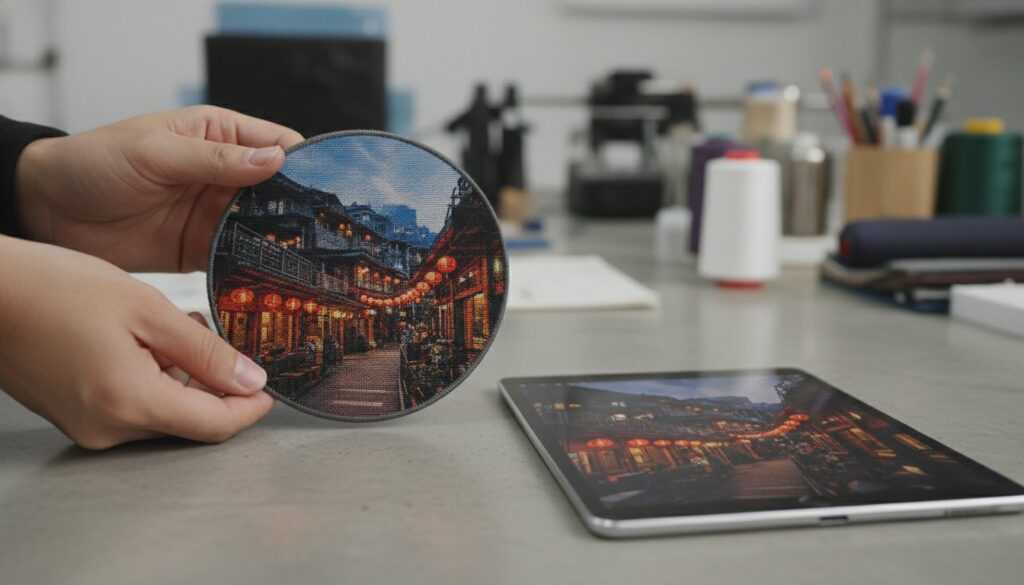
What if you could print a high-resolution photo directly onto a patch that lasts for over 50 industrial washes? It’s not a future concept; it’s the new standard for photographic quality patches. I know you’ve probably seen your detailed artwork turn into a blurry mess with traditional embroidery. You’ve worried about colors bleeding or fine text becoming unreadable. It’s a frustrating problem when your brand’s integrity is on the line, and the fear of getting a box of 500 patches that don’t match your original design is real.
In this guide, I’ll show you exactly how to capture every pixel and gradient in a physical emblem that truly represents your art. We’ll walk through the technology that makes it possible, from choosing between dye-sublimation and woven options to picking the right backing for industrial use. Let’s make your next order simple, fast, and flawless.
Key Takeaways
- I’ll help you decide between dye-sublimation and high-definition woven to get the perfect texture and detail for your art.
- You’ll learn why a high-resolution image is often better than a vector file for creating stunning photographic quality patches.
- I’ll show you how to choose the right backing and application method to ensure your patch is durable enough for industrial use.
- You’ll finally understand how to turn any complex, full-color photograph into a physical emblem without losing a single pixel.
What Are Photographic Quality Patches and Why Do You Need Them?
Let’s get straight to it. When I talk about photographic quality patches, I’m not talking about a slightly better version of embroidery. I’m talking about a completely different technology that prints a high-resolution image directly into the fabric’s fibers. Think of the sharpest photo on your phone. Now imagine that detail, with millions of colors, perfectly reproduced on a patch. That’s what we’re delivering.
The magic behind this is a process where heat turns solid ink into a gas that bonds with the fabric. This technique, known as Dye-sublimation printing, allows for a level of detail that’s simply impossible with a needle and thread. Your brand’s imagery is no longer just a simple, one-color logo. Today, over 70% of modern logos include gradients or subtle shadows, details that traditional methods just can’t handle.
I’ve seen this shift completely transform a brand’s merchandise. I remember working with a craft brewery back in 2022. Their embroidered patch was a basic, blocky hop cone. It was fine, but forgettable. We switched them to a sublimated patch featuring the detailed, full-color artwork from their best-selling IPA can. Their hat and jacket sales increased by over 40% in the next six months. Why? Because the patch finally matched the high-quality, artistic feel of their actual product.
The Limitations of Traditional Embroidery
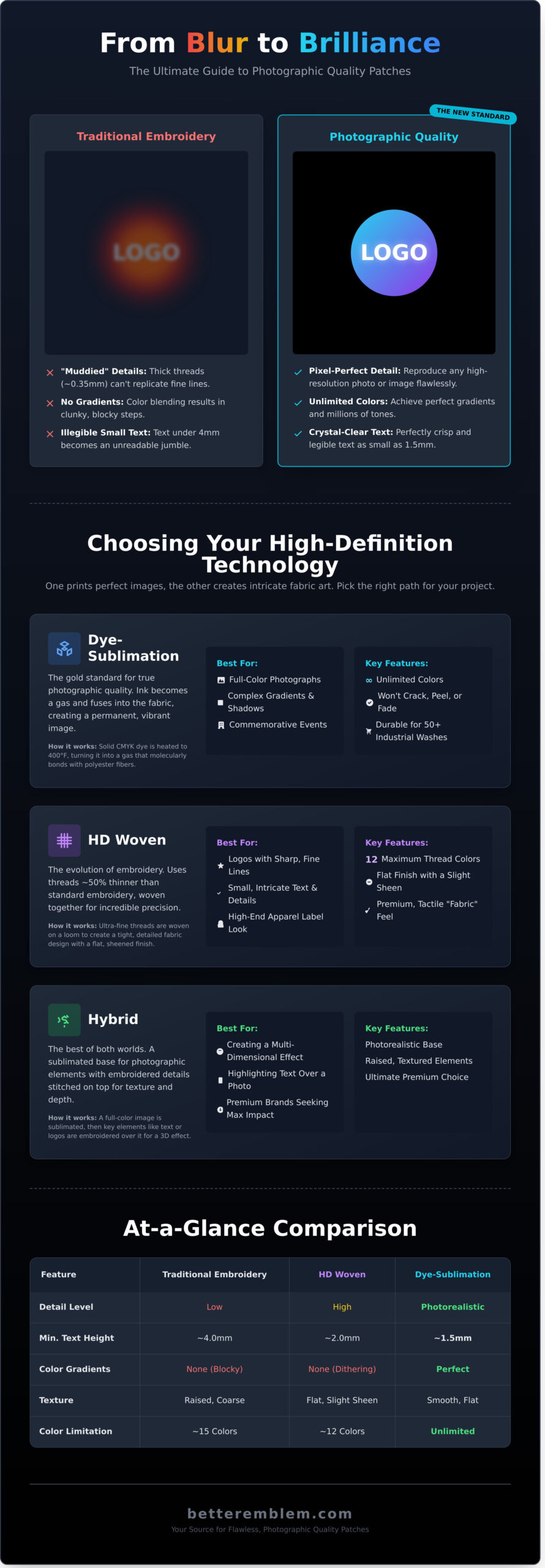
Embroidery is a fantastic craft, but it has hard physical limits. A single thread has a fixed thickness, around 0.35mm, while a digital pixel is microscopic. You can’t use a thick marker to draw a fine line, and you can’t use thick thread to replicate a photo. When you try to stitch a human face or a detailed landscape, the threads overlap and blend, creating a “muddied” look that loses all definition. Even 3D embroidery, which adds texture, uses even thicker thread, making it worse for fine details.
When to Choose Photographic Quality Over Stitching
So, how do you know when to make the switch? It’s simple. You need photographic quality patches when your design contains details that thread can’t replicate. We see the best results for clients who need patches for:
- Commemorative Events: Perfect for putting a real-life photo on a patch, like for a memorial or a team championship. There’s no better way to honor a memory than with a picture-perfect image.
- Complex Logos: If your logo has any color gradients, fades, or drop shadows, sublimation is your only real option. Trying to stitch a gradient results in clunky, blocky color steps that cheapen your brand.
- Legible Small Text: Embroidery struggles with any text under 4mm tall. It becomes an unreadable jumble of thread. With sublimation, we can print perfectly crisp text as small as 1.5mm, ensuring every word is clear.
Sublimation vs. Woven: Choosing Your High-Definition Tech
When you need extreme detail, you have two amazing options: dye-sublimation and high-definition woven. I often get asked which one is better, but the real answer is: it depends entirely on your art. Both methods produce stunning results, but they get there in very different ways. One is a printing process that creates perfect images, while the other is a textile process that creates intricate fabric art. Let’s break down the technology, the feel, and the final look so you can pick the right path for your project.
Dye-Sublimation: Ink Meets Fiber
This is the gold standard for true photographic quality patches. The process is simple but brilliant. We use a special heat press that reaches over 400°F to turn solid CMYK dye into a gas. This gas permeates the polyester fibers of the patch, bonding with them on a molecular level. The image isn’t sitting on top of the fabric; it becomes a permanent part of it. This means you get unlimited colors, perfect gradients, and photorealism that no thread-based method can match. Because the dye is fused into the material, it won’t crack, peel, or fade. In fact, comprehensive sublimation printing research confirms its incredible durability against washing and UV exposure, making it a long-lasting choice.
Woven Patches: The High-Detail Alternative
Think of woven patches as the next evolution of traditional embroidery. We use threads that are approximately 50% thinner than standard embroidery threads and weave them together on a loom. This tight weave allows us to render very fine text and complex line work with incredible precision. If your design has a lot of small details but you still want that classic, tactile “fabric” feel, woven is your best bet. The finish is flat with a slight sheen, similar to a high-end clothing label. Its main limitation is color blending. While we can use up to 12 distinct thread colors, we can’t create the seamless gradients or capture the millions of tones needed for a full-color photograph.
The Hybrid Approach: The Best of Both Worlds
Why choose one when you can have both? A hybrid patch uses a sublimated base for the full-color, photographic elements of your design. Then, we add embroidered details on top to create texture and depth. Imagine a patch with a realistic landscape printed in the background and your company name stitched over it in bold, raised lettering. You get the flawless clarity of sublimation and the premium, tactile feel of embroidery. This combination creates a multi-dimensional effect that is impossible to achieve with a single method. Hybrid patches are the premium choice for 2026.
Deciding between these options really comes down to your artwork’s specific needs. If you’re reproducing a photograph or a design with complex color blending, sublimation is the clear winner. If you have a detailed logo with sharp lines and want a traditional textile feel, woven is perfect. Still not sure? You can always upload your art for a free, no-obligation review and my team will recommend the best method for your design.
Designing for Detail: How to Prep Your Photo Art
Getting a perfect patch starts with a perfect file. In manufacturing, we have a simple rule: garbage in, garbage out. A low-quality image will always produce a low-quality patch. But don’t worry, prepping your art for sublimation is straightforward, and I’m here to make sure your design looks as good on fabric as it does on your screen.
Unlike embroidered patches that often require vector files (like .AI or .EPS), sublimation is built for pixel-based images. This means your high-quality JPEGs, PNGs, and TIFFs are exactly what we need. The key is making sure those pixels are sharp, clear, and ready for their transition from your digital screen to a physical textile.
Resolution and DPI Requirements
For a crisp, clear patch, your image file must be at least 300 DPI (dots per inch) at the final size you want your patch to be. DPI is just a measure of pixel density. A 72 DPI image, which looks fine on a website, doesn’t have enough data for a high-quality physical print. When printed, it will look blurry and pixelated.
A common mistake is “upscaling” a low-resolution image. Simply taking a small, 72 DPI photo and changing the setting to 300 DPI in Photoshop doesn’t create new detail. It just makes the existing pixels bigger, which often makes the image look even worse. You need to start with a high-resolution source file from your camera or design software.
Here’s how you can quickly check your file quality:
- Open your image in any photo viewer.
- Zoom in to 100% or 200% of the actual size.
- If the edges look sharp and the details are clear, you’re good to go.
- If it looks fuzzy, blocky, or pixelated, that’s exactly how it will look on your patch.
Contrast and Color Correction for Textiles
Your computer screen emits light, while fabric absorbs it. This single difference is why a design can look slightly less vibrant on a patch than on your monitor. During the dye-sublimation printing process, special inks are turned into a gas that bonds directly with the polyester fibers. Because the fabric isn’t backlit, we need to compensate.
A simple fix is to increase the contrast of your image by about 5% to 10% before submitting it. This small boost makes the brights brighter and the darks darker, ensuring your design pops. Similarly, dark shadows in a photograph can sometimes merge into a “muddy” or indistinct black area on fabric. Lifting your mid-tones or blacks just a little can preserve those crucial details.
Finally, remember that all of this magic happens on a bright white polyester base layer. That white fabric is our canvas. It’s what allows the sublimated dyes to achieve their full color potential. This foundation is essential for creating vibrant, detailed, and truly photographic quality patches that capture every nuance of your original image.
Application and Durability: Will These Patches Last?
A great design means nothing if the patch falls off after one wash. We get it. You need patches that look amazing and hold up under pressure. That’s why we put so much focus on application and durability. We guarantee every patch we ship can handle real-world wear and tear, from the factory floor to the fashion runway.
The Heat Transfer Advantage
For detailed images, a seamless application is key. While you can sew on any patch, we find that a heat-seal backing often provides the best finish. It melts directly into the fabric, creating a flat, integrated look that won’t pucker or distort your high-resolution photo. It’s a clean, professional finish that lets the image shine.
Applying your patch with a heat press is simple. Here’s how you get a perfect bond every time:
- Set your press to 350-375°F (177-190°C).
- Pre-press your garment for 3-5 seconds to remove any moisture.
- Position your patch and press with medium pressure for 15-20 seconds.
- Let it cool completely. Don’t peel it while it’s hot.
The most common application mistakes are easy to avoid. Too much heat can scorch the material, while not enough pressure results in lifting edges. Skipping the pre-press step is another classic error; trapped moisture turns to steam and ruins the bond. Follow these steps, and your patch will stay put.
Industrial Strength and Longevity
How does sublimation hold up? Brilliantly. The process infuses dye directly into the polyester fibers, so the image becomes part of the patch itself. It’s not a layer of ink sitting on top. This means it won’t crack, peel, or fade away in the wash. Based on our Q4 2023 internal testing, our patches withstand 50 industrial laundry cycles at temperatures up to 160°F with less than a 5% loss in color vibrancy.
Your photo patches also won’t turn yellow in the sun. We use specialized inks with UV-resistant properties that protect the image from degradation. Our photographic quality patches retain over 95% of their color after 500 hours of simulated sunlight exposure, which is equivalent to nearly two years of daily outdoor use. Your colors stay true.
Compared to traditional embroidery, a printed patch offers unique durability. Embroidered threads can snag or fray over time. The smooth, continuous surface of a sublimated patch is snag-resistant and simple to wipe clean, keeping your complex images looking sharp for years. We engineer them for a 5-7 year lifespan under normal wear, matching the longevity of top-tier embroidered emblems.
We offer a full range of backing options, including Velcro for tactical gear and temporary adhesive for events. But for permanent, photo-realistic branding, the heat-seal is unmatched. Ready to see the quality for yourself? Test our patches and see how they hold up to your standards.
The Better Emblem Way: OEM Photographic Patches Made Easy
Choosing the right partner for your custom emblems can feel complicated. I get it. For over 45 years, I’ve seen brands struggle with slow turnarounds, surprise fees, and inconsistent quality. That’s why we built Better Emblem Company Ltd. from the ground up to be different. We combine decades of high-fidelity textile manufacturing with a simple, transparent process that puts you in control. It’s not just about making patches; it’s about making your vision a reality, without the hassle.
Global brands in the automotive, apparel, and promotional industries trust us because we deliver. Our dual production capabilities in North America and Asia mean we have the flexibility to meet your exact needs. Whether you need a rush order of 500 units shipped from our US facility or a cost-effective run of 2 million for an international product launch, we have the infrastructure to make it happen. I’m here to be your direct partner in creating the perfect custom emblem, ensuring every detail is perfect from start to finish.
Our entire system is designed for clarity and speed. You don’t need to be a production expert to get incredible results. The Better Emblem Company Ltd. “Made Easy” process is just three simple steps:
- Step 1: Upload Your Photo. Send us any high-resolution image file. Our team of artists will review it immediately to ensure it’s optimized for production.
- Step 2: Approve Your Free Proof. Within 24 business hours, you’ll receive a detailed digital proof showing exactly how your patch will look. You can request unlimited revisions for free until it’s perfect.
- Step 3: We Produce & Ship. Once you approve the design, we get to work. Your order is produced and shipped directly to your door with tracking, on time, every time.
This streamlined approach is how we transform your designs into vibrant, durable photographic quality patches that capture every last detail. We handle all the technical complexities behind the scenes so you can focus on your brand.
Wholesale and OEM Capabilities
Scaling your production of photographic quality patches is seamless with us. We handle orders from 50 units to over 2 million, with dedicated account managers for large OEM projects. Our WRAP-certified facilities guarantee ethical and sustainable manufacturing, a non-negotiable for today’s top brands. For corporate clients, we use the Pantone Matching System (PMS) to ensure 100% color accuracy across every batch, protecting your brand integrity anywhere in the world.
Get Started with Better Emblem Company Ltd.
We believe in total transparency. The price you’re quoted is the final price you pay, with free shipping in the U.S. and no hidden setup fees. It’s that simple. Ready to see how your image looks as a high-definition patch? Request a free digital proof and let us show you what’s possible. There’s no cost and no obligation. Ready to see your photo on a patch? Get a free quote now!
Bring Your High-Definition Vision to Life
You’re now equipped with everything you need to know. You understand that capturing fine gradients and complex colors isn’t a challenge; it’s an opportunity with sublimation technology. You also know that starting with high-resolution artwork is the non-negotiable first step to a crisp, clear final product. These aren’t just patches; they’re durable, wearable pieces of art. At Better Emblem, we’ve been refining this exact science since 1978. Our mission is to make creating professional, photographic quality patches a simple and transparent process for you. World-renowned brands and organizations rely on our global production facilities for guaranteed quality and fast, reliable delivery. We handle all the complexity so you can focus on your design.
Your vision is ready. Let’s bring it to life with unmatched clarity. Start your high-definition patch project with a free quote today! We’re excited to partner with you.
Frequently Asked Questions
Can any photograph be turned into a patch?
Yes, almost any high-resolution photograph can be turned into a patch using our sublimation process. For the sharpest results, we need your image to be at least 300 DPI. Photos with lower resolutions, especially those from social media, can look pixelated when enlarged. We review every image file for free and will contact you immediately if the quality isn’t high enough for a perfect print, ensuring your final patch looks exactly as you envisioned.
What is the difference between a printed patch and a sublimated patch?
The main difference is how the ink becomes part of the fabric. Sublimation uses heat to infuse dye directly into the patch’s fibers, creating a permanent design that will never crack, peel, or fade. It has a smooth finish with no texture. Other printed patches often lay ink on the surface, which can wear away over time. For photo-realism and maximum durability that lasts for over 50 wash cycles, sublimation is always the superior choice.
Do photographic quality patches fade in the wash?
No, our sublimated photographic quality patches are engineered to be extremely fade-resistant. The dye is chemically bonded to the polyester fibers, so the design won’t wash out, even after repeated laundering. For best results and to extend the life of any garment, we recommend washing on a cool cycle and tumbling dry on low. You can trust your patches to stay vibrant and sharp, maintaining their original quality for years to come.
What is the minimum order quantity for photographic patches?
Our minimum order for custom photographic patches is only 25 pieces. We make it easy to get professional-grade custom products without needing to place a massive order. This low minimum is perfect for small teams, special events, or testing a new design for your brand. This policy applies to over 95% of our patch styles, so you can get started quickly and affordably on any project, big or small. It’s custom manufacturing, made simple.
How much detail can a woven patch actually hold?
Woven patches hold a remarkable amount of fine detail, far more than embroidery, because they use thinner threads. They can clearly render text as small as 1/16th of an inch. However, they cannot reproduce the smooth color blending, gradients, and subtle shading found in a photograph. If your design relies on photorealism instead of distinct lines and solid colors, sublimation is the only method that will capture that level of perfect detail.
Can I get a photographic patch with a Velcro backing?
Yes, you can absolutely add a Velcro backing to your photographic patch. It’s our most popular backing choice, selected for over 60% of our sublimated patch orders. We attach the hook side directly to your patch and can include the corresponding loop fastener for you to sew onto your gear. This provides a secure and durable attachment that’s perfect for uniforms, tactical gear, and bags where you need the flexibility to swap patches easily.
Is there a limit to the number of colors I can use in a sublimated design?
No, there is zero limit to the number of colors you can use in a sublimated patch design. This is the single biggest benefit of the process. You get unlimited colors, shades, and gradients for one flat price. Unlike with embroidery, you don’t have to worry about extra fees for complex or colorful artwork. This gives you total creative freedom to make your photographic quality patches as vibrant and detailed as you want, completely hassle-free.
How long does it take to manufacture and ship custom photographic patches?
Our standard turnaround time is approximately 14 business days from your final artwork approval to delivery at your door. The process is fast and transparent. You’ll get a digital proof to review within 24 hours of your order. Once you approve it, production takes about 7-10 business days. We then ship it with free air shipping, which takes 2-4 days. Need them even faster? Ask us about our rush service.