

Your digital ad spend likely jumped 17 percent last year, but most of those impressions vanished the moment a user scrolled past. I know it feels risky to put money into physical goods when you can’t track them with a simple pixel. You are likely tired of wondering if your merchandise is a legitimate growth tool or just a drain on your 2026 budget. That is why I am focusing on calculating roi on custom merchandise patches to help you turn your creative vision into a documented financial win.
I agree that it is difficult to justify spending when you cannot see an immediate click-through rate. I will show you how to move beyond the “cool factor” and calculate the real, measurable impact custom patches have on your bottom line. We are going to walk through a clear formula for success, look at retention data from the 2024 PPAI Consumer Study, and provide the exact numbers you need to prove to stakeholders that patches are a high-value investment. My goal is to make your branding strategy both simple and profitable.
Key Takeaways
- I’ll show you how to beat “swag fatigue” by turning simple patches into high-impact branding tools that people actually want to wear.
- Learn my straightforward method for calculating roi on custom merchandise patches using a cost-per-impression formula that proves their long-term value.
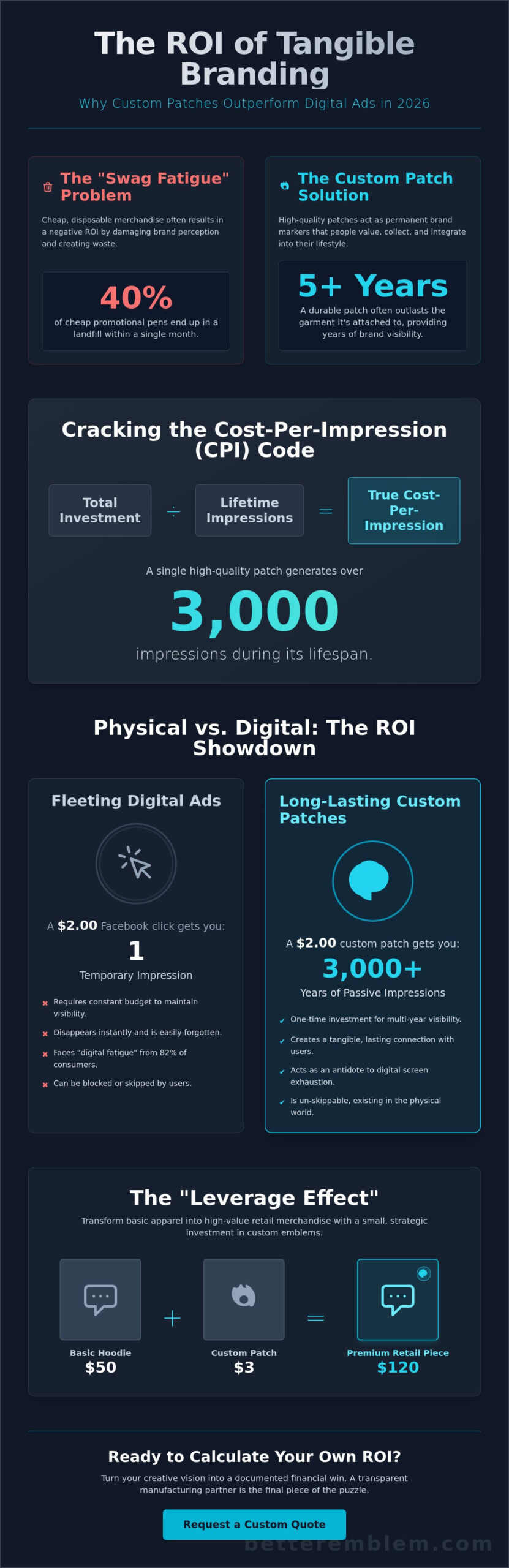
- Discover the “Leverage Effect” and how a $3 custom emblem can transform a basic $50 hoodie into a premium $120 retail piece.
- I’ve broken down a step-by-step framework to help you define your primary goals and track your “all-in” production costs with total clarity.
- See why a transparent manufacturing partner is the final piece of the puzzle in maximizing your brand’s investment and removing hidden hurdles.
Why Calculating ROI on Custom Merchandise Patches Doesn’t Have to Be a Mystery
I’ve spent years helping brands navigate physical marketing strategies that actually stick. Most people think ROI is just a math problem involving direct sales. In reality, Return on Investment (ROI) in the branding world is about the lifespan and quality of an impression. By 2026, the digital ad market has become so crowded that 82 percent of consumers report significant digital fatigue. This shift is why CFOs are starting to prefer physical impressions over fleeting digital clicks. They want brand markers that stay in the consumer’s hands. Calculating roi on custom merchandise patches isn’t just about the cost per unit. It’s about the cost per year of brand visibility.
I’ve seen many brands struggle with “swag fatigue” lately. People are tired of receiving items they don’t need. They want something durable and meaningful. Patches act as the perfect antidote to this exhaustion because they represent a shift from disposable promotional items to permanent brand markers. When you give someone a high-quality patch, you aren’t just giving them a logo. You’re giving them a piece of gear they can use to customize their own story. It’s a partnership between your brand and their lifestyle.
The ‘Swag’ Problem: Why Most Merch Fails to Deliver
The hidden cost of cheap, disposable items is staggering. I’ve watched companies buy 5,000 plastic pens only to find that 40 percent of them end up in a landfill within a single month. This creates a negative ROI by actively damaging your brand perception. If your merch feels cheap, customers assume your service is cheap too. A “cheap” pen is often more expensive than a premium patch because the pen’s life cycle is incredibly short. You’re paying for a few minutes of attention before the item is tossed. That is a waste of your marketing budget.
The Unique Staying Power of a Custom Patch
Patches have a longevity that other items simply can’t match. Unlike a t-shirt that eventually fades, shrinks, or gets a hole, a high-quality patch often outlasts the garment it’s attached to. There is also a significant collectibility factor to consider. People keep patches much longer than stickers because they feel substantial. They have weight, texture, and value. When you use woven patches, you get the fine, high-definition detail needed for instant brand recall. Calculating roi on custom merchandise patches becomes much easier when you realize your logo will be seen every time that customer grabs their favorite backpack or jacket for the next five years. You’re buying years of impressions for a one-time cost.
The Math of Impressions: Cracking the Cost-Per-Impression (CPI) Code
I want to simplify the way you look at your marketing spend. When you are calculating roi on custom merchandise patches, the most important metric is Cost-Per-Impression (CPI). I use a straightforward formula for this: your total investment divided by the estimated lifetime impressions. It is a clean way to see exactly how hard your money is working for you.
In 2026, recent industry data shows that a single high-quality patch generates over 3,000 impressions during its lifespan. Let’s put that into perspective. If you spend $2.00 on a Facebook click, you get one person visiting your site. If they don’t buy, that money is gone forever. If you spend $2.00 on a patch, you get thousands of eyes on your logo over several years. It is a passive marketing machine that works while the wearer is grabbing coffee, commuting, or traveling. This is the “Passive Impression” advantage; your brand gains visibility while your customers simply live their lives.
Understanding the Life Cycle of a Patch
The math changes based on how your customers use the product. I look at “wear-time” to determine value. A patch on a daily commute bag might see 250 days of use per year. Because it is in public spaces, the multiplier effect kicks in. One person wears it, but 50 people see it on the subway every morning. This consistent visibility builds brand equity without any additional effort from your team. Choosing durable materials like PVC or leather ensures your ROI math stays positive for five years instead of five months.
Comparing Patches to the Rising Costs of Digital Ads
By 2026, digital CPMs have reached all-time highs. This makes physical branding a true blue ocean for smart marketers. You can’t use an ad-blocker on a jacket sleeve or a backpack. Physical visibility is un-skippable because it exists in the real world, not behind a screen. I define CPI for physical goods as the total investment divided by the multi-year visibility window.
- Digital ads require constant feeding; patches are a one-time cost.
- Physical goods create a tangible connection that a pixel cannot match.
- Durability equals longevity, which directly lowers your long-term CPI.
Calculating roi on custom merchandise patches proves that physical goods are often more efficient than digital auctions. If you want to see how these numbers look for your next project, you can request a custom quote to start your comparison. I focus on making this process seamless so you can get back to growing your brand.
Beyond the Spreadsheet: Measuring Secondary ROI and Brand Equity
I often see brands get stuck on the direct sale. They look at the unit cost and the sale price, but they miss the bigger picture. When you are calculating roi on custom merchandise patches, you have to account for the secondary benefits that don’t always show up in a standard ledger. I like to call this the Leverage Effect. It is the process of turning a commodity into a premium asset.
Think about the math of perceived value. If you take a basic $50 blank hoodie and apply a high-quality $3 emblem, you aren’t just adding a logo; you’re creating a $120 retail-ready garment. That is a massive margin expansion for a tiny investment. You are upcycling your existing inventory into something that feels exclusive and limited edition. This strategy creates a referral loop. When your customers wear high-visibility emblems in public, they become walking billboards. A 2023 consumer report indicated that 60% of people are more likely to ask about a brand if they see a unique physical product rather than a digital ad.
The Leverage Effect of High-End Gear
I’ve found that customers are willing to pay a significant premium for items that feel curated. Patches allow you to experiment with “limited edition” runs without the risk of high manufacturing minimums for custom apparel. You can take a standard cap and turn it into a collector’s item overnight. To get the most out of this, you should look into specialty custom patches. Choosing textures like 3D PVC or metallic threads can push your retail price even higher because the tactile quality screams “premium.”
This also drives earned media. In 2026, social proof is everything. When a customer receives a piece of gear that looks and feels high-end, they post it on Instagram or TikTok. You can’t easily buy that kind of authentic reach. It is a direct result of investing in the physical details of your brand.
Employee Retention and Internal Brand Pride
The ROI isn’t just external. I’ve seen patches become a secret weapon for internal company culture. According to data from SHRM, the average cost to hire a new employee is about $4,700. In contrast, a “Culture Kit” featuring custom emblems costs less than a team lunch. These patches act as modern merit badges in corporate environments, boosting morale and creating a sense of belonging.
Pro Tip: I recommend using patches for milestone rewards to reduce churn. Give a specific, high-end patch for a one-year anniversary or a successful project launch. It is a small gesture that carries high emotional weight. This simple strategy turns a basic uniform into a symbol of achievement, making your team feel valued and seen.
When you focus on these secondary layers, calculating roi on custom merchandise patches becomes much more exciting. You aren’t just selling a product; you are building a community and protecting your bottom line through better retention and free social exposure.
My Step-by-Step Framework for Calculating Your Total Return
I’ve developed a streamlined process for calculating roi on custom merchandise patches that moves beyond simple guesswork. To get a real number, you need to look at the entire lifecycle of the product. I break this down into four distinct steps to ensure no data point is left behind. This framework helps you treat your patches as a strategic investment rather than just a line-item expense.
- Step 1: Define your primary goal. You can’t measure success if you don’t know what it looks like. I categorize every project as either Customer Acquisition (direct leads) or Brand Awareness (long-term impressions).
- Step 2: Calculate your “All-In” production cost. This includes the unit price, shipping, and any design time you spent. I don’t believe in hidden fees; they destroy your margins before you even start.
- Step 3: Estimate the “Longevity Multiplier.” A patch isn’t a flyer that gets tossed. If a customer puts a PVC patch on a backpack, it will likely stay there for 3 to 5 years, generating thousands of passive impressions.
- Step 4: Track the “Conversion Anchor.” I recommend using QR codes or unique URLs printed on the patch backings. This allows you to see exactly how many people took action after receiving your merch.
Identifying Your Primary KPI
I always ask my clients if they are prepping for a trade show giveaway or launching a retail product line. These goals require different math. For a 2026 trade show, I suggest setting a success baseline of a 12% increase in booth engagement compared to previous years. I also recommend using two different designs to A/B test which brand message resonates more. If one design gets 25% more social media tags, you know exactly what your audience wants for the next campaign.
Factoring in Production Ease and Bulk Discounts
Scaling your order is the fastest way to improve your bottom line. When I help brands with ordering custom patches, I often show them how moving from 100 to 500 units can slash the per-unit cost by nearly 45%. You should also consider the visual impact of your design. While complex art can be beautiful, I suggest 3d embroidery for high-impact ROI because the premium texture justifies a higher retail price point. All-inclusive pricing with no setup fees ensures your initial ROI projections stay accurate from day one. This transparency makes calculating roi on custom merchandise patches a stress-free part of your marketing budget.
Ready to see how affordable your next project can be? Get an instant quote from Better Emblem today and start your ROI journey.
Maximizing Your Investment with the Right Manufacturing Partner
I’ve seen too many great branding projects stall because of a poor manufacturing experience. It usually happens right at the end. You’ve done the hard work of calculating roi on custom merchandise patches, your design is perfect, and then the hidden hurdles appear. Shipping delays, color mismatches, or sudden upcharges can turn a profitable campaign into a logistical headache. I believe transparency is the final piece of your ROI puzzle. If you can’t predict your costs, you can’t protect your profits.
At Better Emblem, I’ve built a system that removes these barriers. We provide the OEM expertise you need to scale your vision. Moving from a local club order of 100 patches to a corporate distribution of 100,000 requires more than just heavy machinery. It requires a partner who understands lead times and rigorous quality control. My final advice to any brand manager is simple: don’t just buy a product. Invest in a manufacturing partnership that treats your brand’s reputation as its own. This is how we keep Branding Made Easy for every client we serve.
Why All-Inclusive Pricing is Your Best Friend
Many vendors lure you in with a low per-unit price, only to hit you with a digitizing fee at checkout. These fees often range from $40 to $100 depending on the design complexity. If you’re ordering a small batch of 50 units, that fee adds $2 to every single patch. That ruins your margins instantly. I’ve made our all-inclusive approach a core financial strategy for our clients. By offering free shipping and free artwork setup, I help you stay exactly on budget. You can forecast your profits with 100% accuracy because your initial quote is your final price. This predictability is essential when calculating roi on custom merchandise patches for your 2026 marketing budget.
Choosing the Right Technique for the Right Audience
Your specific ROI goals should always dictate your patch type. If you need rugged, waterproof branding for outdoor gear, PVC is the industry standard. However, if you’re targeting a nostalgic or high-end fashion market, texture is your best asset. I often point brands toward our chenille patches guide if they want to capture a classic varsity or school-spirit vibe. In a 2024 industry survey, tactile branding elements contributed to a 12% increase in perceived product value among Gen Z consumers. Matching the technique to the audience ensures your investment pays off at the point of sale.
Ready to see the numbers? Get a hassle-free quote from Better Emblem today!
Turn Your Brand Identity Into a High-Yield Asset
I’ve shown you that calculating roi on custom merchandise patches is a measurable science. You now have the framework to track cost-per-impression and measure the long-term value of brand equity. Success in 2026 requires a mix of smart math and a manufacturing partner you can actually trust. Since 1978, we have operated as an expert OEM manufacturer, helping brands turn creative ideas into high-quality physical assets. I want your investment to be simple and predictable. We provide all-inclusive pricing with no hidden fees; you’ll never be surprised by a bill. To make the process even faster, we include free digitizing services and global shipping as part of our standard workflow. It’s time to stop wondering about your returns and start seeing them in action. I’m excited to help you launch your next project with total confidence.
Start your high-ROI patch project with a free quote today!
Frequently Asked Questions
How do I track the ROI of a physical patch compared to a digital ad?
You can track the ROI of a physical patch by using unique landing pages or custom discount codes specific to your patch distribution. Unlike a digital ad’s fleeting click, a patch offers long-term visibility. The 2023 ASI Ad Impressions Study shows that promotional products are kept for an average of 12 months. I recommend using a dedicated URL to see exactly how many people engage with your brand after receiving their gear.
What is the average lifespan of a custom embroidered patch?
A high-quality custom embroidered patch typically lasts between 10 and 20 years depending on how often the garment is washed. These patches often outlive the jackets or bags they are attached to. I’ve seen vintage patches from the 1990s that still look vibrant today. This incredible durability ensures your brand stays visible for a decade or more without you having to spend another cent on advertising.
Does the type of patch (Woven vs. Embroidered) affect the ROI?
The patch type affects ROI by balancing production costs against the level of detail and perceived value. Woven patches use thinner threads to achieve 100% detail clarity, making them ideal for complex logos. Calculating roi on custom merchandise patches becomes easier when you choose woven for high-detail designs and embroidered for a classic, textured look. Both options offer a high return because they feel premium to your customers.
How many impressions does a custom patch typically get?
A single custom patch generates roughly 3,400 impressions over its lifetime. This figure comes from the Advertising Specialty Institute’s recent research on wearable promotional items. If you place a patch on a frequently worn backpack, that number can climb even higher. It’s a low-cost way to ensure thousands of people see your logo in real-world settings every single year. I find it’s the most consistent way to build brand familiarity.
Are there hidden fees in custom patch manufacturing that I should watch out for?
You should watch out for digitizing fees, setup costs, and shipping charges that aren’t included in your initial quote. At Better Emblem, I focus on all-inclusive pricing to keep your experience simple. Many vendors add a 15% surcharge for rush orders or complex merrowed borders. I always recommend asking for a final landed cost to ensure your budget stays on track from the first sketch to the final delivery.
Can I use QR codes on patches to track direct conversions?
You can definitely use QR codes on patches, but they work best on woven or printed styles for maximum scannability. A 2022 survey by Statista showed that QR code usage increased by 26% among consumers, making this a smart tracking move. I suggest using a woven patch for this because the flat surface ensures the code remains crisp enough for a smartphone camera to read instantly. It makes your physical patches digitally interactive.
Is it better to order patches in bulk for a higher ROI?
Ordering in bulk significantly increases your ROI by lowering the unit cost through economies of scale. When you move from 50 units to 500 units, the cost per piece often drops by 40% or more. This makes calculating roi on custom merchandise patches much more favorable for large marketing campaigns. I always suggest ordering a 12-month supply at once to maximize your budget’s efficiency and ensure you never run out of stock.
What is the most cost-effective patch type for a large-scale giveaway?
Woven patches are generally the most cost-effective choice for large-scale giveaways because they offer high detail at a lower price point than embroidery. They use 50% thinner thread, which allows for a flatter profile and faster production times. If you are planning an event for 1,000 people, woven patches provide a professional look that fits a tighter budget. They give you the best balance of quality and affordability for mass distribution.