
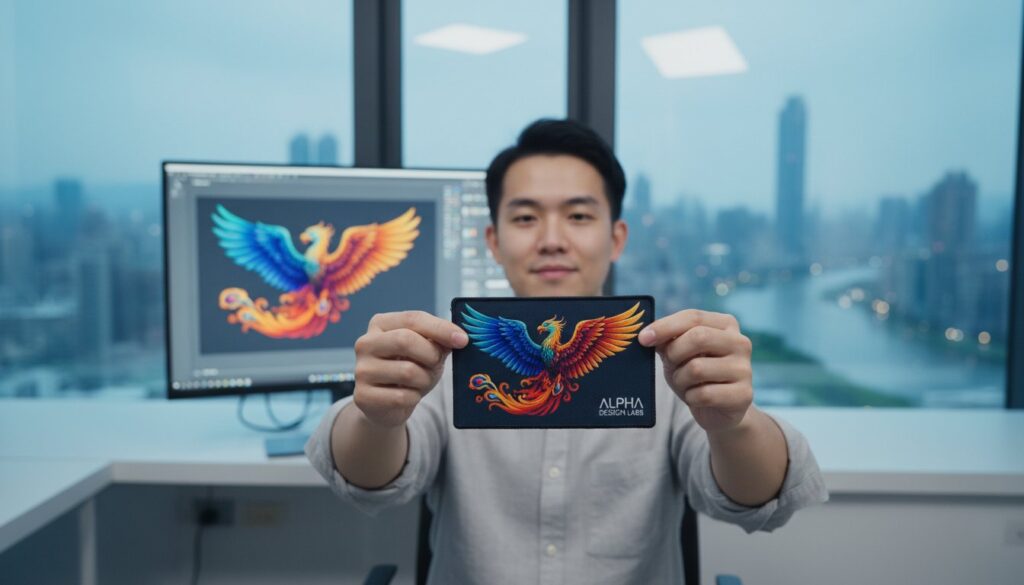
You’ve spent countless hours perfecting your brand’s logo. So, it’s beyond frustrating when embroidery turns those crisp lines and vibrant gradients into a blurry suggestion of your design. What if I told you there’s a better way? A method that captures every pixel, every color gradient, and every fine detail with photographic precision. That’s the power of modern stampa a trasferimento termico, and it’s a total game-changer for brands that refuse to compromise on quality.
In this guide, we’ll cut through the confusion. We’ll show you exactly how this technology delivers patches that are not only stunningly detailed but also built to last-no cracking, no peeling. We’ll break down the differences between DTF, sublimation, and other methods so you can make a smart investment. You’ll walk away knowing how to get the best ROI for your bulk order and find a manufacturing partner you can trust. Let’s make your brand look as sharp in real life as it does on screen.
Punti di forza
- Learn when a sleek, detailed patch is a better choice for your brand than a classic embroidered one.
- Discover how heat transfer printing turns your complex digital artwork into a durable, photo-realistic patch.
- I’ll cut through the confusion of terms like DTF and sublimation so you can see what’s best for your project.
- Get my simple design rules for setting up your digital files to ensure a flawless, high-impact final product.
What is Heat Transfer Printing for Custom Patches?
Let’s break it down. Simply put, stampa a trasferimento termico is a modern method where we print your design onto a specialized carrier film. Then, using precise heat and pressure, we thermally bond that design onto your products. It’s different from direct-to-garment (DTG) printing, which dyes the fabric itself. Instead, this process creates a distinct, vibrant patch that sits cleanly on the surface, giving your branding a sharp, professional finish. We call it the “detail king” for a reason-it flawlessly captures photorealistic images, complex gradients, and razor-sharp text.
The technology has evolved dramatically from the basic iron-on transfers of the 1970s. Today, the process is a high-tech affair, driven by advancements like dye-sublimation printing, which turns solid ink into gas to permanently permeate the material. This leap in technology is why our patches meet 2026 performance standards. They’re engineered to be incredibly durable, flexible, and vivid, ready for any application you can imagine.
The Anatomy of a Heat Transfer Patch
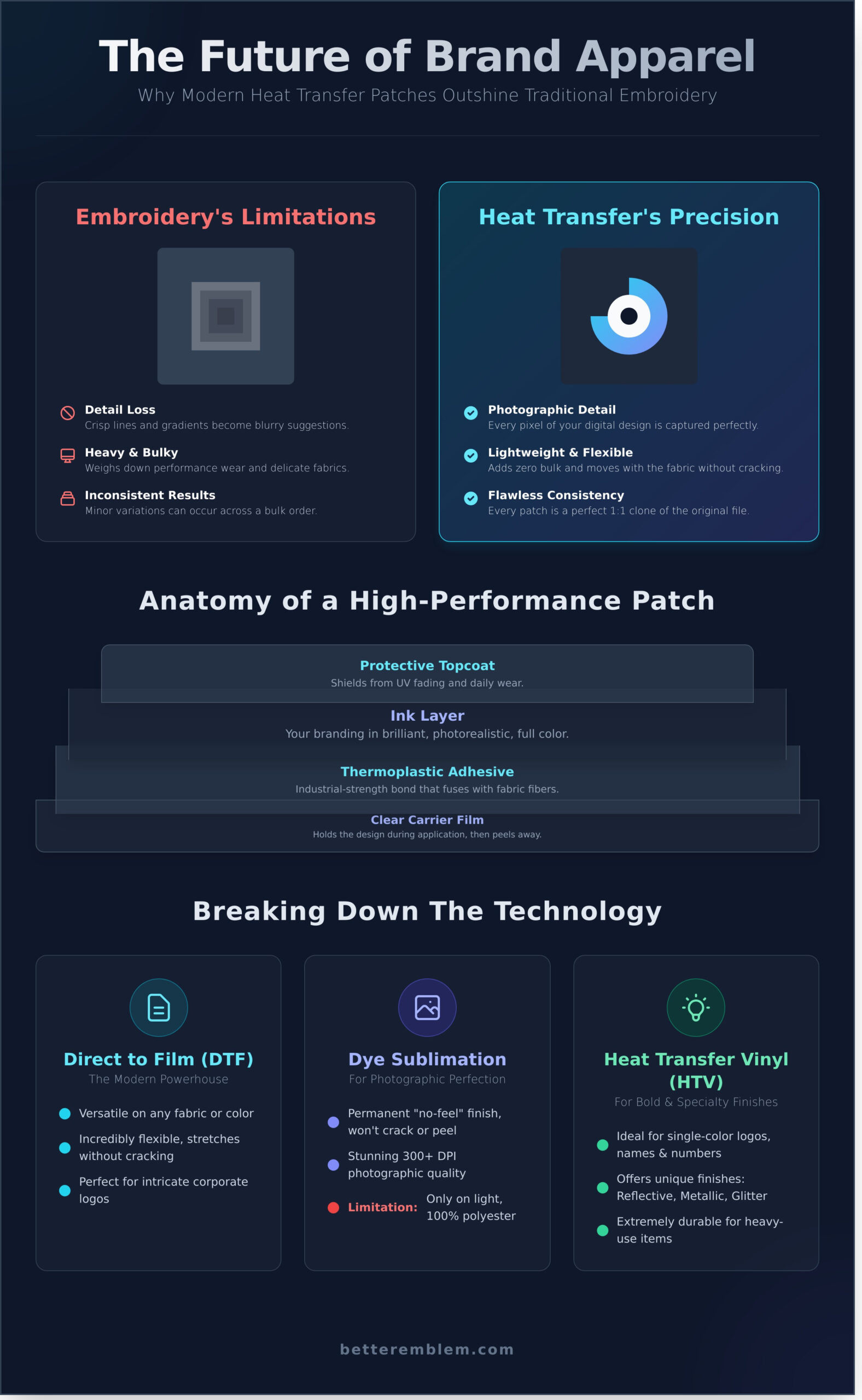
Think of your heat transfer patch as a high-performance sandwich. Each layer has a specific job. It starts with a clear carrier film that holds the design during application. In the middle is the ink layer, where your branding comes to life in brilliant, full color. The final, and most critical, layer is a powerful thermoplastic adhesive. This isn’t just glue; it’s an industrial-strength bonding agent that fuses with fabric fibers for a truly permanent hold that withstands dozens of washes. A protective topcoat is also applied to shield your design from UV fading and daily wear.
Why Brands are Switching from Embroidery
We see top brands making the switch from traditional embroidery every day. While embroidery has its place, it comes with limitations that modern apparel and branding simply can’t afford. Here’s why heat transfers are quickly becoming the new standard:
- Lightweight Performance: They add virtually no weight or bulk. This makes them ideal for performance gear, athletic wear, and delicate fabrics where a heavy embroidered patch would sag or pucker the material.
- Unlimited Detail: You can achieve perfect color gradients, tiny text, and intricate fine lines that a needle and thread simply cannot replicate. Your finished patch looks exactly like your digital file, every time.
- Flawless Consistency: In a bulk order, every single patch is a perfect 1:1 clone of the original. There are no slight variations or inconsistencies-just a professional, unified look across your entire product line.
This benefit extends beyond athletic wear into high-end fashion, where maintaining the soft drape of delicate fabrics is paramount. To see how detailed branding can be applied to refined garments, you can explore Women’s Apparel Collections for inspiration.
This focus on lightweight, detailed branding is why you’ll see heat transfers on advanced athletic gear. For a great example of this in action, you can explore Compression Clothing, which requires branding that doesn’t interfere with fabric performance.
Breaking Down the Tech: DTF, Sublimation, and Vinyl
Let’s cut through the alphabet soup of printing methods. When you see terms like DTF, HTV, and Sublimation, it’s easy to get lost. My goal is to make it simple. We choose the right technology for your project based on two things: your design’s complexity and the fabric you’re printing on. This isn’t just about looks; it’s about performance and longevity. Modern stampa a trasferimento termico is also evolving, with upcoming 2026 eco-friendly ink standards pushing us toward cleaner, more efficient methods.
Ultimately, a “one size fits all” approach just doesn’t work. To make the best choice for your brand, it helps to understand the fundamentals. For a deeper dive, industry publications like Impressions Magazine offer a great primer on Heat-Transfer Basics that covers the core concepts. Here’s how we break it down for our partners.
Direct to Film (DTF): The Modern Powerhouse
Think of DTF as the ultimate all-rounder. This technology lets us print your full-color designs onto a special film, which we then transfer to the garment. The magic is in its versatility-it produces brilliant, sharp colors on both light and dark fabrics, including cotton, polyester, and blends. Best of all, the print is incredibly flexible and durable, so it stretches with the fabric without cracking. This makes it perfect for detailed corporate logos and intricate crests on everything from t-shirts to hoodies.
Dye Sublimation: For Photographic Perfection
Sublimation is pure science. We use special inks that turn from a solid into a gas when heated, permanently bonding with the fabric fibers. The result is a vibrant, full-color graphic with a “no-feel” finish you can’t even tell is there. Because the ink becomes part of the material, it will never crack, peel, or fade. The only catch? It works exclusively on light-colored, 100% polyester fabrics. It’s our go-to for creating patches with photographic quality and stunning 300+ DPI clarity.
Heat Transfer Vinyl (HTV) and Specialty Films
When your design is bold and simple, Heat Transfer Vinyl (HTV) is a fantastic choice. We use a plotter to precisely cut your design from a sheet of colored vinyl before heat-pressing it onto the garment. While it’s not ideal for complex, multi-color logos, HTV shines in other areas. It’s perfect for single-color branding, names, and numbers, and it opens the door to unique finishes that other methods can’t offer, including:
- Reflective for safety and high-visibility gear.
- Glow-in-the-dark for a fun, memorable effect.
- Metallic and glitter for a premium, eye-catching look.
Heat Transfer vs. Traditional Embroidery: A Comparison
I often get asked if heat transfers look “as good” as embroidery. The simple answer is: they aren’t trying to. It’s not about better or worse; it’s about choosing the right tool for your brand’s specific look and budget.
Embroidery is a classic, offering a textured, raised feel. But when your design is rich with color, gradients, or fine details, embroidery costs can skyrocket due to high stitch counts. This is where stampa a trasferimento termico shines. Since transfers are priced by size-not by the number of colors-you can print a full-color photograph for the same price as a simple one-color logo. It’s a game-changer for complex artwork.
Tactile Experience and Aesthetic
Your choice sends a message. Embroidery gives you a traditional, crafted feel with its 3D texture. It feels substantial. Heat transfers, on the other hand, provide a professional sleekness. They sit flush against the fabric, creating a sharp, modern profile that’s perfect for performance apparel or tech-focused brands. You get crisp lines and photorealistic quality that thread simply can’t replicate.
You don’t have to choose just one. Many brands create a high-end look by combining techniques-imagine an embroidered crest with a small, detailed heat transfer element inside it. You get the best of both worlds.
The Longevity Myth: Do Transfers Peel?
Let’s clear this up right away. The number one concern I hear is about durability. You’re probably thinking of those stiff, cracking iron-on letters from a craft store. Industrial heat transfers are a completely different product. Their durability comes from a precise, factory-controlled process involving the perfect combination of heat, pressure, and time. The science behind modern Heat Transfer Printing Technology ensures a permanent molecular bond.
When applied correctly, our industrial-grade adhesives are engineered to fuse with the fabric fibers and will outlast the garment itself.
Design Best Practices for Maximum Impact
I’ve been in this business a long time, and I can tell you one thing for sure: great emblems start with great digital files. Your artwork is the blueprint for the final product. Getting it right from the start is the fastest way to get a high-quality, vibrant transfer that makes your brand look its best. This isn’t about being a design expert-it’s about understanding a few key rules that make the manufacturing process fast and flawless.
Resolution and File Types: The Blueprint for Quality
To get crisp, clean lines, vector files are still the gold standard. Formats like .AI, .EPS, or .SVG can be scaled to any size without losing a single drop of quality. If you’re working with a photograph or a pixel-based design (a raster image), be sure it’s a high-resolution file. We need at least 300 DPI (dots per inch) at the final print size to avoid a blurry or pixelated result. A logo saved from a website just won’t cut it.
Color Management: Getting Your Brand Hues Right
Your brand colors are non-negotiable, and we get that. While traditional screen printing uses Pantone (PMS) colors, modern digital stampa a trasferimento termico uses a CMYK process. We’ve built a system to precisely convert your PMS colors into CMYK values that stay consistent across different fabrics and products. What you see on your screen is rarely what you get in print, because most monitors aren’t calibrated. That’s why our digital proofing process is so critical-it’s your guarantee of color accuracy.
So, what about the fine details? Can you really print small text and intricate lines?
Absolutely. The technology for stampa a trasferimento termico has advanced dramatically. In 2026 and beyond, we can achieve stunning detail that wasn’t possible a decade ago. Here’s what you need to know:
- Testo in piccolo: We can typically print text as small as 4 points and keep it perfectly legible.
- Fine Lines: We recommend lines be at least 0.5 points thick to ensure they transfer cleanly and remain durable after washing.
Preparing your artwork shouldn’t be a headache. Our entire process is designed to be seamless. Just send us the best file you have, and our in-house design team will handle the technical prep work for free. We’ll check every detail and send you a digital proof to approve before we ever go to print.
Ready to see your design come to life? Get a free quote and a digital proof at betteremblem.com.
Making Your Manufacturing Hassle-Free with Better Emblem
Understanding the technical details of heat transfer and sublimation is one thing. Turning that knowledge into a finished product without the usual manufacturing headaches is another. At Better Emblem Company Ltd., we’ve been perfecting the art of the emblem since 1978, and we’ve learned that the best quality comes from the simplest process. That’s our “Made Easy” philosophy in action: guiding you from quote to delivery without the stress.
We handle the complexities so you can focus on your brand. This commitment extends to our materials and our planet. As we look toward the future, we’re dedicated to innovation that matters. By 2026, we are committed to transitioning our core product lines to eco-friendly adhesives and inks, ensuring your brand not only looks good but also does good.
Our Global OEM Capabilities
Your supply chain should be a strength, not a liability. We leverage our wholly-owned facilities in Taiwan, China, and North America to keep your production moving, no matter what. This global footprint allows us to:
- Handle high-volume orders with surgical precision and consistent quality.
- Navigate international export seamlessly, removing logistical burdens from your team.
- Offer robust contingency options to guarantee on-time delivery.
With us, you get a partner who understands the demands of large-scale stampa a trasferimento termico and global distribution.
Get Started with Your Custom Project
Seeing is believing. Request a free sample pack to feel the quality of our emblems for yourself. Our pricing is always transparent-what you’re quoted is what you pay. No setup charges, no hidden fees. Just honest, high-quality manufacturing designed to make your job easier. When you’re ready to bring your vision to life, consult with our experts on your next custom stampa a trasferimento termico design.
Make Your Mark with Flawless Heat Transfer Patches
We’ve covered a lot of ground, from the incredible, photo-realistic detail you can achieve to the specific technologies that make it happen. The most important takeaway is that stampa a trasferimento termico opens up a world of creative possibilities for custom patches. You can use complex gradients, fine text, and vibrant colors without compromise. Your brand deserves to be seen in full detail, and this is the technology that delivers.
Making it happen shouldn’t be complicated. As manufacturing experts since 1978, with a global OEM presence in Asia and North America, we’ve perfected a seamless process. We handle the technical details so you can focus on your design. With Better Emblem, you get a dedicated partner and our promise of all-inclusive pricing-no setup charges, no hidden fees. Just amazing patches, delivered on time.
Ready to see your vision in high definition? Let’s create something that truly represents your brand. Start your custom heat transfer project today.
Domande frequenti
Is heat transfer printing permanent on clothing?
Yes, our heat transfers are designed for permanence. When applied correctly with a professional heat press, they fuse directly with the fabric fibers and can easily withstand 50+ washes without cracking, peeling, or fading. This professional-grade bond makes our stampa a trasferimento termico a durable and reliable choice for retail-quality apparel. The key is proper application-it ensures your design lasts as long as the garment itself.
Can heat transfer patches be applied to any fabric type?
Our heat transfers work beautifully on a wide range of fabrics, including cotton, polyester, and poly-cotton blends. These materials handle the required heat and pressure perfectly. However, we advise caution with delicate or heat-sensitive materials like nylon, silk, or certain synthetics, as high temperatures can damage them. For any unique fabric, we always recommend testing a sample first to guarantee a flawless application for your project.
What is the minimum order quantity for custom heat transfer patches?
We make getting started simple and accessible for everyone. Our minimum order quantity (MOQ) for custom heat transfer patches is just 25 units. This low minimum is perfect for small brands, limited-edition drops, or for testing a new design without a huge upfront investment. We believe in providing professional quality for projects of any size, ensuring you get exactly what you need, when you need it.
How do I wash garments with heat transfer patches to ensure they last?
Caring for your garments is easy and ensures maximum durability. We recommend turning the item inside out before washing. Use a cold water, gentle cycle, and a mild detergent. For best results, hang dry or tumble dry on the lowest heat setting. Be sure to avoid using bleach or ironing directly over the transfer design. Following these simple steps will keep your patches looking crisp and vibrant for years to come.
What is the difference between heat transfer and screen printing?
The main difference is the application method. With stampa a trasferimento termico, your design is printed onto a special transfer material, which is then applied to the garment using heat and pressure. Screen printing involves pushing ink directly onto the fabric through a mesh screen. Heat transfers excel at producing full-color, highly detailed graphics and are more cost-effective for smaller, multi-color orders, offering incredible versatility for your brand.
Can you achieve metallic or reflective finishes with heat transfer?
Absolutely! This is one of the most exciting benefits of using heat transfers. We offer a fantastic range of specialty finishes to make your designs pop. You can choose from options like brilliant metallic foils, vibrant glitter, high-visibility reflective material, and eye-catching holographic effects. These finishes are perfect for creating premium apparel and accessories that truly stand out and capture your brand’s unique style.
Do I need a professional heat press to apply these patches?
For a professional, long-lasting bond, we strongly recommend using a commercial heat press. A heat press provides the consistent temperature and even pressure that a home iron simply cannot match. This is crucial for properly curing the adhesive and ensuring your patch withstands washing and wear. Investing in the right tool guarantees a retail-quality finish and protects the integrity of your design and your brand’s reputation.
How long does the manufacturing process take for bulk orders?
We pride ourselves on our fast, efficient process. Standard production for most bulk orders is typically completed within 7-10 business days after you approve your final design proof. Shipping time is additional. If you have a tight deadline, please let our team know. We offer rush services when possible to help you meet your launch dates without any stress. Our goal is to get your high-quality patches to you quickly.