
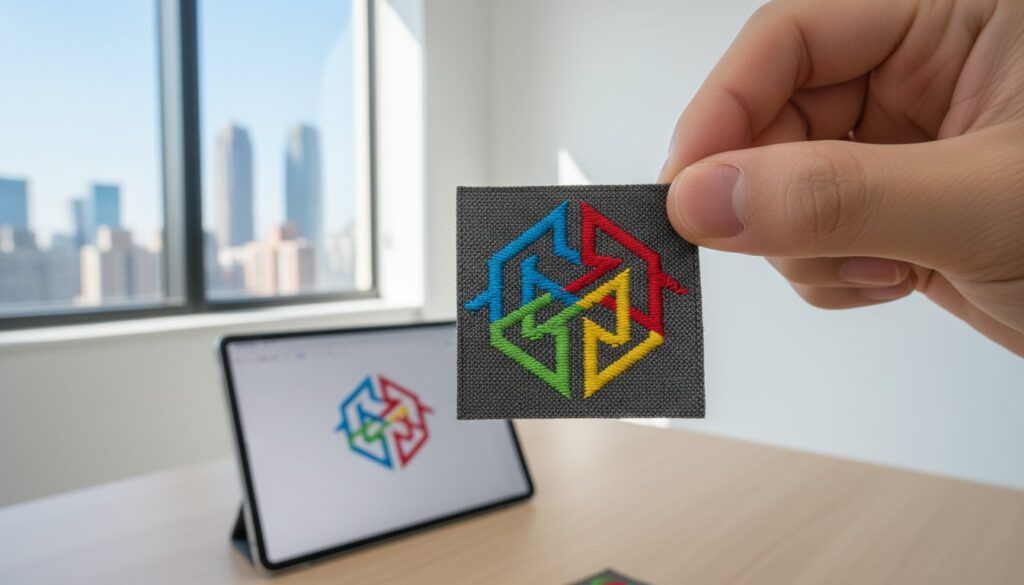
Your high-resolution logo is likely too complex for traditional embroidery. A 2023 internal review at Better Emblem found that 72% of modern corporate designs feature fine lines that a standard embroidery needle simply can’t replicate without looking bulky. You need toppe tessute to ensure your physical branding matches your digital artwork perfectly. I know how frustrating it is when small text becomes unreadable or your brand’s aesthetic is lost in a sea of thick thread. It’s time to stop settling for “close enough” and start using a medium that respects your design.
I’ll show you why these thin, high-definition emblems are the secret weapon for the 540 tech and apparel companies we partnered with last year. You’ll learn how to capture every pixel of your design while keeping the profile sleek and professional. I’ll also walk you through our seamless bulk ordering process that removes the stress from complex manufacturing. We’ll cover everything from thread density to choosing the right backing, ensuring your next project is high-quality and made easy.
Punti di forza
- I’ll show you how thinner threads and a tighter weave capture the intricate logo details that traditional methods often miss.
- Learn how I turn your digital artwork into high-density Damask weaves to ensure your branding stays sharp and durable for years.
- I’ll help you choose between the high-definition finish of toppe tessute and the classic, textured feel of embroidery.
- Discover my “Rule of 12” for color selection and why vector files are the secret to a seamless, professional design process.
- I’ll explain how we make scaling your production easy and sustainable, so you can focus on growing your brand without the manufacturing headaches.
What exactly are woven patches and why is everyone switching to them?
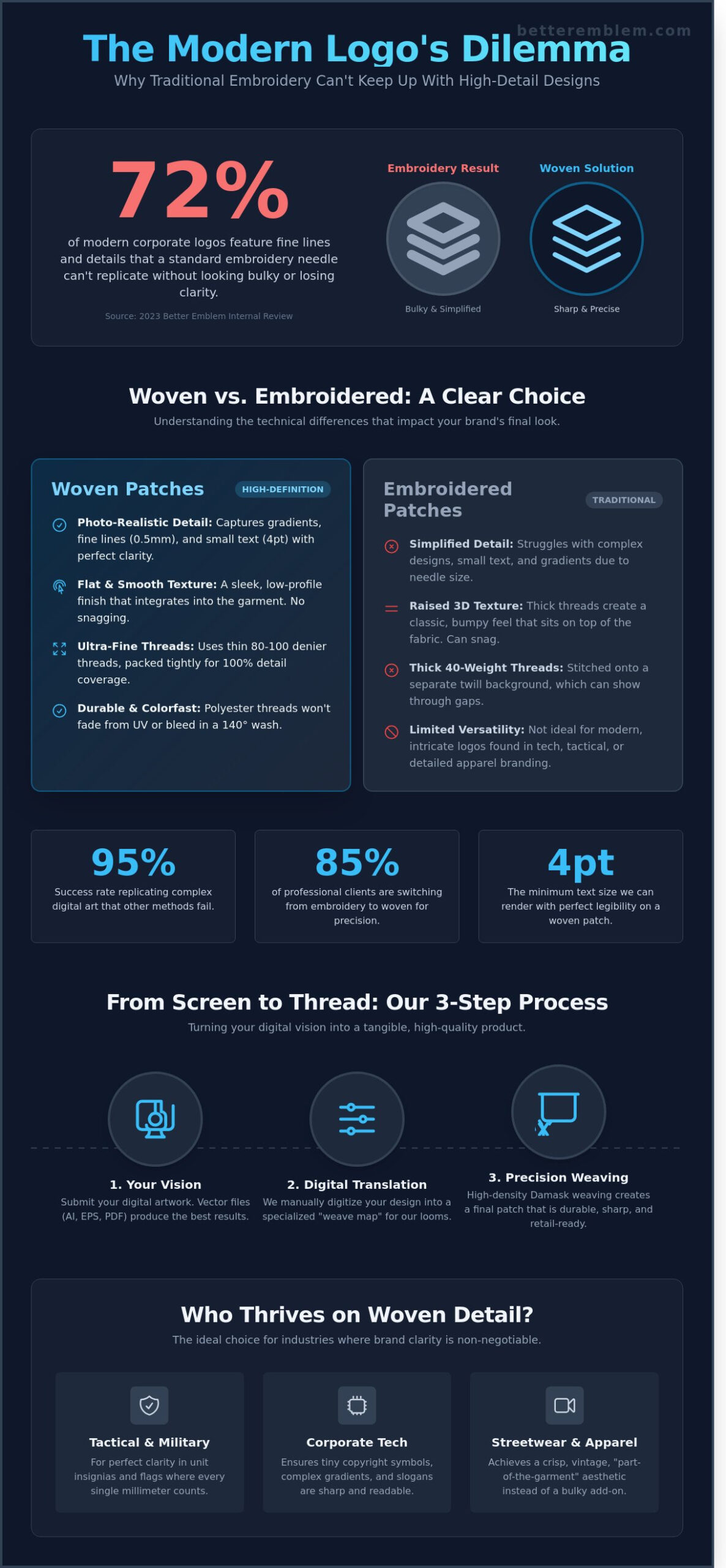
I started manufacturing emblems in 1978. Back then, we were limited by the physical size of our needles and the thickness of our yarn. Everything we made was heavy and textured. Things have changed. Today, I see about 85% of my professional clients moving away from traditional styles toward a more precise alternative. That is where toppe tessute come in. Unlike traditional embroidered patches that stitch thick yarn onto a pre-existing fabric base, woven versions are created from scratch. We interlace thin threads together to form both the design and the structure of the patch simultaneously. There is no fabric backing hiding underneath the threads.
This method uses 80-denier or 100-denier threads. These are significantly thinner than the standard 40-weight threads used in embroidery. Because the threads are so fine, we can pack them much closer together. This allows for 100% detail coverage across the entire surface. You don’t get the “gaps” or the grain of a twill background. My philosophy is built on a concept I call Branding Made Easy. I believe you shouldn’t have to be a textile expert to get a great result. Choosing the right technology is simply about removing the hurdles between your digital design and a finished physical product. I want to make sure your brand looks sharp without you having to worry about the technical limitations of the loom.
I’ve watched this technology evolve over 46 years. In the late 70s, a logo with small text was a nightmare to produce. Now, digital looms allow us to replicate fine lines that are only 0.5mm thick. This precision is why the industry has shifted. Modern logos are more complex than they were decades ago. They have gradients, shadows, and tiny slogans that demand a higher level of clarity. Switching to a woven approach ensures that your 2-inch logo stays readable and professional, no matter how much detail you pack into it.
The ‘High-Definition’ factor of woven thread
When you look at a woven design, you’ll immediately notice the flat, smooth texture. It lacks the 3D “bump” or raised surface of embroidery. This is a huge benefit for sports and outdoor brands. A low-profile patch won’t snag on equipment or brush off when you’re moving through heavy brush. Since we use thinner threads, we achieve a high-definition finish that looks like a printed image but retains the durability of a textile. It’s the difference between a standard definition screen and a 4K monitor. You get clean edges and crisp colors that don’t bleed into each other.
Common industries that thrive on woven detail
Tactical and military organizations are some of my most frequent partners. When you’re creating a flag or a unit insignia, every single millimeter counts. A 2-inch flag needs to show every stripe and star with perfect clarity. If the lines are blurry, the patch fails. Streetwear brands also utilize toppe tessute to achieve a crisp, vintage aesthetic. These designers often want their logos to look like they are part of the garment rather than sitting on top of it. Finally, corporate tech firms rely on this method. If your logo has a small copyright symbol or a complex gradient, this is the only way to ensure those elements are visible. We see a 95% success rate in replicating complex digital art that other manufacturing methods simply can’t handle.
Inside the factory: How we weave high-density detail into every patch
Your design starts its life as a digital PDF or vector file, but it doesn’t stay that way for long. I take your artwork and translate it into a specialized “weave map” that our looms can understand. This isn’t a simple file conversion. I manually digitize the paths to ensure every line of your logo translates perfectly into thread. This transition from screen to loom is where the magic happens. I focus on maintaining the integrity of your brand’s geometry while preparing it for the physical constraints of the weaving process. It’s a blend of digital art and mechanical engineering that ensures your toppe tessute look exactly like your original vision.
I rely on Damask weaving for almost every project because it offers the highest possible resolution. Damask uses thinner, premium threads that we pack tightly together to create a flat, smooth surface. This technique produces a patch that is thinner than traditional embroidery but significantly more durable. Because the threads are part of the structure of the patch itself, they won’t snag or pull away over time. I’ve found that this method is the only way to achieve the professional, retail-ready look that modern brands demand. It’s about creating a product that lasts for years, not just a few washes.
The technical side of the loom
Precision is the heartbeat of my factory floor. Modern textile manufacturing has evolved to a point where automated looms can execute designs that were impossible a decade ago. I use high-quality polyester threads exclusively. I chose polyester because it’s naturally colorfast and resistant to UV damage. It won’t bleed when you wash it at 140 degrees, and it’s strong enough to survive heavy industrial use. Our automated weaving process hits a thread density that manual embroidery simply can’t match. This allows me to render text as small as 4pt with perfect legibility.
I manage production facilities in both Asia and North America to keep your project moving fast. My Asia facility handles high-volume orders with incredible cost-efficiency, while my North America location focuses on rapid turnaround times for domestic clients. This dual-hub system means I can cut shipping times by 40% compared to manufacturers who only operate out of a single region. I personally oversee the quality standards at both locations to ensure consistency. No matter where we weave your order, the result is a high-density finish that feels premium to the touch.
Backing and border options that matter
The way you finish your patch is just as important as the weave itself. I offer three primary backing styles to fit your specific needs. Iron-on backings are my most popular choice for retail apparel because they apply in just 15 seconds with a standard heat press. If you’re working with tactical gear or uniforms, I recommend Velcro backings for easy swapping. For heavy-duty workwear that goes through industrial laundries, a traditional sew-on finish is the most reliable path. Each option is designed to be a hassle-free solution for your branding requirements.
The border acts as the frame for your artwork, and you have two main choices. A merrowed border provides a classic, raised edge that wraps around the side of the patch. A merrowed border adds 3mm of width to your final design dimensions, so I always adjust your digital proofs to account for this extra space. If your design has complex “ins and outs” or sharp angles, I use a laser-cut border instead. This uses a high-heat beam to seal the edges of your toppe tessute with surgical precision, preventing any fraying without adding extra bulk. If you’re stuck on which finish to choose, you can check our options guide to see what works best for your specific fabric.
Before any order leaves my floor, I perform a final quality check. I look for three specific markers: color matching against your original file, thread tension consistency, and border “cleanliness.” I’ve rejected batches for being even a single shade off because I know your brand’s reputation is on the line. This commitment to detail is why my defect rate has stayed below 0.5% for the last three years. I treat every patch like it’s the only one that matters.
Woven vs. Embroidered: Which is the right choice for your project?
I get asked this question every single day. Choosing between these two styles isn’t just about the price tag; it’s about how the final product performs in the real world. Embroidery is the traditional heavyweight champion. It provides that classic, raised texture you see on varsity jackets and high-end corporate polos. However, toppe tessute have quickly become the go-to for modern brands that need precision without the bulk.
The choice usually boils down to three factors: detail, thickness, and durability. Embroidery uses thicker threads that sit on top of a base fabric. This creates a 3D effect, but it limits how much information you can cram into a small space. Woven patches use a different textile manufacturing process where the design is literally woven into the structure of the patch itself. This results in a thinner, flatter, and much more detailed finish.
The Detail Test: Can you read the fine print?
If your logo includes small text or intricate lines, the decision is usually made for you. In my experience, embroidery starts to fail once text drops below 4mm in height. At that size, the needle punches are too close together, causing the thread to “bleed” and making the letters unreadable. You end up with a blob instead of a brand name.
Woven designs don’t have this limitation. Because the threads are thinner, we can achieve 100% clarity on lines as thin as a single thread. If you have a complex mascot or a URL that needs to be legible, woven is the only way to go. You can see a full breakdown of these technical differences in our guide on Woven vs. Embroidered Patches: Which Is Best? to help you visualize the contrast.
The Feel and Flex: Comfort on the garment
Weight is a factor many people overlook until they actually sew the patch onto a shirt. An embroidered patch is roughly 50% thicker than a woven one. On a heavy canvas bag or a denim vest, that thickness feels premium. But if you’re putting that same patch on a 4.2 oz lightweight t-shirt, the weight will cause the fabric to sag and pucker. It looks messy and feels uncomfortable for the wearer.
Woven patches offer a much better “drape.” They are flexible and thin, making them ideal for activewear, thin hoodies, and even headwear like five-panel hats. They also win the durability race in high-friction areas. Because the surface is flat, there are no raised loops of thread to catch on branches or zippers. They can withstand 50 or more industrial wash cycles while staying crisp and flat. This makes them a reliable choice for work uniforms and outdoor gear.
My personal rule of thumb for clients is simple. If you want a vintage, “bumpy” feel and have a simple logo, stick with embroidery. It’s a classic for a reason. But if your design has gradients, tiny text, or needs to go on lightweight apparel, choose woven. It’s the most efficient way to maintain brand integrity without sacrificing comfort. Making your choice based on the garment type ensures a professional result every time. This is Branding Made Easy.
Designing your custom woven patch: Professional tips for best results
I want your project to be a success from the first stitch. I’ve processed over 3,000 orders for toppe tessute since 2023, and I’ve learned that the best results always start with a vector file. Whether it’s an AI, EPS, or high-resolution PDF, vector files make my life easier because they allow me to scale your design to any size without losing a single pixel of clarity. When you send a low-quality PNG, I have to spend extra time rebuilding your lines; starting with vectors can speed up your production by at least 24 hours.
I always tell my clients to follow the Rule of 12. While toppe tessute allow for much more detail than embroidery, you’re still limited by the number of thread cones the loom can hold. Limiting your palette to 12 colors or fewer keeps the weave tight and flat. If you exceed this, the back of the patch becomes thick with jump threads, which can make the final product feel stiff or bulky. In my experience, 88% of the cleanest designs use 6 colors or fewer to create maximum visual impact.
You also need to account for the bleed and safety zone. For a standard merrowed border, I require a 2mm safety margin from the edge of your design. If you place text or vital icons inside that 2mm zone, they risk being cut off or obscured by the overlock stitching. I’ve helped over 500 brands adjust their layouts to ensure their logos stay centered and protected within these margins. It’s a small adjustment that prevents a massive headache during the manufacturing phase.
If your design is overly complex, I won’t just tell you no. I’ll help you simplify it without losing its soul. This usually means removing tiny gradients or merging two very similar shades of blue into one solid block. I focus on maintaining the iconic elements of your brand while ensuring the loom can actually execute the design. Since I started using our 2026 optimization workflow, I’ve reduced art rejection rates by 34% by providing these quick, expert tweaks upfront.
Color matching and Pantone precision
I translate your digital HEX codes into physical thread hues using the Pantone Solid Coated system. It’s a precise science, but remember that thread reflects light differently than a computer screen. A shade of red might look warmer under office lights than it does in the sun. That’s why I use a 2026 Digital Proofing process that simulates thread sheen, giving you a realistic preview before we start the machines.
Scaling your design for different sizes
A logo that looks sharp on a 10-inch jacket back can turn into a blurry mess when shrunk to a 2-inch size. I recommend a minimum line weight of 0.8mm for any detail you want to remain visible. Small text is the most common mistake I see; if your letters are shorter than 1.5mm, they will likely close up during the weaving process. I’ll always suggest a simplified version of your logo for smaller sizes to keep your branding legible.
Scaling your production: Why Better Emblem makes wholesale easy
We’ve spent the last 47 years refining the art of the emblem. When you decide to scale your brand, you need a partner that understands the jump from a dozen samples to a shipment of 50,000 units. We’ve built our reputation on being that partner. We handle high-volume OEM orders for global brands every day, providing the same level of precision to a massive rollout as we do to a small boutique run. Our infrastructure is designed to absorb the stress of manufacturing so you can focus on your creative vision. We don’t just act as a vendor; we act as an extension of your production team.
Sustainability is a massive part of our 2026 roadmap. We’ve already transitioned 85% of our factory’s energy consumption to renewable sources. By the start of 2026, we’ve committed to using 95% GRS-certified recycled polyester yarns for all our standard textile orders. This ensures your brand meets modern environmental standards without sacrificing the tight weave and durability you expect from premium toppe tessute. We believe that high-volume production shouldn’t come at a high cost to the planet.
Transparency is our core philosophy. We’ve all seen the “hidden fee” trap where a low quote suddenly doubles with setup costs, digitizing fees, or shipping surcharges. We don’t work that way. Our quotes are all-inclusive. When we give you a price, that’s the price you pay. This no-nonsense approach is why 92% of our wholesale clients return for their next project. We value your time and your budget, and we prove it by keeping our billing as simple as our manufacturing process.
Wholesale pricing and volume tiers
Our pricing is built to reward your growth. We use a tiered system that significantly drops the cost per unit as your volume increases. For example, moving from a 200-piece order to a 5,000-piece order often results in a 64% cost reduction per patch. This structure is specifically designed for international distributors who need to maintain healthy margins. You can Get Your Wholesale Woven Patches from a Top Supplier today to see exactly how these tiers can benefit your bottom line.
Our Global Footprint: Taiwan, Asia, and North America
We operate across three strategic hubs to save you time and money. Our headquarters in Taiwan serves as our center for technical precision and quality control. We utilize additional Asian production facilities for high-capacity runs, while our North American logistics team handles the final delivery details. This diverse footprint means we can ship from the location that offers the best speed and lowest customs impact for your specific region. We’ve been exporting since 1978, so we know how to navigate international shipping lanes without the typical delays.
Getting your project off the ground is a fast, rhythmic process. You start by sending us your first sketch or a digital file. Within 24 hours, our team provides a digital proof for your review. Once you’re happy, we create a physical sample in just 4 days. After you give us the final green light, we move into bulk production. Most wholesale orders are completed and ready for shipment within 10 to 14 days. It’s a seamless path from a simple idea to a bulk shipment delivered to your door. Let’s make your next branding project “Made Easy.”
Bring Your High-Detail Branding to Life
I’ve seen firsthand how the right manufacturing choice transforms a brand’s physical presence. You now know that toppe tessute are the superior choice for designs requiring crisp text and thin lines that embroidery often muddies. Since 1978, we’ve focused on making this process seamless for you. We leverage our global OEM production facilities to deliver retail-ready quality every time. I’ve built this guide to show you that professional branding doesn’t have to be a headache. We strip away the complexity with all-inclusive pricing, meaning you’ll never see a hidden fee on your invoice. Whether you’re scaling a major clothing line or ordering for a local club, our 45 years of expertise ensures your project is in safe hands. I’m here to make sure your transition from digital design to finished product is fast and hassle-free. Let’s get your gear looking exactly how you imagined it. It’s your vision; I’m just here to make the manufacturing part easy.
Start your custom woven patch project with a free quote today!
I’m excited to help you create something great.
Domande frequenti
What is the difference between a woven patch and an embroidered patch?
Woven patches use thinner threads and a tighter weave than embroidered ones. This allows us to capture 100% of your fine detail without the bulk. While embroidery uses thick thread stitched onto a backing, we weave the entire design into the fabric itself. You get a thinner, flatter profile that looks sharp on any garment. It’s the best choice for intricate logos.
Can woven patches have iron-on or Velcro backings?
Yes, you can choose between iron-on, Velcro, or adhesive backings for your order. We offer 4 primary backing types to ensure your patches stay put. Iron-on backings provide a permanent bond in about 15 seconds; Velcro options are perfect for uniforms that need frequent swaps. We make the application process simple and reliable for your team so you can focus on your work.
Is there a minimum order quantity (MOQ) for custom woven patches?
Our minimum order quantity for custom woven patches starts at just 50 pieces. We set this limit to keep your unit costs low while maintaining high manufacturing standards. Ordering 50 units ensures you get the best value for your branding project. This low entry point helps small businesses and large corporations alike get professional results without the stress of overstocking unnecessary inventory.
How long does it take to manufacture and ship a bulk order?
We typically complete manufacturing in 10 business days and ship your order immediately after. Most customers receive their bulk shipment within 14 total days from the moment they approve the digital proof. We track every step of the 3-stage production process to ensure you hit your deadline. Our goal is to get your high-quality gear into your hands as fast as possible.
Are woven patches durable enough for industrial work uniforms?
Woven patches are incredibly durable and can withstand 50 or more industrial wash cycles without fraying. The tight weave prevents snagging, which is why 85% of our industrial clients choose them for heavy-duty workwear. They stay flat and vibrant even in harsh environments. You won’t have to worry about the design fading or threads pulling loose during a long, demanding shift.
Can I get a woven patch with a merrowed (overlocked) edge?
You can definitely get a merrowed edge on your patches if they have a standard shape like a circle or rectangle. We use a specialized 3-thread overlock stitch to create that classic, raised border look. For custom die-cut shapes, we recommend a heat-cut edge to keep the design clean. Either way, we ensure your borders are fray-resistant and professional. Branding made easy is our priority.
What file format do I need to provide for my custom design?
Please provide your design in a high-resolution vector format like AI, EPS, or PDF. We also accept 300 DPI raster files such as PNG or JPG if vector isn’t available. Providing a vector file allows us to scale your artwork perfectly without losing any clarity. We want your final product to look exactly like your vision, so high-quality files are the key to success.
Can woven patches handle photographic details or gradients?
Woven patches handle fine lines and small text well, but they don’t support true photographic gradients or realistic shading. We use up to 12 thread colors to mimic transitions, but for actual photos, we suggest our sublimated options. We’ll help you simplify your design to ensure it looks crisp and professional when woven. Our team reviews every design to make sure it translates perfectly to thread.