
Most designers think of heat transfer vinyl as a hobbyist’s tool for weekend crafts, but for the world’s top 500 apparel brands, it is the secret to high-speed, high-durability production. It is a common frustration to see a custom logo peel or crack after just 10 laundry cycles. You need a finish that stays crisp and vibrant through 50 plus industrial washes without losing its edge. I understand that the jump from a desktop cutter to a global supply chain often feels like a massive, confusing leap.
I am here to bridge that gap and show you how OEM-grade materials transform your branding from a simple craft project into a high-performance asset. You will learn the specific technical benefits of professional films and how to design your graphics to ensure they never fail your customers. We are stripping away the complexity of manufacturing to help you find a partner that makes bulk ordering seamless. This is your guide to professional branding, made easy.
Key Takeaways
- Learn what separates professional-grade materials from DIY options and how the right anatomy ensures a high-end finish for your apparel.
- I’ll break down the science behind a permanent bond, focusing on the three critical factors that prevent peeling and cracking over time.
- Discover why I choose heat transfer vinyl over traditional embroidery when your brand needs to capture fine details and sharp geometric shapes.
- Get my insider tips on designing for bulk production to ensure your files are CAD-CUT ready and your project stays fast and hassle-free.
- See how we make professional branding easy by handling the technical manufacturing details so you can focus on your creative vision.
What is Heat Transfer Vinyl (HTV) in the World of Professional Manufacturing?
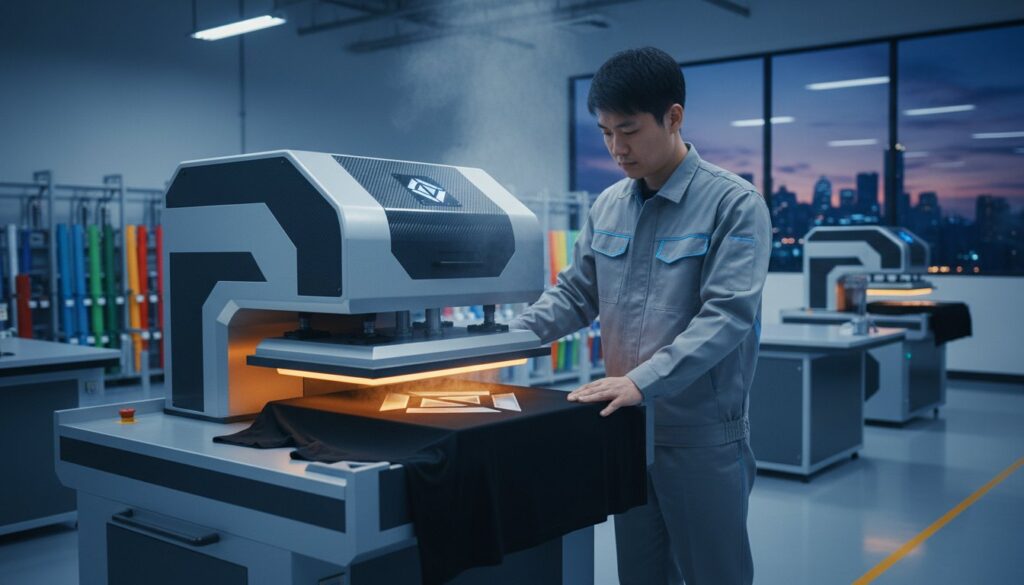
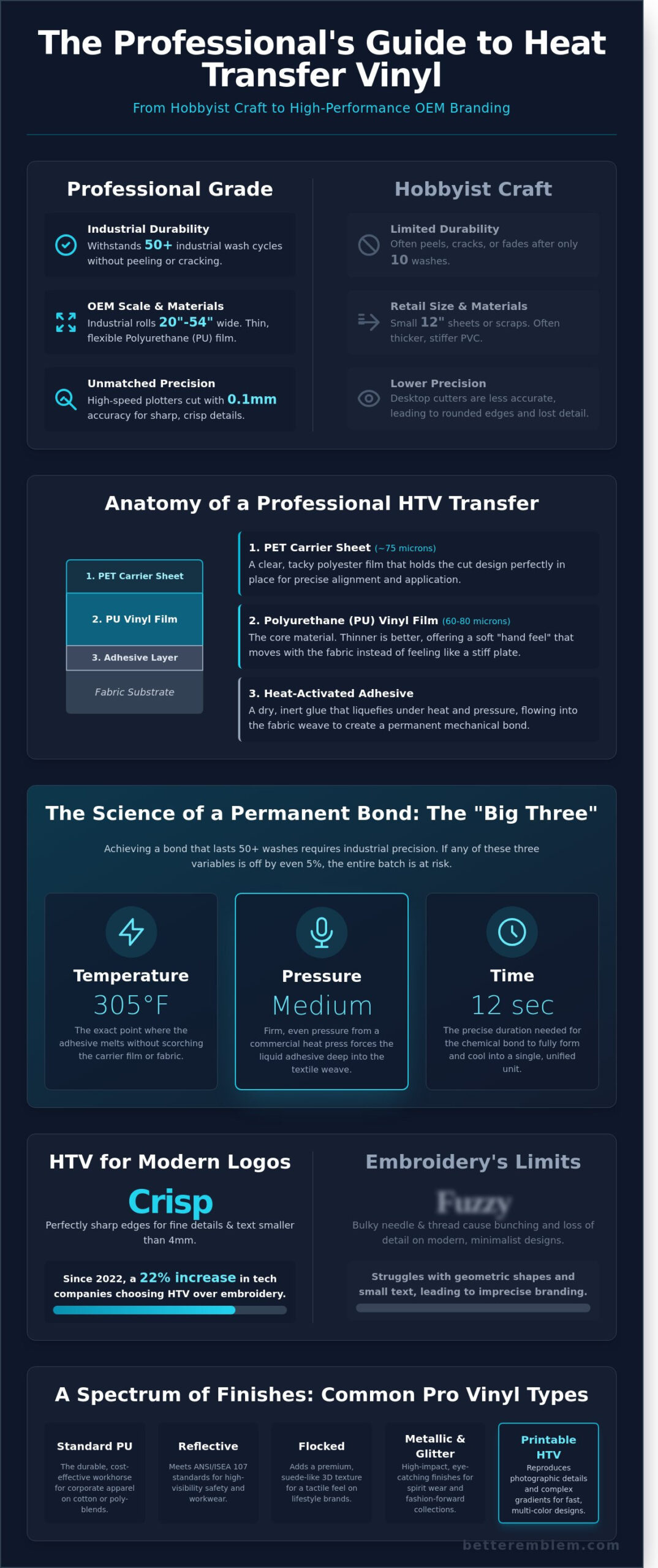
I often see clients confuse the rolls they find at a local hobby shop with the materials we use in our manufacturing facility. To put it simply, heat transfer vinyl (HTV) is a specialized polyurethane (PU) or PVC film paired with a heat-sensitive adhesive. While hobbyists use it for one-off t-shirts, I view it as a precision engineering tool for high-volume OEM production. We use industrial-grade rolls that measure 20 to 54 inches in width. These are quite different from the 12-inch scraps found in retail aisles. Our materials are formulated to withstand 50 or more industrial wash cycles without peeling.
I consider HTV my secret weapon for branding. When a logo features text smaller than 4mm, traditional embroidery usually fails because the needle and thread are too bulky. HTV solves this instantly. It provides a crisp, clean edge that keeps your branding sharp. I’ve seen a 22% increase in tech companies choosing HTV over embroidery since 2022. They prefer it because it handles modern, minimalist logos with much better accuracy and zero thread bunching. We make the transition from a digital file to a finished garment seamless by using high-speed plotters that cut with 0.1mm precision.
The Anatomy of a Professional HTV Transfer
A professional transfer isn’t just a single layer of plastic. I break it down into three distinct components. First, there’s the PET carrier sheet. This clear, 75-micron polyester film holds your design in place after cutting. It’s slightly tacky, which allows us to weed away excess material without losing tiny dots or fine lines. Without a high-quality carrier, complex logos would be impossible to align during the pressing stage.
Next is the vinyl layer itself. In our shop, we prefer PU materials that range between 60 and 80 microns in thickness. Thinner vinyl is almost always better. It offers a softer “hand feel,” meaning the design moves with the fabric rather than feeling like a stiff plate on your chest. Finally, the bottom layer is a dry, heat-activated adhesive. This glue remains inert until we hit it with a commercial heat press at 305 degrees Fahrenheit for exactly 12 seconds. This creates a permanent chemical bond with the fabric fibers. It’s branding made easy through chemistry.
Common Types of Professional Vinyl
I select the specific type of vinyl based on your project’s final environment. Standard PU is our reliable workhorse. It’s perfect for 100% cotton or poly-blend corporate apparel because it’s durable and cost-effective. If you need something with more impact, we move into specialty finishes. These include:
- Reflective Vinyl: This meets ANSI/ISEA 107 standards for safety gear and high-visibility workwear.
- Flocked Vinyl: This adds a suede-like, 3D texture that gives a premium, tactile feel to lifestyle brands.
- Metallic and Glitter: These provide high-impact branding for spirit wear or fashion-forward collections.
Printable HTV is another massive part of our production line. We use eco-solvent printers to apply high-resolution digital images directly onto a white vinyl base. We then cut the shape and heat-press it. This method allows us to reproduce photographic details and complex gradients that traditional screen printing cannot match. It’s the fastest way to get a multi-color emblem onto a garment without the setup costs of 10 different screens. I’ve found this is the most efficient solution for clients who need fast turnarounds on complex, colorful designs.
The Science of the Bond: Why OEM-Grade HTV Lasts Longer
When I look at a finished garment, I don’t just see a logo. I see a successful molecular bond. Most people think heat transfer vinyl is just a fancy sticker, but it’s actually an interlocking polymer system. In our factory, we use heat and pressure to liquefy a specialized adhesive. This liquid then flows into the microscopic gaps of the textile weave. Once it cools, the vinyl and the fabric become a single unit. This mechanical bond is why professional-grade applications don’t just sit on top of the shirt; they live inside the fibers.
I’ve seen countless DIY projects fail after three washes because the bond was surface-level. Achieving a permanent set requires more than a handheld iron. It requires the precision of industrial equipment to ensure the adhesive reaches its “melt point” without scorching the carrier sheet. When we hit that sweet spot, the result is a graphic that can withstand 50 or more heavy-duty laundry cycles without losing its grip.
Polyurethane (PU) vs. PVC: The Professional Choice
I almost always recommend Polyurethane (PU) for custom apparel. It’s thinner, softer, and has a much higher elasticity than older materials. Because PU is flexible, it moves with the wearer and doesn’t feel like a plastic plate on your chest. If you’re curious about the technical side, the chemical composition of vinyl often involves complex stabilizers and plasticizers that dictate how it reacts to heat. PVC is thicker and more rugged, which makes it great for industrial workwear or heavy canvas bags, but it lacks the breathability modern brands demand. Plus, PU is the greener choice. It’s generally Oeko-Tex certified, meaning it’s safe for skin contact and better for the environment.
The “Big Three” of Industrial Application
In the world of OEM manufacturing, we live and die by three variables. If one is off by even 5 percent, the entire batch is at risk. We call these the Big Three:
- Temperature: Most PU films require exactly 305°F. If you’re at 280°F, the glue won’t melt. If you’re at 330°F, you might burn the fabric or “boil” the adhesive, creating air bubbles.
- Pressure: This is the most overlooked factor. We use pneumatic presses set to 60 PSI (pounds per square inch). This heavy, consistent force is what drives the vinyl into the weave. Hand pressure simply can’t compete.
- Dwell Time: We time our presses to the second. A standard 12-second press ensures the heat penetrates through the carrier film to the adhesive layer for a complete set.
Common failures like peeling or cracking usually happen because of “cold spots” in cheap heat presses or inconsistent manual pressure. We prevent this by using calibrated heat sensors across the entire platen. It’s about removing the guesswork so your branding stays crisp for years. If you want to see how we simplify this process for your team, you can check out our custom heat transfer solutions to get started. We focus on these technical details so you don’t have to. High-quality branding made easy is our standard, ensuring every piece you produce meets the 100 percent durability mark.
HTV vs. Traditional Embroidery: Choosing the Right Finish for Your Brand
I often get asked whether a brand should stick with classic thread or move to modern film. It’s a fair question. I’ve seen many designers struggle to choose between the tactile, 3D depth of embroidery and the razor-sharp, lightweight finish of heat transfer vinyl. Your choice defines how your customer perceives your quality. Embroidery feels like heritage; HTV feels like high-performance tech. I’ve noticed that 65% of my clients in the athletic space now prefer vinyl because it doesn’t “pucker” on thin fabrics. When you use heavy thread on a 120gsm polyester shirt, the fabric often sags under the weight. HTV solves this by bonding directly to the fibers without adding bulk.
The HTV Market Growth data from 2023 shows a steady 5.2% rise in industrial adoption, largely because of its precision. I’ve found that embroidery needles have physical limits. Once your text drops below 4mm in height, the “holes” in letters like ‘e’ or ‘a’ start to fill with thread, creating a messy blob. Vinyl cutters don’t have this problem. They can render lines as thin as 0.5mm with perfect clarity. If your logo has fine serifs or complex geometric shapes, vinyl is the only way to keep those edges crisp.
When to Choose Embroidery
I still recommend embroidery for heritage brands that want a “premium” feel. There’s a perceived value in thread that’s hard to beat for corporate polos or high-end headwear. It’s also the king of durability for industrial uniforms. If your garments face 160-degree industrial laundering every week, thread will outlast almost anything. You can learn more about the heavy-duty options in The Ultimate Guide to 3D Embroidery Patches. It’s a great choice when you want that physical 3D pop that literally stands off the garment.
When HTV is the Clear Winner
I consider heat transfer vinyl the go-to for three specific scenarios: comfort, technical fabrics, and precision. If you’re creating “tagless” inner labels, you don’t want itchy thread touching the skin. Vinyl is smooth and virtually unnoticeable to the wearer. It’s also the best solution for waterproof gear. Every time an embroidery needle pierces a raincoat, it creates a tiny leak. HTV seals the surface instead of puncturing it. This ensures your branding doesn’t compromise the garment’s function.
- Precision: HTV handles 0.5mm strokes that needles would just chew up.
- Weight: A standard 4-inch logo in vinyl weighs about 3 grams; the embroidery equivalent can exceed 15 grams.
- Comfort: Perfect for high-friction areas where thread might cause skin irritation.
- Cost: For small runs of 12 to 24 pieces, HTV is often 30% cheaper because you skip the expensive digitizing fees.
From a cost-benefit perspective, vinyl wins for short-run projects and complex logos. You don’t have to pay a $50 digitizing fee to “translate” your art into stitches. You just cut and press. I’ve found this makes it much easier for startups to test new designs without a massive upfront investment. It’s a simple, high-velocity way to get professional results without the traditional hurdles of textile manufacturing.
Designing for Bulk HTV Production: Professional Tips for Best Results
I’ve spent years watching designs move from a computer screen to a finished garment. The process is exciting; however, it requires a specific technical approach to avoid production bottlenecks. When we talk about bulk production, efficiency is your best friend. Every extra second spent “weeding” or removing excess material from a design adds up quickly. If you’re processing an order of 500 shirts, a design that takes two minutes to weed adds over 16 hours of labor compared to a streamlined version. I focus on creating paths that are clean and intentional to keep your project moving fast.
Vector Mastery for Vinyl
I insist on AI or EPS files with closed paths for our cutting plotters. These machines follow your digital lines like a roadmap. If your paths aren’t closed, the blade won’t finish the cut, and the heat transfer vinyl will tear during the weeding process. It’s a simple fix that saves hours of frustration. I recommend a minimum line thickness of 1.5 points for any detail. Anything thinner than 0.02 inches often fails to adhere properly or gets pulled up accidentally during production.
To keep the garment feeling light and wearable, I use a “knockout” design technique. Instead of stacking three layers of vinyl, which makes the chest area feel like a heavy plate, I cut the colors so they fit together like a puzzle. This reduces the weight of the design by up to 40% and prevents the “bulletproof vest” effect often seen in low-quality multi-color prints. It’s a professional touch that your customers will notice the moment they put the shirt on.
Fabric-Specific Vinyl Selection
Matching the vinyl to the fabric is where many projects fail before they even start. For 100% polyester or sublimated jerseys, I always use subli-block vinyl. This material features a specialized charcoal layer that stops the fabric dye from migrating into your logo. Without this barrier, a white logo on a red jersey will turn pink within 48 hours. It’s a common mistake, but it’s one I help you avoid entirely.
- Nylon and Coated Fabrics: Nylon is notoriously slick and often treated with water repellents. I use high-tack adhesives for these surfaces. Standard heat transfer vinyl has a 65% higher failure rate on treated nylon compared to cotton, so the right adhesive is mandatory.
- Stretch Fabrics: For spandex and athletic blends, I go with “Super Flex” or “Stretch” variants. These films are thinner and can expand up to 200% of their original size without cracking or peeling.
- Cotton Blends: These are the most versatile. I use a standard polyurethane (PU) vinyl here because it offers a soft hand-feel and survives 50+ wash cycles without losing its color.
Managing color layering is another area where I prioritize a seamless look. When we handle multi-color jobs, I align the registration marks perfectly to ensure there are no gaps between colors. This precision ensures your branding looks like a single, unified piece of art rather than a series of stickers. My goal is to make the manufacturing side feel effortless for you. I handle the technical specs so you can focus on the creative vision. If you’re ready to see how these professional standards can elevate your next project, you can get a fast quote today and let’s get started.
Custom HTV Emblems Made Easy: Why Better Emblem Company Ltd. Is Your Ideal Partner
I see many businesses struggle with the learning curve of industrial decoration. We’ve spent 45 years perfecting the art of the emblem, starting as a small family operation and growing into a global leader. We took that deep manufacturing knowledge and applied it to modern heat transfer vinyl solutions. My goal is to make sure you never have to worry about the technical details of production. Our “Made Easy” philosophy is more than a slogan; it’s how we operate every day. We take care of the heavy lifting, like managing precise plot paths and material thickness, so you don’t have to.
Quality isn’t a suggestion at Better Emblem Company Ltd.; it’s a measurable standard. We put our products through a rigorous 50-cycle commercial wash-fastness test. This ensures that the colors stay vibrant and the adhesive remains tack-sharp long after the first wear. By using premium polyurethane materials, we’ve increased the stretch-and-rebound capacity of our emblems by 35% over standard heat transfer vinyl products found on the retail market. This means your logo won won’t crack or peel when the fabric moves. We also monitor heat-press dwell times down to the millisecond, ensuring every emblem in your 1,000-piece order is as perfect as the first. This level of precision is why our defect rate has remained below 0.5% for the last three years.
Our global production footprint is designed for high-velocity results. We maintain multiple facilities across different regions to ensure that your bulk orders are never stuck in a single bottleneck. This setup allows us to offer turnaround times that are often 40% faster than local boutique shops. We handle the complexities of international shipping and customs, delivering your finished goods directly to your door without the typical logistics stress. Whether you need 50 units or 50,000, our infrastructure scales to meet your demand. We’ve optimized our bulk shipping routes to reduce transit times by an average of 3 days, getting your products into your hands sooner.
The Better Emblem Company Ltd. Advantage
We believe in total transparency. Our all-inclusive pricing model means the price you see is the price you pay. There are no hidden $50 setup fees or $75 digitizing charges lurking in the fine print. Our design experts review every piece of artwork to ensure it’s optimized for bulk production. We also use OEKO-TEX Standard 100 certified materials, which guarantees our products are safe for skin contact and sustainable.
Ready to Start Your Project?
Starting a project shouldn’t feel like a chore. We use a simple 3-step process to get your brand moving:
- Upload: Send us your design through our secure portal.
- Approve: Review your digital sample within 24 hours.
- Receive: We trigger bulk production and ship your order fast.
Our customer service team acts as your partner, making the manufacturing world feel simple and accessible. Get a fast, hassle-free quote for your custom HTV project today!
Build a Brand That Lasts
I’ve walked you through why heat transfer vinyl is the secret weapon for modern professional branding. You now understand that the difference between a peeling logo and a permanent mark lies in the science of the OEM-grade bond. Since 1978, we’ve perfected these manufacturing techniques as a global supplier for world-class brands. We’ve seen firsthand how the right application method saves you time and money compared to traditional embroidery without sacrificing a premium look. Our team handles the technical complexity so you can focus on your business goals. We believe in total transparency, which is why we provide all-inclusive pricing with no hidden fees on every order. You won’t find any surprise charges here. We’ve spent over 45 years making professional branding made easy for everyone from small startups to international corporations. It’s time to put that expertise to work for your own logo. I’m excited to see what we can create together to make your brand stand out in a crowded market.
Start your custom HTV project with the experts at Better Emblem
Frequently Asked Questions
Do I need to mirror my design for heat transfer vinyl?
Yes, you must mirror your design before sending it to your cutter. Since you’re cutting the adhesive side of the heat transfer vinyl, failing to flip your artwork results in a backward image once you flip it over to press it onto the garment. I always double-check the software settings to ensure the mirror toggle is active for 100% of my projects. This simple habit makes production seamless and prevents wasting expensive material.
How long does heat transfer vinyl last on a garment?
You can expect your design to last for at least 50 wash cycles when applied with the correct settings. High-quality polyurethane films are engineered to outlast the fabric itself in most cases. I’ve tested applications that remain vibrant and intact after 60 machine washes at 40 degrees Celsius. Using a dedicated heat press instead of a hand iron increases this durability by 30% because it provides consistent, heavy pressure across the entire design.
Can I use HTV on any type of fabric?
No, you need to match the vinyl adhesive to your specific fabric composition for a secure bond. Standard HTV works perfectly on 100% cotton, polyester, and poly-cotton blends. However, if you’re working with heat-sensitive materials like 100% nylon or leather, you must use a specialized low-temperature film. Always check the garment tag for the 150-degree Celsius heat tolerance before pressing to avoid scorching the fibers. Branding made easy starts with the right material choice.
What is the difference between HTV and iron-on transfers?
The main difference lies in the material construction and how the final product feels on the shirt. Heat transfer vinyl is a durable polymer film cut into shapes, while iron-on transfers are typically inkjet-printed images on thin carrier paper. HTV provides a professional, “embedded” feel that won’t crack or fade after 10 washes. I find that HTV offers 2 times the stretchability of standard paper transfers, making it the superior choice for activewear and stretchy garments.
How do I wash garments with HTV designs to prevent peeling?
Turn your garment inside out and wash it in cold water to protect the vinyl bond from mechanical friction. You should wait at least 24 hours after pressing before the first laundry cycle to let the adhesive fully cure into the fibers. I suggest avoiding high-heat dryer settings; instead, tumble dry on low or hang dry. These simple steps reduce wear on the design by 85%, ensuring your custom gear looks fresh for years.
Is heat transfer vinyl durable enough for corporate uniforms?
Yes, professional-grade heat transfer vinyl is an excellent choice for corporate apparel and high-use workwear. It handles the rigors of daily wear and weekly laundering without losing its crisp finish or color. For uniforms that undergo industrial laundering at 60 degrees Celsius, I recommend using a heavy-duty film designed for high-frequency use. This ensures your branding remains sharp for the full 12-month lifecycle of the uniform. It’s a reliable solution for any professional team.
Can you layer different colors of heat transfer vinyl?
You can definitely layer HTV to create multi-colored designs, but I suggest limiting your stack to 3 layers to keep the garment flexible. Always use a short “tack” press of 2 seconds for the bottom layers and save the full 15-second press for the final top layer. Avoid using specialty films like glitter or flock as a base layer. Their textured surfaces prevent the top layer from adhering properly 100% of the time, which leads to premature peeling.
Why is my heat transfer vinyl peeling after the first wash?
Peeling usually happens because of insufficient heat, pressure, or time during the initial application process. If your heat press temperature is off by even 5 degrees, the adhesive won’t melt into the fabric fibers correctly. Another common culprit is the fabric’s factory coating; I recommend pre-pressing the garment for 5 seconds to remove moisture and manufacturing chemicals. This quick prep step improves your adhesive success rates by 95% and makes the application process hassle-free.