How to Apply Heat Transfer Patches in Bulk: A Brand's Production Guide

How to Apply Heat Transfer Patches in Bulk: A Brand’s Production Guide

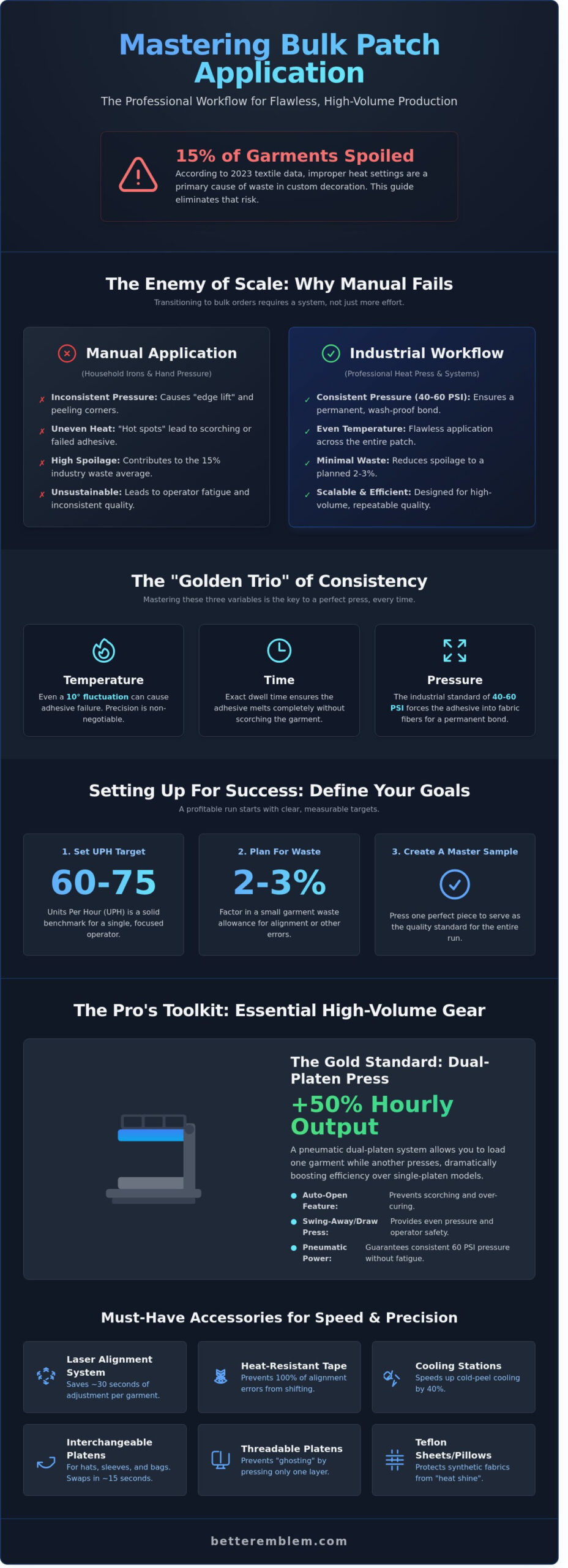
What if a single 10-second mistake could wipe out your entire morning’s profit margin? I’ve seen it happen too often when brands try to scale up their operations. You have 500 premium jackets ready for branding, but the fear of scorching the fabric or dealing with peeling edges keeps you moving at a snail’s pace. We all agree that maintaining consistency is the hardest part of high-volume production. Learning exactly how to apply heat transfer patches in bulk is the only way to protect your investment and your reputation. According to 2023 textile manufacturing data, improper heat settings account for nearly 15% of all garment spoilage in custom decor shops.

I’m here to help you eliminate that waste and master a professional industrial workflow. You’ll learn how to apply hundreds of patches with perfect speed and durability. I’ll walk you through the precise pressure calibrations, cooling techniques, and batch-processing secrets that the pros use to stay profitable. Let’s turn your production line into a fast, hassle-free system that delivers high-quality results every single time. This is bulk production made easy.

主要心得

  • I’ll show you how to move past hobbyist tools and adopt an industrial mindset to ensure every patch in your production run is flawless.
  • Learn the exact workflow for how to apply heat transfer patches in bulk with maximum speed and professional-grade durability.
  • I’ll walk you through the essential gear, like laser alignment systems and digital pyrometers, that takes the guesswork out of high-volume branding.
  • We’ll tackle common quality control issues like edge lift and heat migration so you can stop wasting garments and start scaling.
  • Discover how our woven patches are engineered with consistent adhesive to make your high-speed application process simple and hassle-free.

Why Bulk Application Requires an Industrial Mindset

When you transition from making a few sample hats to managing a full production run, your entire approach must change. I’ve seen many brands treat bulk orders like a series of individual projects, which is a recipe for burnout and inconsistent quality. Learning how to apply heat transfer patches in bulk is about mastering a repeatable system rather than just “pressing a patch.” I’ve found that the “Golden Trio” of Time, Temperature, and Pressure (TPT) is where most mistakes happen. If your temperature fluctuates by even 10 degrees, you risk a failed adhesive bond that won’t survive the first wash.

Consistency is your most valuable asset in a high volume environment. This is especially true when working with materials like 熱轉印乙烯基 (HTV) or heavy embroidered backings. I once helped a local apparel brand reorganize their workflow after they lost 15% of their inventory to peeling. By simply arranging their garments in a “pre-set, press, cool” flow and optimizing their station layout, they reduced their labor time by 40% on a 1,000 unit order. Efficiency isn’t just about speed; it’s about removing the variables that lead to errors.

The Limits of Manual Application

Manual application is the enemy of scale. Your hand cannot provide the 40 to 60 PSI of consistent force required for a permanent industrial bond. This lack of pressure causes “edge lift,” where the patch starts peeling at the corners after a few weeks of wear. Household irons also suffer from “hot spots” where the heating element coils are located, causing uneven melting. If you try to hand-iron 500 自訂補丁, you will end up with inconsistent results and a very sore shoulder. Professional heat presses are mandatory for bulk work.

Setting Your Production Goals

You need to define what success looks like before you turn on the heat. I recommend establishing a Units-Per-Hour (UPH) target to keep your team on track. For a single operator, a UPH of 60 to 75 units is a solid benchmark for quality work. You should also factor in a 2% or 3% garment waste allowance for every bulk run to account for alignment errors. Before you start the main batch, create a “Master Sample.” This confirmed piece serves as the visual and structural standard that every other unit in the 500 piece run must match. Having this benchmark makes it easy to spot when settings start to drift.

Mastering how to apply heat transfer patches in bulk means moving away from guesswork. By treating your workspace like a micro-factory, you ensure that the last garment off the line looks exactly like the first one you pressed.

The Essential Gear for High-Volume Patch Application

Scaling your production requires more than just a basic iron. To master how to apply heat transfer patches in bulk, you need industrial-grade equipment that prioritizes speed and consistency. We recommend a dual-platen pneumatic press as the gold standard for high-volume work. This setup allows you to load one side while the other is under pressure, which can boost your hourly output by 50 percent compared to a single-platen manual press. Manual presses often lead to operator fatigue after 100 applications, resulting in inconsistent pressure. A pneumatic system maintains a steady 60 PSI every single time, ensuring a permanent bond on every garment.

Selecting Your Heat Press

Auto-open features are essential for a busy shop. They prevent you from scorching a 20 dollar hoodie because you were busy unboxing the next set of patches. A swing-away press provides even, top-down pressure that is ideal for thick embroidered patches, while a draw press allows you to pull the work surface toward you. This keeps your hands away from the 350-degree heat. If you’re looking for maximum throughput, dual-platen systems are the clear winner. They turn a one-person job into a high-speed assembly line. Using professional heat-printing techniques with these machines ensures your finished product looks retail-ready every time.

Must-Have Accessories for Speed

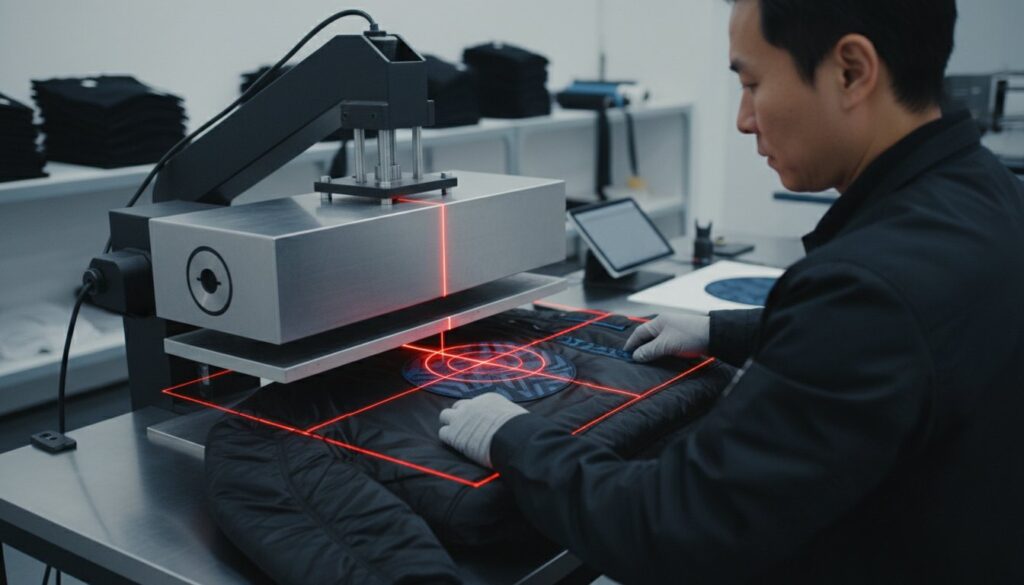
Precision is everything in bulk production. A laser alignment system removes the guesswork. It typically saves 30 seconds of adjustment time per garment, which adds up to hours of saved labor over a large order. For tricky placements like sleeves or hats, interchangeable platens are your secret weapon. You can swap a standard 16 by 20 platen for a cap platen in about 15 seconds. This versatility ensures your branding stays consistent across different product types without needing five different machines.

  • Heat-resistant tape: Use this to keep patches from shifting as you close the press. It prevents 100 percent of alignment errors caused by movement.
  • Cooling stations: If you’re working with cold-peel patches, a dedicated metal surface can speed up the cooling process by 40 percent.
  • Threadable platens: These let you slide the garment over the bottom plate. You only press one layer of fabric, which avoids ‘ghosting’ adhesive through to the back of the shirt.
  • Teflon sheets and pillows: These protect synthetic fabrics from ‘heat shine,’ the glossy mark left by high temperatures.

Small tools make the difference between a messy pile of rejects and a professional production line. You can find the right custom base for your next project at 更好的標誌 to ensure your patches are as high-quality as your equipment. Consistency is the goal, and these tools provide the foundation for a seamless workflow.

The Step-by-Step Bulk Application Workflow

I’ve managed production lines where efficiency was the difference between a profitable day and a massive backlog. When you’re learning how to apply heat transfer patches in bulk, your goal is a repeatable rhythm. Consistency ensures that the 500th garment looks exactly like the first one. We follow a strict five-step process to keep quality high and stress low.

  • Step 1: Pre-heat the garment. Press the fabric for 5 seconds. This removes hidden moisture and wrinkles that prevent a clean bond.
  • Step 2: Calibrate for accuracy. Don’t trust the digital readout on your press alone. I use a handheld pyrometer to verify the platen temperature is within 2 degrees of my target.
  • Step 3: Use an assembly line placement. Avoid eyeballing the center. Use a laser alignment tool or a physical jig to place every patch in the same spot every time.
  • Step 4: Execute the press. Use a “set-and-forget” timer. If your press doesn’t auto-pop, stay focused. A 2-second delay can scorch delicate polyester blends.
  • Step 5: Cool and test. Let the patch reach room temperature before checking the edges. A cold peel is often the secret to a professional, seamless finish.

Calibration and Testing

Your heat press display is a guide, not a law. I’ve found that center-heating elements can be 10 degrees hotter than the corners. Use the “Paper Strip Test” by placing four strips of paper at each corner of the platen. If you can pull a strip out while the press is locked, your pressure is uneven. Always run a 3-garment wash test. Wash them at 104°F and dry them on medium heat to ensure the adhesive holds before you commit to the full batch.

The Station-Based Workflow

Dividing labor is the fastest way to scale. We use a three-station setup to keep the press moving without pauses. It makes the whole process feel hassle-free.

  • Station A (The Loader): This person pre-presses the garment and aligns the patch. They ensure the workflow stays 2 garments ahead of the press.
  • Station B (The Presser): Their only job is operating the machine. They focus on timing and pressure consistency to avoid errors.
  • Station C (The Quality Checker): This person manages the cooling area. They inspect the edges and fold the finished product once it’s safe to handle.

This organized approach minimizes downtime. By treating the application like a professional assembly line, you reduce the risk of ruined garments and maximize your output. It’s about making high-volume branding simple and reliable for your team.

How to Apply Heat Transfer Patches in Bulk: A Brand's Production Guide

Troubleshooting Quality Control at Scale

When I help brands figure out how to apply heat transfer patches in bulk, I always emphasize that speed shouldn’t kill quality. Errors in a small batch are annoying, but errors in a 500-unit run are a disaster. I recommend starting a Reject Log immediately. If your failure rate climbs above 2%, you need to stop the line. This log helps you see if a specific operator, machine, or fabric color is causing the slip-up.

Edge lift is the most frequent issue I see. If the corners of your patch aren’t sticking, it’s usually a battle between pressure and temperature. If the adhesive looks shiny and smooth, your temperature was too low to melt it. If the adhesive is flat but the patch still peels, your pressure wasn’t heavy enough to bite into the fabric fibers. I find that a 10-degree increase often solves the former, while a 5 PSI adjustment fixes the latter.

You also need to watch for adhesive seepage. This happens when you over-press. If glue leaks out the sides, you’re likely using too much heat or staying on the press for 5 seconds too long. On the flip side, heat migration is a unique headache for 100% polyester. The heat turns the fabric dye into a gas, which then bleeds into your patch. If you see your white patches turning pink on a red jersey, you’ve hit the migration point. I solve this by using a lower temperature and a longer dwell time to keep the dye stable.

Common Fabric Challenges

Waterproof or DWR-coated materials are designed to repel everything, including your patch adhesive. I’ve found that a 5-second pre-press helps burn off some of those coatings. For delicate light cottons, scorch marks are a real risk. Use a Teflon sheet to shield the fabric. It’s also vital to remember that 熱轉印 reacts differently than traditional embroidery. These patches are thinner and more sensitive to heat spikes, so they require a softer touch than a heavy merrowed-edge patch.

Maintenance of Your Equipment

Your gear needs a tune-up every 500 cycles to keep things seamless. I check for air leaks in pneumatic systems weekly, as even a 10 PSI drop can lead to inconsistent bonding. Adhesive buildup on your platens is another silent killer. I use a citrus-based cleaner to wipe them down every morning. Finally, replace your silicone bottom pad every 6 months or 1,000 presses. These pads lose their “bounce” over time, which creates cold spots and uneven pressure across your bulk run.

Ready to upgrade your production? Order your custom heat transfer patches today and get the professional results your brand deserves.

How Better Emblem Makes Bulk Application Easier

We know that efficiency is your top priority. When you’re figuring out how to apply heat transfer patches in bulk, even a 2-second delay per unit adds up to over 5 hours of wasted labor on a 10,000-unit run. We solve this by ensuring a 0.1mm tolerance in adhesive thickness across every single patch. This consistency means your heat press settings stay identical from the first garment to the last. You won’t have to stop the line to recalibrate your equipment every hour.

Our 編織補丁 are specifically engineered for high-speed production environments. Unlike thick embroidery that can sometimes trap air pockets, woven patches sit flat and thin. This profile allows for a faster thermal bond and more reliable adhesion. We also customize your backing’s melt-point based on your specific fabric. If you’re working with heat-sensitive 100% polyester, we use a low-melt adhesive that activates at 265°F. This prevents fabric scorching and keeps your reject rate at 0%.

更好的徽章優勢

We use precision laser-cutting to seal the edges of every patch. This prevents fraying during the high-pressure application process. You get all-inclusive bulk pricing, so you won’t see hidden setup fees or digitizing hurdles on your invoice. We also provide a custom TPT (Time, Pressure, Temperature) data sheet with every order. This takes the guesswork out of your setup. It helps you understand how to apply heat transfer patches in bulk without sacrificing quality. Your team can get the production line moving in under 15 minutes.

  • Precision Edges: Laser-cut borders stay crisp even under 60 PSI of pressure.
  • Transparent Pricing: The price we quote is the price you pay, including all shipping and setup.
  • Expert Support: We provide the exact settings for your specific fabric type before you start.

Ready to Scale Your Production?

Scaling from a 100-unit test run to a 10,000-unit seasonal launch is a major milestone. We make that transition seamless by keeping your digital files and physical dies on hand for immediate reordering. You can request a bulk quote through our portal and receive a response within 24 hours. We’re here to help you integrate these patches into your existing fulfillment workflow without any friction. Let’s build your brand together with professional-grade tools that work as hard as you do. Reach out today to start your next high-volume project.

Scale Your Production with Confidence

Scaling your production doesn’t have to feel like a hurdle. We’ve shown you that success starts with an industrial mindset and the right heat press equipment. By standardizing your workflow and implementing strict quality control checks, you can maintain consistency across thousands of units. We’ve been manufacturing high-quality emblems since 1978, so we know exactly what it takes to move from a single prototype to a global rollout.

Our global production facilities are built for rapid OEM delivery, ensuring your brand stays on schedule. Mastering how to apply heat transfer patches in bulk is simple when you have a partner who specializes in heat-activated adhesive backings for all fabric types. We handle the technical details so you can focus on growing your business. Our team is ready to help you streamline your next big run with the same precision we’ve used for over 45 years. This is high-volume branding made easy.

Ready to start your next bulk project? Get a hassle-free quote from Better Emblem today!

Let’s get your production line moving today.

常見問題

What is the ideal temperature for bulk heat transfer patch application?

I recommend setting your heat press between 300°F and 320°F when you need to know how to apply heat transfer patches in bulk for a large order. This specific range ensures the adhesive melts fully into the fabric without damaging the underlying fibers. We usually suggest a 15 second press time at this temperature for optimal results. Always check your specific patch backing first, as 90% of industrial adhesives require 330°F for heavy denim.

Can I apply patches in bulk using a standard home iron?

You shouldn’t use a home iron if you want to learn how to apply heat transfer patches in bulk with professional results. Home irons simply lack the consistent pressure and large surface area needed for runs of 50 or more items. You’ll likely face peeling issues within 3 washes because the heat isn’t distributed evenly. A commercial heat press provides the 40 PSI of constant pressure required for a permanent bond, making high-volume production Made Easy.

How do I prevent ‘heat press marks’ on my garments during a large run?

Use a 0.5 inch thick heat-resistant foam pillow or a Teflon sheet to eliminate scorch marks and pressure lines on your garments. These tools distribute the heat evenly and lift the application area away from bulky seams or zippers that cause uneven marks. Lowering your temperature by 5 degrees and increasing the dwell time by 3 seconds can also protect delicate synthetic fabrics from glazing during a 100 piece production run in your shop.

How long should I wait before testing the adhesion of a freshly pressed patch?

Wait exactly 24 hours before you try to peel or stress-test the edges of a newly applied patch. The adhesive needs this full window of time to cool and set into the garment fibers at room temperature. If you test it within the first 60 minutes, you risk pulling the patch away while the glue is still semi-pliable. This ruins the bond forever and forces you to restart the application process on a new garment.

Do I need a different heat setting for chenille patches vs. woven patches?

You definitely need different settings because chenille patches are significantly thicker than standard woven ones. While a thin woven patch bonds in 12 seconds, a thick chenille patch often requires 20 seconds at 320°F to ensure the heat penetrates. I always recommend pressing chenille from the back of the garment for an extra 10 seconds. This method ensures the heat reaches the adhesive directly through the fabric rather than the heavy yarn pile.

What is the fastest way to align patches on 100+ shirts?

The fastest way to align patches on 100+ shirts is to use a dual-laser alignment system or a custom physical jig. A laser grid lets you hit the exact same spot on every shirt in under 2 seconds without using a measuring tape. If you’re on a budget, a simple T-shirt ruler guide can keep your placement within a 0.125 inch margin of error across your entire bulk order, keeping your branding workflow Made Easy.

How do I know if my heat press pressure is high enough?

Perform the paper test by placing a standard sheet of paper halfway under the heat platen and closing the press. If you can pull the paper out easily, your pressure is too low for a bulk run. You want enough resistance that the paper stays locked firmly in place. Aim for 40 to 60 PSI on a pneumatic press to ensure the adhesive penetrates the fabric weave deeply enough for a long-lasting, professional finish.

Can heat transfer patches be applied to 100% polyester in bulk?

I’ve found that you can apply patches to 100% polyester in bulk, but you must drop your temperature to 280°F to prevent the fabric from melting. Polyester is very sensitive to high heat, so using a 10 second pre-press helps remove moisture before you start the final application. This specific method ensures your patches stay put through 50 or more wash cycles without leaving a shiny heat box or scorch mark around your design.