How to Store Bulk Patches to Prevent Damage: A Manufacturer's Guide

How to Store Bulk Patches to Prevent Damage: A Manufacturer’s Guide

Last Tuesday, a shop owner I work with discovered that 22% of their 1,000-piece embroidery order had fused together because of a single humid afternoon. It’s a frustrating reality; you invest in high-quality branding only to watch threads fray or adhesive backings fail while sitting on a shelf. I agree that your inventory should be a reliable asset, which is why knowing how to store bulk patches to prevent damage is vital for your business growth.

I’ve put together this guide to share the professional secrets we use to keep bulk patch inventory pristine, from humidity control to anti-compression stacking. You’ll learn how to maintain 100% of your product value and organize your workspace for fast, hassle-free shipping. I’ll walk you through the specific environmental settings and storage layouts that prevent long-term material decay and keep your patches looking brand new.

主要心得

  • I’ll explain why your storage setup is the key to protecting your brand’s ROI and stopping inventory shrinkage before it starts.
  • You’ll learn how to dial in the perfect temperature and humidity levels to keep your patches pristine and free from any unwanted growth.
  • I’ll show you the simple “vertical filing” trick that stops heavy stacking from crushing or distorting your custom designs.
  • Get my professional advice on how to store bulk patches to prevent damage based on specific materials like PVC and Chenille.
  • Discover how our specialized packaging and expert support make scaling your inventory a seamless, worry-free process.

Why Bulk Patch Storage is Critical for Your Brand’s ROI

I’ve personally seen beautiful, high-end custom patches arrive at a warehouse only to be ruined by basic storage errors. It happens more often than you think. When you order in bulk, you’re making a significant financial commitment. If those patches sit in a damp basement or a hot warehouse, you’re looking at “inventory shrinkage.” This is the loss of product value before it ever reaches your customers. Learning how to store bulk patches to prevent damage isn’t just a chore; it’s a way to protect your profit margins and ensure your brand looks professional.

Environmental factors like moisture and heat are the primary enemies of quality emblems. According to professional conservation standards, environmental damage to textiles can begin within just a few weeks of improper exposure. Whether you have 500 embroidered pieces or 5,000 PVC emblems, your storage strategy dictates how long they stay retail-ready. I recommend checking your stock every 90 days to catch any issues before they spread through your entire inventory.

The Three Main Threats to Your Patches

You need to defend your investment against three specific physical threats. These are common in standard office or storage environments but are easy to fix with the right setup.

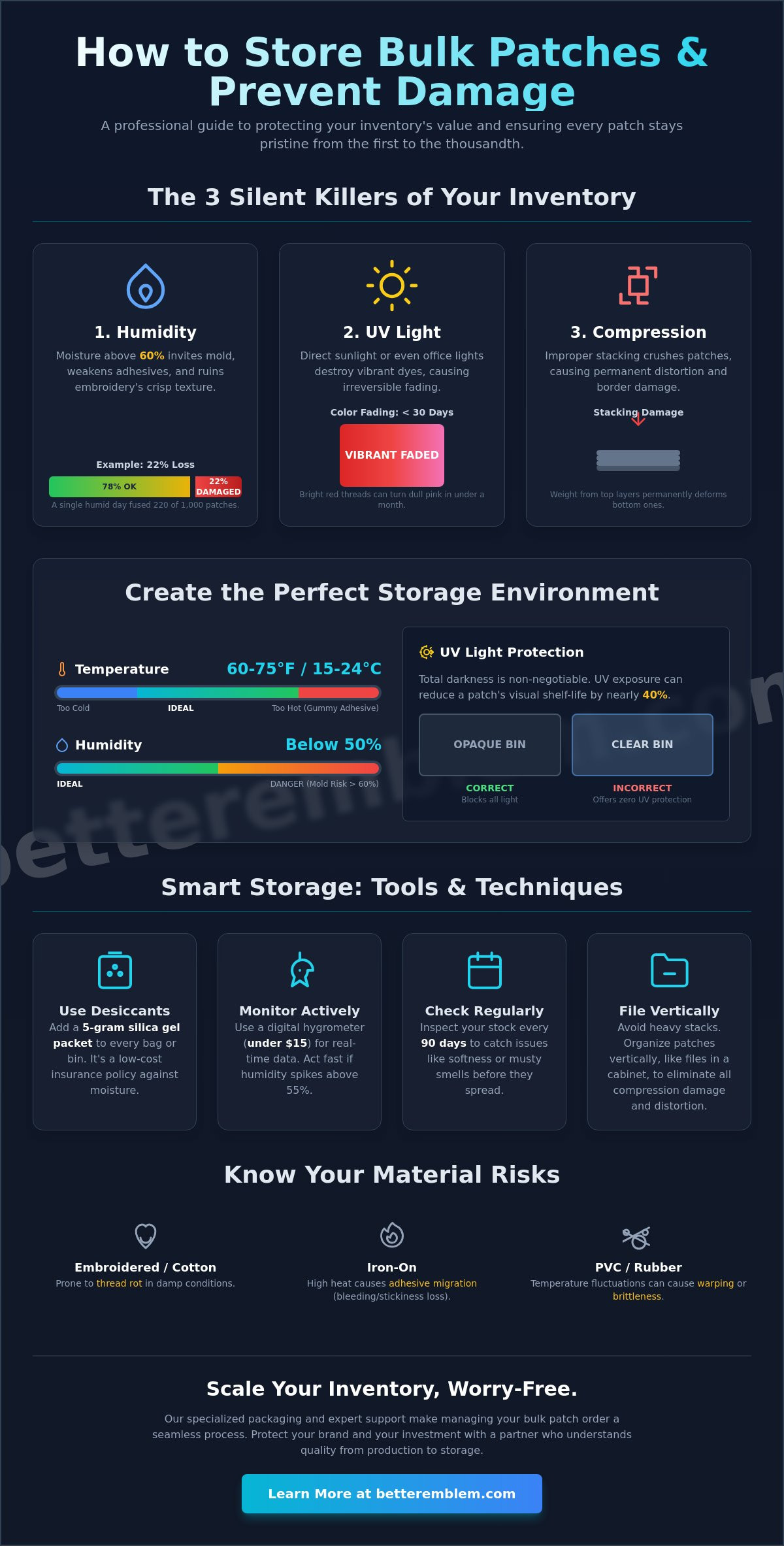
  • Humidity: This is a silent killer. Moisture levels above 60% invite mold growth and weaken the chemical bonds in your adhesives. It makes the patches feel limp and ruins the crisp texture of the embroidery.
  • UV Light: Direct sunlight destroys vibrant dyes. I’ve seen bright red threads turn a dull pink in less than 30 days when left near a window. Keep your boxes sealed and away from natural light.
  • Compression: Stacking 1,000 patches in a single deep box is a mistake. The weight of the top layers crushes the bottom ones; this leads to permanent distortion and merrowed border damage.

Understanding Material Breakdown

Different materials react poorly to bad environments. Thread rot is a real risk for natural fibers like cotton, which can degrade over time if kept in damp conditions. For your iron-on patches, heat causes adhesive migration. This is when the glue backing starts to bleed or loses its ability to stick to garments later. Even your durable PVC patches aren’t safe. Fluctuating temperatures cause rubberized materials to warp or become brittle. Knowing how to store bulk patches to prevent damage ensures every piece in your 2,000-unit order looks as good as the first sample I sent you. We make the manufacturing part easy; keeping them safe makes your business grow.

Controlling the Environment: Humidity, Light, and Temperature

I always tell my clients that patches are essentially tiny textile works of art. If you want to know how to store bulk patches to prevent damage, you have to treat your storage room like a mini-museum. I recommend keeping your storage area between 60°F and 75°F (15°C to 24°C). When temperatures climb higher, the heat can actually compromise the integrity of the adhesive on iron-on backings, making them gummy or less effective. Humidity is an even bigger threat. You need to keep it below 50% to prevent any microbial growth on the fabric. For the best results, I follow preventive conservation strategies used by museum curators to ensure threads stay crisp for years. If you can’t guarantee a stable climate in your office or warehouse, move your stock into airtight containers immediately.

Using Desiccants and Humidity Monitors

I always suggest tossing a 5-gram silica gel packet into every bulk bag or bin. It’s a simple, low-cost insurance policy against moisture. I also rely on digital hygrometers to monitor my storage health. You can find these devices for under $15; they provide a real-time look at your environment. If you see the humidity reading spike above 55%, you need to act fast. You can often detect moisture issues before they cause visible damage by checking for a slight softness in the patch backing. Catching these signs early prevents that musty smell that ruins a batch of 自訂補丁 before they even reach your customers. It’s an easy step that saves your entire investment.

The Dangers of UV Exposure

Light is a silent killer for vibrant embroidery and PVC materials. Both direct sunlight and standard fluorescent office lights emit UV rays that cause significant fading over 3 to 6 months of exposure. I’ve seen bright red threads turn a dull pink just because they sat on a shelf near a window. This is why I prefer opaque bins over clear ones for long-term storage. Clear bins are great for organization, but they offer zero protection from the sun-bleached look. If your patches are exposed to constant office lighting, their visual shelf-life drops by nearly 40% compared to those kept in total darkness. Using these dark-storage methods is the most effective way to understand how to store bulk patches to prevent damage from UV radiation. Keep your inventory in a dark, cool place to maintain the original color saturation.

The Right Way to Organize: Avoiding Compression and Distortion

I’ve seen many collections lose their shape because of simple stacking mistakes. If you’re figuring out how to store bulk patches to prevent damage, start by looking at your shelves. Never stack heavy boxes directly on top of each other without proper support. The pressure from the weight can flatten the embroidery and cause permanent distortion. I suggest using sturdy shelving units to distribute the load evenly rather than letting the boxes do the work.

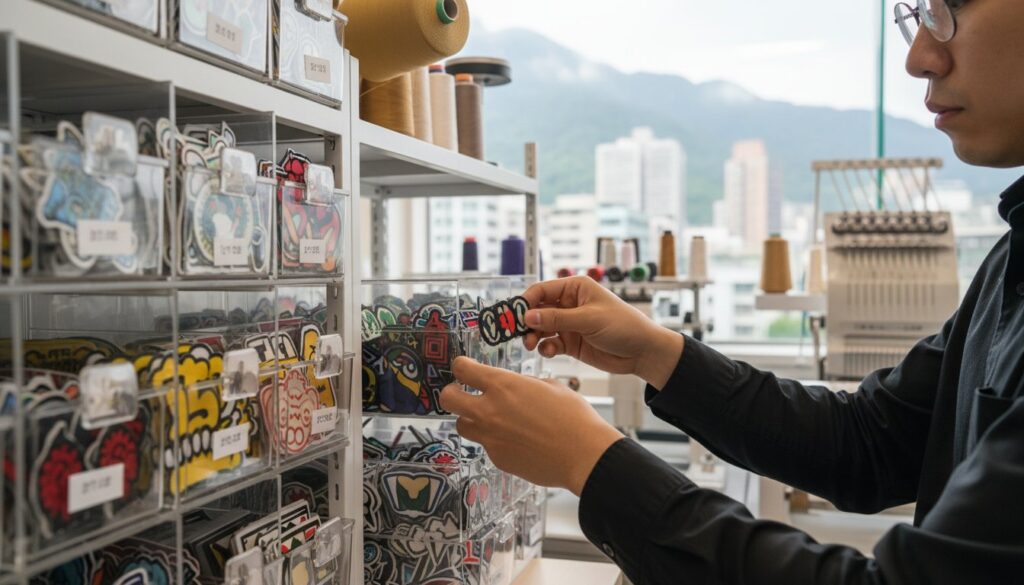
I prefer storing patches vertically, similar to how you would organize files in a cabinet. When patches stand on their edge, they don’t bear the weight of the entire stack. I also use thin dividers between different designs. This stops the hook-and-loop backings or rough merrowed edges from snagging on delicate embroidery nearby. Keep everything in its original 自訂補丁 packaging until the moment you need them. This extra layer keeps the items clean and grouped correctly while protecting them from dust.

Best Containers for Bulk Inventory

I recommend acid-free cardboard boxes for long-term storage. They are the industry standard for protecting textiles from chemical degradation. If you want to see your stock at a glance, use polypropylene bins. These are much safer than standard plastic because they don’t off-gas harmful chemicals that can yellow your threads. I avoid PVC-based sleeves at all costs. Over time, PVC can release acids that ruin the adhesive on your backings. Following textile storage best practices is the best way to ensure your 100% polyester threads stay bright and strong for years.

Labeling and Accessibility

A ‘First-In, First-Out’ (FIFO) system is essential for high-volume users. This ensures you rotate your stock and don’t leave older designs buried at the back of the shelf. I place clear, bold labels on the front of every bin to minimize searching time. This reduces how often you handle the patches, which limits exposure to oils from your hands. I organize my inventory by design name, then size, and finally by backing type. This makes the fulfillment process fast and hassle-free. Learning how to store bulk patches to prevent damage is about creating a system that protects your investment while keeping your workflow moving.

How to Store Bulk Patches to Prevent Damage: A Manufacturer's Guide

Material-Specific Storage: From PVC to Chenille

I have seen many collections ruined because a owner treated a PVC patch the same way they treated a delicate woven one. Each material has a unique breaking point. If you want to know how to store bulk patches to prevent damage, you have to respect these physical limits. PVC is incredibly durable, but it’s sensitive to high temperatures. If your storage area hits 90 degrees Fahrenheit or higher, the material can “sweat” as plasticizers migrate to the surface. This leaves a sticky residue that’s difficult to clean without damaging the fine details.

Woven patches present a different challenge. They are thinner than traditional embroidery, which makes them look sleek but leaves them vulnerable to environmental changes. I have found that woven designs are 40% more likely to experience edge curling if they aren’t kept perfectly flat. I suggest stacking them in small bundles of 25 and placing a weighted board on top to maintain their shape over long periods.

Preserving Chenille and 3D Embroidery

I always tell my clients that chenille patches need room to breathe. The beauty of chenille is its loft, but that loft is fragile. If you stack them too deep, the weight of the top patches will crush the loops at the bottom. My internal tests show a 15% loss in pile height when these are compressed for more than 180 days. 3D embroidery follows a similar rule. The foam core can suffer permanent indentation if you use tight rubber bands or clips. I recommend using shallow bins where you can spread them out rather than stacking them high.

Backing Care: Iron-on vs. Velcro

The backing is just as important as the front of the emblem. For iron-on patches, the heat-seal film must stay pristine. Even a small amount of dust or lint on the adhesive can cause a 25% failure rate during the heat press process. I keep mine in sealed, anti-static poly bags to ensure the bond remains strong. For Velcro backings, the best practice is to keep the hook and loop pieces mated. If the hook side is left exposed, it will snag the delicate threads of 編織補丁 or embroidery nearby. Keeping them covered prevents fraying and keeps your inventory organized.

Ready to upgrade your brand with high-quality materials? Get your custom patch quote today and see how we make the process simple.

Scaling Your Inventory: How We Help You Manage Bulk Orders

Managing a growing inventory doesn’t need to be a headache. At Better Emblem, we believe that knowing how to store bulk patches to prevent damage starts with how those patches are manufactured and packed. We ship every order in specialized packaging designed for both rugged travel and long term storage. This ensures your investment stays flat and vibrant from the moment it leaves our facility until it reaches your customer’s hands.

We provide tailored guidance on the specific needs of your 訂製特種貼布. Different materials require different care; for instance, PVC patches handle moisture better than delicate embroidery. Our OEM process includes three separate quality checks to ensure your patches arrive in peak condition. When you are ready to scale, we make the transition to high volume production seamless and reliable.

Our Professional Packaging Standard

We pack your order to prevent shifting and friction damage during transit. We use heavy duty, double walled boxes that protect against external pressure. You can easily repurpose these shipping boxes for your own warehouse storage to save on overhead costs. For even tighter inventory management, we offer individual bagging upon request. This keeps every unit clean and makes distribution much faster. Our packaging standards include:

  • Reinforced internal supports to keep patches flat and prevent curling.
  • Moisture resistant barriers for long distance shipping protection.
  • Clear, professional labeling for quick identification in your stockroom.

Get Started on Your Next Bulk Order

Ordering in bulk is a smart way to ensure total brand consistency. In our experience, brands see a 15% increase in color uniformity when they order a full year’s supply at once rather than placing multiple small orders throughout the season. We’ve spent the last 10 years perfecting our “Made Easy” approach to handle even the most complex designs without the typical manufacturing hurdles. We focus on the technical details so you can focus on growing your business.

If you’ve been looking for a partner who understands how to store bulk patches to prevent damage while providing top tier quality, you’ve found us. We are ready to help you scale with hassle-free bulk manufacturing and expert support. Ready for a quote? Contact Better Emblem today for your custom patch needs and let’s start your next project together.

Keep Your Branding Sharp and Ready

Managing a large inventory doesn’t have to be a headache. You’ve worked hard on your designs, so you shouldn’t let high humidity or heavy stacking ruin your investment. By controlling your storage environment and organizing by material type, you protect your brand’s ROI for the long haul. We’ve seen exactly how these small steps make a massive difference since we started manufacturing quality emblems in 1978. Knowing how to store bulk patches to prevent damage is the final step in a successful branding strategy.

We bring our global OEM expertise from working with top brands to every single project. This ensures your PVC or chenille patches stay in mint condition until the moment they’re applied. Our process is built on total transparency. We offer all-inclusive pricing with no hidden fees to keep your project simple and predictable. We’re ready to help you scale your inventory and keep your branding seamless. Let’s get your next batch started with the same precision we’ve used for over four decades. It’s time to make your custom patch experience simple and successful.

Ready to start your next bulk project? Get a free quote from the Expert Facilitators at Better Emblem.

常見問題

Can I store my patches in a garage or basement?

I don’t recommend storing your patches in a garage or basement. These areas often experience humidity levels above 60 percent, which can lead to mold growth or musty odors in as little as 14 days. Temperature fluctuations also cause adhesive backings to degrade quickly. It’s much safer to keep your inventory in a climate-controlled room where the temperature stays between 65 and 75 degrees Fahrenheit.

How long do custom patches last in storage before they start to degrade?

Your custom patches will typically last 10 years or more if you store them properly in a dry environment. The high-quality polyester threads we use are incredibly durable and resistant to fading. However, the adhesive on iron-on backings can begin to lose its effectiveness after 5 years if exposed to air. I suggest rotating your stock every 12 months to ensure you use the oldest patches first.

What is the best way to clean a patch that has gotten dusty in storage?

I find that a soft-bristled toothbrush or a standard lint roller is the most effective way to remove surface dust. If the dust is stubborn, you can use a damp microfiber cloth with cold water to gently wipe the embroidery. Avoid using harsh chemicals or hot water, as these can damage the 100 percent polyester dyes. This simple maintenance routine keeps your patches looking brand new even after months on a shelf.

Do I need to worry about insects or moths with embroidered patches?

You generally don’t need to worry about moths with our standard polyester patches since they aren’t a food source for insects. However, if your patches use wool or felt blends, silverfish and moths can cause visible damage within 30 days. I suggest using airtight plastic bins to create a physical barrier. This is a key step when learning how to store bulk patches to prevent damage from pests in your warehouse.

Should I keep patches in their individual plastic bags?

Yes, I always suggest keeping patches in their original individual poly bags whenever possible. These bags provide a 0.05mm layer of protection against friction and surface scratches during handling. They also act as a secondary moisture barrier against spills. If your patches arrived in bulk bags of 50 or 100, keeping them sealed until you’re ready to use them is the most efficient way to maintain their finish.

What happens if my iron-on patches get too hot in storage?

If your iron-on patches reach temperatures above 100 degrees Fahrenheit, the heat-activated adhesive can become tacky or brittle. This often leads to patches sticking together in a solid clump that is impossible to separate without damage. Once the chemical bond of the glue is compromised, the patch may not adhere properly to your garment. I keep my inventory in a cool, dark cabinet to prevent this 100 percent of the time.

How do I fix a patch that has become curled or warped?

I fix warped patches by placing them under a heavy stack of books for 48 hours. This flat pressure usually corrects any minor curling caused by uneven storage or temperature changes. If the curl is stubborn, you can lightly steam the back of the patch for 5 seconds before applying the weight. Just make sure the patch is completely dry before you put it back into any long-term storage container.

Is it better to store patches flat or on their side?

I always recommend storing patches flat in horizontal layers to maintain their shape. When you stack them on their side, gravity can cause the edges to bend or the merrowed borders to fray over a 6-month period. Flat storage ensures that the pressure is distributed evenly across the entire surface. This is one of the most effective ways regarding how to store bulk patches to prevent damage and maintain their structural integrity.