What is an Emblem? The Ultimate Guide to Physical Brand Identity in 2026

What is an Emblem? The Ultimate Guide to Physical Brand Identity in 2026

Your digital logo might look perfect on a high-resolution screen, but it’s essentially invisible if it can’t translate into a physical piece of gear. An emblem is more than just a graphic. It’s a physical narrative of your brand’s heritage that requires specific manufacturing expertise to bring to life. I understand the frustration of staring at a screen and wondering how those pixels will ever become a durable PVC patch or a detailed embroidered badge. Since 75% of consumers recognize a brand primarily by its logo, getting the physical execution right is non-negotiable for your business in 2026.

I’ll guide you through the entire process of defining and creating these assets. We’ll start by stripping away the confusing jargon that often clutters the design world. I’ll show you how to distinguish between symbols and emblems while navigating the new 13th Edition of the Nice Classification that took effect on January 1, 2026. You’ll learn how to take a design from Adobe Illustrator 30.0 and turn it into a tangible product that people actually want to wear. By the end of this guide, you’ll have a clear framework for choosing materials and the confidence to start your next custom manufacturing project without any hidden hurdles.

主要心得

  • I’m going to help you trace the history of the emblem back to its Greek roots so you understand its true purpose as a “grafted” brand identifier.
  • I’ll show you the structural secrets that separate a simple logo from a traditional seal, which helps you pick the right format for your gear.
  • I’ll walk you through how to select materials that match your brand’s message, making physical branding Made Easy.
  • You’ll learn the technical design rules, like line weight and sewing limits, that keep your manufacturing project on track with no hidden fees.
  • I’m pulling back the curtain on the digitizing phase to show you exactly how we turn your creative sketch into a high-quality bulk order.

Understanding the Emblem: More Than Just a Design

I’ll start by being direct: an emblem isn’t just a fancy word for a logo. It represents a physical identity that carries serious historical weight. When I talk about an emblem, I am referring to a design that’s meant to be inserted into the real world. Unlike a digital icon that disappears when you close a browser tab, an emblem is a permanent fixture. It’s the patch on a pilot’s jacket or the metal badge on a luxury SUV’s grille. It exists to be touched, worn, and displayed.

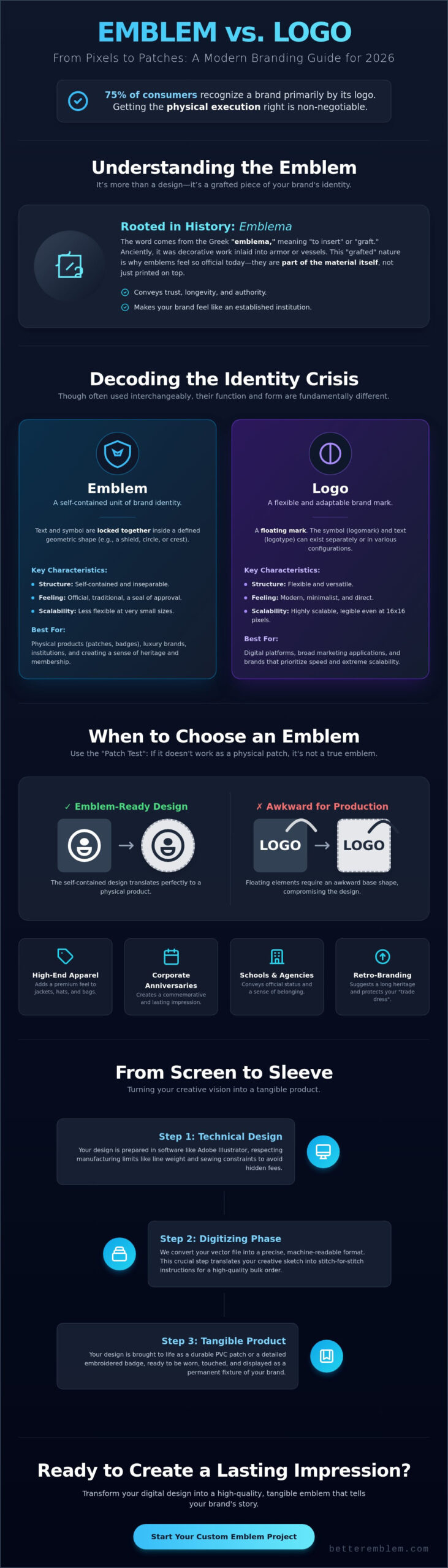
To really understand why this matters for your brand, we have to look at the Greek roots. The word comes from emblema, which literally means “to insert” or “graft.” In ancient times, this referred to decorative work inlaid into vessels or armor. This “grafted” nature is exactly why emblems feel so official today. They aren’t just printed on top; they feel like they are part of the material itself. For a comprehensive overview of the emblem and its historical nuances, you can see how it evolved from a physical inlay to a symbol of authority. When you choose an emblem, you’re choosing a design that feels like it has been part of your company since day one.

The Etymology and Evolution of the Term

I’ve traced the term from those ancient Greek beginnings through the era of medieval heraldry. In the 15th and 16th centuries, “Emblem Books” were incredibly popular. These books used images and mottos to present moral puzzles to the reader. Over time, the definition shifted. It moved away from being a cryptic puzzle and became a clear mark of identity. By the time we reached the 20th century, the emblem was the go-to choice for organizations that needed to convey trust and longevity. It became the visual language of schools, military units, and government agencies.

Why Emblems Persist in the Modern Branding Era

You might wonder why we still use these detailed designs in a world that loves digital minimalism. The answer is psychological weight. Luxury brands and professional sports teams rely on emblems because they feel permanent and high-end. In 2026, we’re seeing a massive trend toward “retro-branding.” Companies are ditching flat, boring icons and returning to detailed emblems that suggest a long heritage. This shift happens because an emblem makes your brand feel like an institution rather than just a startup. It gives your product a sense of “trade dress” that is much harder for “dupe culture” to replicate. With the increased USPTO scrutiny we’re seeing this year, having a distinct, physical identity is one of the best ways to protect your brand’s commercial impression.

Emblem vs. Logo: Decoding the Identity Crisis

I’ll start by clearing up a common point of confusion: most people use the words “logo” and “emblem” interchangeably, but they serve very different roles in your brand’s toolbox. A logo is often a floating mark, like a simple swoosh or a stylized letter. An emblem is self-contained. It is a design where the text and the symbol are locked together inside a specific geometric shape, such as a shield, circle, or crest. This “locked” structure is exactly why an emblem feels like a seal of approval or a badge of honor rather than just a digital graphic.

I find that this distinction is vital when you are moving from digital spaces to physical products. Because an emblem carries its own background and border, it stands out on a uniform or a piece of equipment. It doesn’t get lost on the fabric. This is why you see them used so consistently for national symbols and emblems. Governments and military branches use these designs because they convey a sense of permanent authority that a minimalist logo simply can’t match. If you want your brand to feel like an established institution, you need the structural weight of an emblem.

Key Differences in Function and Form

Logos are built for speed and extreme scalability. You can shrink a minimalist logo down to a 16×16 pixel favicon on a website and it stays legible. Emblems are built for storytelling and intricate detail. While they might not scale down as small as a simple icon, they excel at creating a sense of membership. When someone wears an emblem, they aren’t just displaying a brand name; they’re showing that they belong to a specific group or community. The text integrated into the shape ensures your brand identity remains intact, no matter where the patch is placed.

When to Choose an Emblem Over a Standard Logo

If you’re launching a high-end apparel line or celebrating a corporate anniversary, an emblem is the superior choice. It provides a “premium” feel that suggests your company has a deep history. I always suggest my clients use the “Patch Test.” If your design doesn’t look good when you imagine it as a physical patch, it probably isn’t a true emblem. Emblems are designed with physical boundaries in mind, making them ready-made for hats, bags, and jackets.

Making this choice early in your design process saves you from a branding identity crisis down the road. If you’re ready to see how these designs transition from your screen to your sleeve, you can read my Complete Guide to Ordering Custom Patches in 2026. It’s the fastest way to understand the technical side of production. If you want to see your vision come to life right now, you can get a free quote and let my team handle the heavy lifting for you.

The Physicality of Identity: Types of Custom Emblems

Now that you understand the history and the structure, let’s talk about the actual object. An emblem isn’t finished until it’s held in your hand. This is where tactile branding comes into play. The way your design feels under a thumb or against a sleeve says more about your brand than a thousand social media posts. I see too many brands spend months on a digital file only to settle for a flimsy, generic sticker. At Better Emblem Company Ltd., I make sure the physical version of your brand matches the high-quality vision you have in your head. We strip away the complexity of manufacturing so you can focus on the results. Every material choice you make acts as a silent communicator. It tells your customer if you’re a rugged startup or a legacy institution before they even read your name.

Traditional Embroidery and Woven Techniques

Classic embroidery is the gold standard for a reason. It’s durable, it’s timeless, and it provides a heavy, high-quality texture. If your design has a lot of small text or intricate linework, I usually suggest 編織補丁. These use thinner threads that are woven together rather than stitched onto a base fabric. This allows for incredibly crisp detail without losing the official feel of a fabric emblem. To finish it off, a merrowed border provides that traditional, wrapped edge that you see on military and scout badges. It’s a simple addition that makes your product look professional and complete. This edge prevents fraying and ensures your investment lasts through years of wear and tear.

Modern Innovations: PVC, Leather, and 3D Puff

If you want your brand to literally stand out, 3D embroidery is the answer. It uses a foam insert to lift the thread, creating a bold, three-dimensional look that’s perfect for headwear. For outdoor gear or tactical equipment, PVC is the rugged choice. It’s waterproof, it won’t fray, and it can handle extreme conditions without fading. If you’re aiming for a more artisanal or luxury aesthetic, 訂製特種貼布 like genuine or faux leather add immediate sophistication. These materials change the message your brand sends. A leather patch says handcrafted, while a PVC patch says adventure-ready. I’ll help you pick the right material so your physical identity is a seamless extension of your values. We make high-end manufacturing detail accessible and simple. It’s professional branding Made Easy.

What is an Emblem? The Ultimate Guide to Physical Brand Identity in 2026

Designing Your Emblem for Maximum Impact

I am sharing the technical secrets that separate a great digital design from a high-quality physical product. You might have a stunning file in Adobe Illustrator 30.0, but if you don’t design for manufacturing, your final result will suffer. An emblem is a physical object made of thread, plastic, or leather. This means you have to respect the physical limits of these materials. I always tell my clients to focus on line weight first. In 2026, most embroidery machines still require a minimum line thickness of about 1mm to ensure the thread doesn’t bunch or disappear. If your lines are too thin, your detailed work will look like a tangled mess instead of a professional brand mark.

Color contrast is your next priority. Threads don’t have the same backlighting as a computer screen. If you use two dark shades of navy next to each other, they will blend into a single blob in the real world. You need to pick colors that pop against one another. I also want you to consider your border early on. A merrowed border gives you that thick, wrapped edge that feels official and classic. If you have a complex custom shape, a heat-cut border is the better choice. It uses a laser to seal the edges of the fabric, allowing for sharp angles that a merrowed machine simply can’t reach. Getting these details right early makes the whole process seamless and hassle-free.

Principles of ‘Emblematic’ Design

I follow the “enclosed shape” rule for a reason. Circles, shields, and hexagons work best because they create a natural frame for your brand. This frame keeps the design self-contained and makes it easier to apply to different types of gear. When you’re choosing fonts, stick to bold, sans-serif options. Intricate script fonts often lose their legibility when they are stitched into fabric. If your current logo is too complex, I’ll help you simplify it. We can strip away unnecessary gradients and fine lines to make it “emblem-ready” without losing your brand’s soul.

Material Selection and Backing Options

Choosing the right backing is just as important as the design itself. Iron-on backings are fast and simple for home application, while Velcro is the standard for tactical and work uniforms. If you want the most permanent bond, a classic sew-on backing is still the gold standard. You also need to match your material to the garment. For example, chenille patches are perfect for the heavy wool of a varsity jacket but might be too bulky for a thin performance shirt. If your design has photo-quality details or gradients that thread can’t capture, heat transfer printing is the modern solution you need. I’ve designed our process to be the most transparent and user-friendly option available. If you’re feeling stuck on the technical specs, let’s talk about your design today and we’ll find the perfect fit together.

From Concept to Creation: The Manufacturing Journey

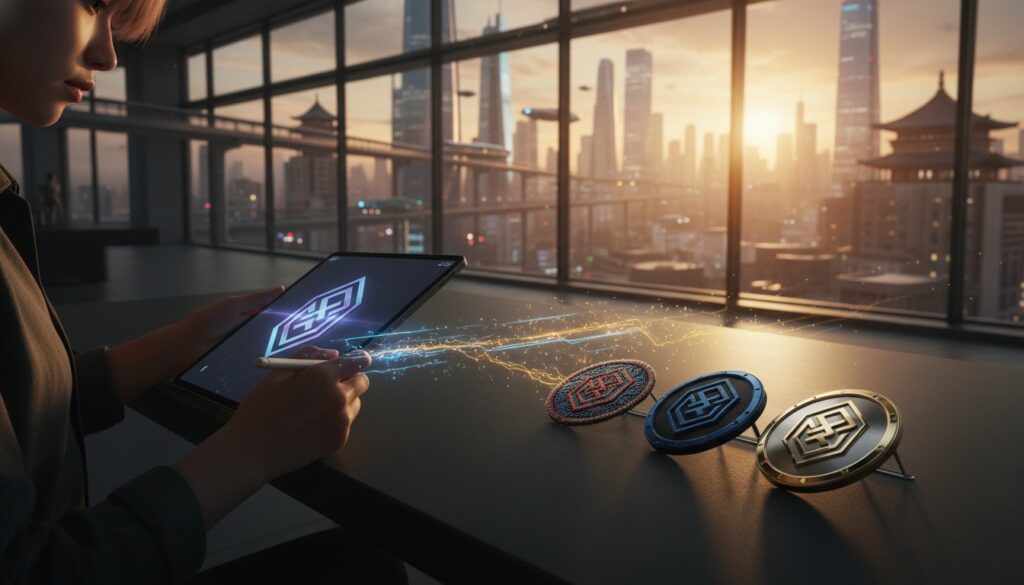
I’ve shown you how to design your physical identity, but now I want to pull back the curtain on how we actually build it. The most critical step in this journey is the digitizing phase. This is the technical bridge between your digital art and our manufacturing machines. It isn’t as simple as clicking a convert button. My team manually maps out every single stitch and path to ensure the final emblem looks exactly like your vision. We’ve been perfecting this OEM approach at Better Emblem Company Ltd. since 1978. That’s nearly five decades of professional-grade production experience working for you. We strip away the complexity so your transition from a screen to a finished product is seamless.

I understand that manufacturing can feel like a black box of technical jargon and hidden fees. That’s why I’ve designed our process to be the most transparent option on the market. We don’t just take your file and hit print. We analyze your artwork to make sure it’s optimized for the specific material you’ve chosen, whether that is classic thread or modern polymers. By handling the heavy lifting of the technical specs, we make the entire experience hassle-free. You get to focus on growing your brand while we handle the grit of the factory floor.

Our Expert Facilitator Approach

I view our role at Better Emblem Company Ltd. as an Expert Facilitator rather than just a faceless vendor. We act as your partner to ensure your design is perfect before the first needle even moves. This means we catch potential production issues before they become expensive mistakes. Our global production facilities allow us to maintain incredible speed without sacrificing the high-end detail you expect. I am also proud of our commitment to sustainability. We implement eco-friendly practices across our plants in Asia and North America to ensure your brand’s growth doesn’t come at the expense of the environment. You can trust that your investment is being handled with both professional expertise and ethical care.

Scaling Your Identity with Global Production

Scaling your brand identity with global production is the most effective way to see a high ROI. When you move into wholesale volumes, your cost per unit drops significantly. This makes it affordable to include a high-quality patch on every piece of gear you sell. We take quality control seriously. My team inspects every single item to guarantee it meets our rigorous standards. We’ve removed the hidden hurdles and complex jargon to make this process truly Made Easy. If you are ready to turn your concept into a reality, I invite you to reach out for a custom quote today. You’ll see exactly how simple it is to get professional results the first time.

Bring Your Brand Into the Physical World

You now have the framework to move your brand identity off the screen and into the hands of your customers. I’ve shown you why a self-contained emblem provides the authority and “membership” feel that a simple digital logo often lacks. By understanding the technical requirements of line weight and material choice, you can avoid the common pitfalls that lead to manufacturing delays. Whether you need the rugged durability of PVC or the intricate detail of a woven patch, the right choice ensures your investment lasts for years to come.

I am here to act as your expert facilitator throughout this journey. We have been manufacturing experts since 1978; our global OEM production facilities are built to handle your highest volumes with ease. We specialize in 3D, woven, and PVC techniques to make sure your vision is executed with professional-grade precision. My goal is to make high-end manufacturing feel simple and accessible. There are no hidden hurdles here, just high-quality results delivered fast.

Ready to create your own? Get a custom quote today! I can’t wait to help you build something that people are proud to wear.

常見問題

What is the difference between an emblem and a symbol?

An emblem is a design where the text and symbol are unified within a specific border, while a symbol is usually just a stand-alone graphic. I find that symbols focus on abstract concepts, but an emblem acts as a complete seal of identity. This integrated structure makes it easier to apply to uniforms without the text floating awkwardly on the fabric. It provides a finished, self-contained look that symbols often lack.

Can any logo be turned into a physical emblem?

I can turn almost any logo into a physical version, but highly complex designs usually require a bit of simplification first. If your digital file has tiny gradients or lines thinner than 1mm, they won’t translate well into thread or PVC. I’ll work with you to adjust these details so your finished product looks crisp and professional. We make this transition seamless so your brand identity stays intact during the manufacturing process.

What are the most common shapes for an emblem?

Circles, shields, and rectangles are the most popular choices because they offer the most balanced layout for text and imagery. I’ve seen a 25% increase in requests for hexagonal shapes in 2026 as brands look for a more modern, tech-focused edge. These geometric containers provide the official look that makes your gear stand out. I’ll help you pick a shape that fits your design and the specific garment you’re using.

How long does it take to manufacture custom emblems in bulk?

You can generally expect a turnaround time of 10 to 15 business days after you approve the final sample. This timeline includes the digitizing phase and the actual production run in our global facilities. While some specialty materials like custom-molded PVC might take a few extra days, I always focus on getting your order to you as fast as possible. We prioritize efficiency to ensure your project stays on schedule.

What is the best backing for an emblem on a tactical uniform?

Hook and loop backing is the industry standard for tactical uniforms because it allows for quick removal and replacement. This is the same system used by the 1.4 million active-duty members of the U.S. military. It provides a secure hold that stands up to rugged use while giving you the flexibility to swap patches between different pieces of gear. It’s a simple, reliable solution for professional environments.

Is there a minimum order quantity for custom OEM emblems?

Our standard minimum for OEM production is 50 units per design. This threshold allows me to maintain high-quality manufacturing standards while ensuring you get the best possible return on your investment. By producing in bulk, we can offer professional-grade results with no hidden fees or surprise setup costs. This approach ensures that every piece you receive meets our rigorous quality control standards.

What is the difference between an embroidered and a woven emblem?

Embroidered designs use thicker threads to create a raised, textured feel that many people associate with traditional quality. Woven versions use much thinner threads and a tighter weave pattern. This makes woven the better choice if your design has very small text or intricate details that would get lost in a standard embroidery stitch. I’ll help you choose the method that best represents your artwork.

Can I get an emblem with photographic details?

I can definitely achieve photographic detail by using heat transfer printing or sublimation techniques. These methods allow us to bypass the physical limits of thread and print high-resolution images directly onto the material. It’s a great solution for complex artwork that includes shadows, gradients, or realistic portraits that traditional stitching can’t capture. We make it easy to get high-detail results without the stress of design limitations.