
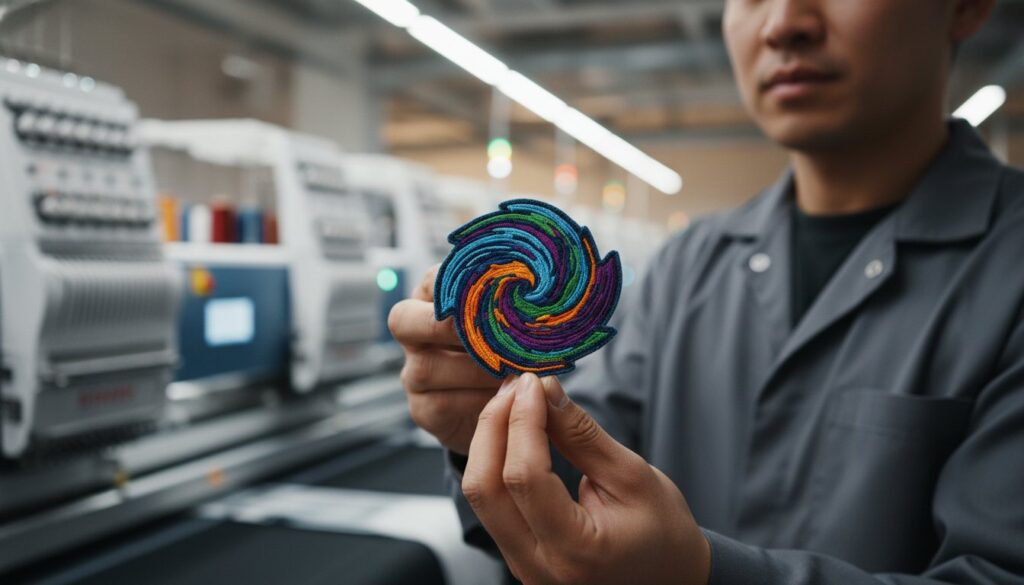
Why does ordering 50 custom patches sometimes feel like a bigger financial headache than ordering 500? I know the frustration of looking at a quote and seeing “under-minimum” fees that seem to come out of nowhere. It is confusing when one style requires 10 pieces while another demands 50, leaving you worried about over-ordering and getting stuck with dead stock. Understanding minimum order quantities for custom patches is the first step toward taking control of your brand’s production costs. I have seen these hurdles from the inside, and I want to help you clear them with confidence.
I am going to pull back the curtain on why these MOQs exist and show you how to leverage them to get the best possible price for your brand. We will explore the technical reasons behind machine setup times and how different materials, like leather or 3D embroidery, change the math. I will also give you a roadmap for hitting better price tiers without cluttering your storage room with items you don’t need. By the end, you will know exactly how to turn a manufacturing requirement into a strategic advantage for your business and find a reliable partner for the long haul.
الوجبات الرئيسية
- I’ll share the “Setup Story” so you can see exactly how your digital art transforms into a physical patch and why this step determines your baseline volume.
- Master the logic of understanding minimum order quantities for custom patches by comparing how different styles, from 3D embroidery to leather, impact production.
- I’ll show you how the “Price Break” phenomenon works so you can get more value out of every dollar by hitting higher volume tiers.
- Discover four pro tactics I’ve seen brands use to consolidate designs and reach better pricing without the fear of holding dead stock.
- Learn how the direct-to-factory approach at Better Emblem Company Ltd. strips away middleman markups to help you scale your brand with total transparency.
What Is an MOQ and Why Do I Require It? The Setup Story
I often get asked why I can’t just make one or two patches for a project. I understand the request, but I view a Minimum Order Quantity (MOQ) as the baseline required to make a production run economically viable for both of us. Understanding minimum order quantities for custom patches starts with a look at the factory floor. This concept is rooted in the Economic Order Quantity (EOQ); it’s a standard manufacturing principle that helps balance setup costs with order volume to keep your per-unit price low. Without these minimums, the initial labor would make a single patch cost more than a high-end jacket.
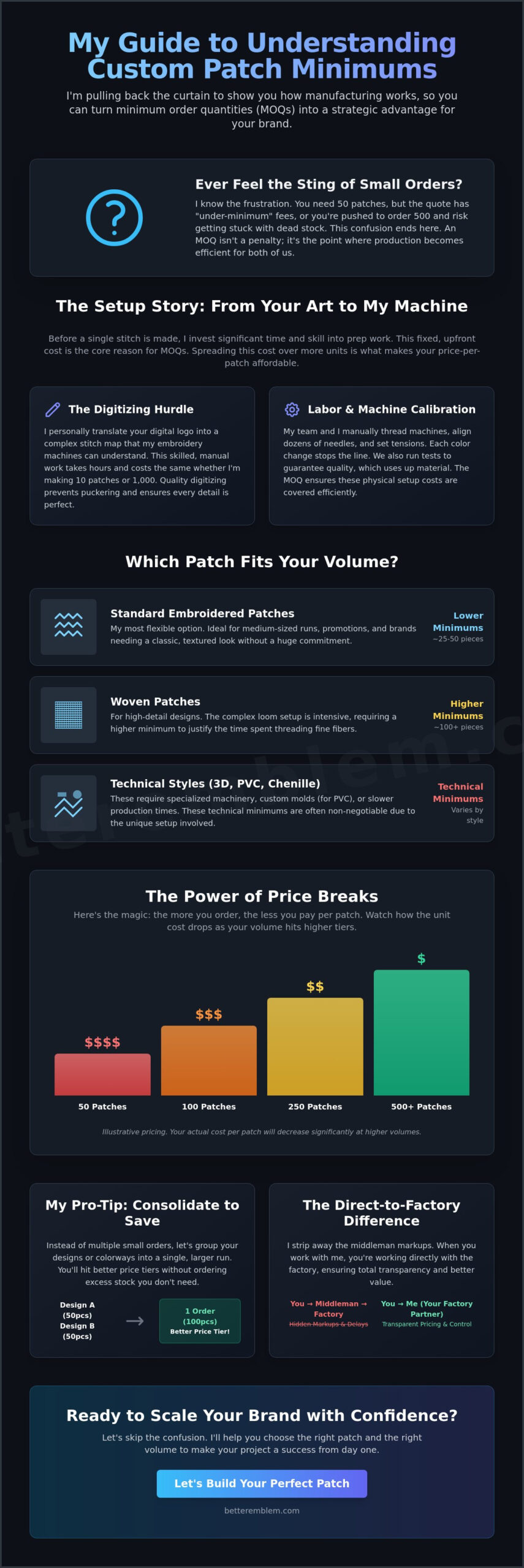
The “Setup Story” is the journey from your digital art file to a physical embroidery machine. It isn’t as simple as hitting “print.” I spend hours preparing the machinery and the software before the first needle even moves. When I set an MOQ, I’m ensuring that these fixed preparation costs are spread across enough units to make your investment make sense.
The Digitizing Hurdle
I explain digitizing to my partners as creating a highly detailed map of stitches. Your logo doesn’t naturally speak the language of an industrial embroidery machine. I have to manually translate your lines, colors, and gradients into specific needle paths and jump stitches. This is professional manual labor, and the cost is the same whether I am making one patch or 1,000. High-quality digitizing is what ensures your logo doesn’t “pucker” or lose its fine details during production. If I rushed this one-time labor cost for a tiny order, the quality would suffer, and the price would skyrocket. By hitting the MOQ, you ensure this technical groundwork is covered efficiently.
Labor and Machine Calibration
Understanding minimum order quantities for custom patches also involves the physical labor of machine calibration. I walk my team through the process of threading industrial looms, which is particularly intense for رقع منسوجة. We don’t just click a button; we manually set thread tension and align dozens of needles. Changing a single thread color requires stopping the entire production line, which is why small, varied orders are so difficult to manage. There is also the reality of “waste” material. Every initial machine test run generates a certain amount of scrap fabric and thread while we dial in the settings. I use these test runs to guarantee perfection, but that material cost must be accounted for in the minimum order volume.
Comparing MOQs Across Patch Styles: Which One Fits Your Volume?
I have found that different materials dictate different minimums based on the specific tooling and machine time required for each. While I aim to keep things simple, the physical reality of the factory floor means a woven label and a PVC patch have very different “starting lines.” Understanding minimum order quantities for custom patches requires looking at the technical needs of each style. For example, embroidered patches are often the most flexible option for medium-sized runs because they use standard needles and threads that are quick to calibrate. However, if you move into high-detail woven patches, the looms are much larger and more complex. These high-detail looms usually require a 100-piece minimum just to justify the hours spent threading the fine warp and weft fibers.
Standard vs. Technical Minimums
I often explain to my partners that some styles have “technical minimums” that are impossible to bypass. Take تطريز ثلاثي الأبعاد as an example. This style requires significantly more machine time because the needles must move slower and more precisely over the foam inserts to create that iconic “pop.” This increased production time naturally affects the MOQ. PVC patches present a different hurdle: the mold fee. Unlike thread-based designs, PVC requires a custom-carved metal mold. This is a major part of understanding your expenses when launching a new product line. I also manage ترقيع مخملي, which use specialized loop-stitch machinery. Because these machines are dedicated to a specific texture, they have their own unique setup requirements that differ from standard flat embroidery.
Matching Your Brand Goals to the Right Material
I suggest choosing embroidered patches for smaller, high-impact promotional events where you need speed and flexibility. They offer a classic look and are easier to produce in lower volumes. If you are an apparel brand needing consistent, high-volume labels that lay flat against a garment, I recommend woven patches. The higher 100-piece minimum is offset by the professional, thin profile that won’t irritate the wearer. For photo-realistic designs or gradients that simply don’t work as embroidery, choosing heat transfer or sublimation is your best bet. These methods allow for infinite color detail without the same needle-path restrictions. If you are feeling stuck on which path to take, I can help you look through our custom patch styles to find the perfect fit for your current goals.
Specialty styles like bullion or leather also have their own rules. Bullion is hand-stitched with wire, meaning the labor is intense but the machine setup is minimal. Leather patches, on the other hand, often involve laser engraving or heat debossing, which requires its own set of calibration steps. By matching your design to the right manufacturing method, you can hit your volume goals without overspending on unnecessary stock.
The Economics of Patch Production: Setup Fees and Price Breaks
I want to show you how a $55 setup fee essentially disappears when you order at higher volumes. Understanding minimum order quantities for custom patches is ultimately an exercise in simple math. It’s all about the concept of Economies of scale. When I spread a fixed setup cost across 500 units, it adds mere cents to each patch. If you only order 10, that same fee adds dollars to every single piece. This creates what I call the “Price Break” phenomenon. I’ve often seen situations where ordering 200 patches costs nearly the same as ordering 100 because the production efficiency offsets the material cost.
My goal is to help you calculate your landed cost per unit so you can protect your margins. You might see “No Minimum” shops online, but I’ll be honest with you. Most of those are just middlemen with massive markups. They buy from factories and hide the setup costs inside an inflated unit price. You end up paying more for less, which is exactly what I want to help you avoid. By working directly with a manufacturer, you see exactly where your money goes.
Understanding the Under-Minimum Fee
I explain this fee as a direct way to cover the technician’s time on small runs. It takes just as long to calibrate a machine for 10 patches as it does for 1,000. I am transparent about these costs rather than hiding them in the unit price. You can tell if an “under-minimum” fee is a profit-padding trick if it doesn’t correlate to the complexity of the work. A real manufacturer’s fee reflects the actual hours spent on your specific design and the manual labor required to set up the production line.
Tiered Pricing and Your ROI
I break down typical price tiers into manageable steps: 50, 100, 500, and 1,000+ pieces. The jump between 50 and 500 pieces is where the real magic happens for your budget. I’ve seen brands cut their unit cost by 60% just by planning their inventory ahead of time. I always advise you to look at your total annual needs before placing an order. If you know you’ll need 500 patches over the next year, ordering them all at once gives you a much better return on investment than five separate small orders. It’s the smartest way to scale your brand without wasting capital on repeated setup fees.
Pro Strategies to Navigate MOQs and Scale Your Brand
I have seen smart brands use four specific tactics to beat the MOQ hurdle and maximize their budget. Understanding minimum order quantities for custom patches doesn’t have to be a barrier to your growth. Instead, you can use these requirements as a roadmap for efficient scaling. By thinking like a manufacturer, you can unlock better pricing tiers without drowning in excess stock. It is all about being intentional with your designs and your timeline.
One of the most effective methods is the “Stockpile” strategy. I always suggest ordering your core logo in bulk. While seasonal designs might change, your primary brand emblem is a constant. Ordering a two-year supply of your main logo allows you to hit the 500 or 1,000-piece price breaks. This significantly lowers your per-unit cost compared to ordering small batches every few months. You save on repeated setup fees and ensure you always have branding ready for new merchandise.
Consolidating Your Orders
I show my partners how to combine different patch shapes into one production window. If you have three different designs that use the same thread colors, I can often group them to save on setup time. Using common thread colors across your entire collection is a pro move. It reduces the need for machine stops and recalibration, which helps me pass those efficiency savings on to you. I love working with brands that plan their seasonal drops in one go. When you submit your spring and summer designs together, we can look at the total volume to find a better price point for the entire project.
Inventory Planning for Longevity
I explain to every client that a patch doesn’t “expire.” It is the perfect item to stock because it takes up very little space and stays relevant for years. When you are calculating the cost of “holding” inventory, compare it to the cost of re-ordering and paying multiple setup fees. Usually, the bulk discount far outweighs the storage cost. To keep your investment safe, I recommend storing patches in a cool, dry place away from direct sunlight. This ensures the adhesive on iron-on backings stays fresh and the thread colors remain vibrant for years to come.
You should also design for efficiency to avoid specialty machine fees. Avoiding overly complex borders or excessive color counts can keep you in a more affordable production tier. If you want to see how your current designs can be optimized for better pricing, you can طلب عرض أسعار مخصص and I will help you find the best path forward.
By mastering these strategies, you turn understanding minimum order quantities for custom patches into a competitive advantage. You aren’t just buying a product; you are managing a supply chain that supports your brand’s long-term health.
How I Help You Scale: Better Emblem Company Ltd.’s Partner-First Approach
Since 1978, I have spent my career perfecting the balance between high-end quality and production volume. My mission is to act as your partner, not just a vendor. Understanding minimum order quantities for custom patches is much easier when you work with someone who values your time and budget. Because I operate a direct-to-factory model at Better Emblem Company Ltd., I eliminate the middleman markups that usually drive up costs. This transparency allows you to invest more in your brand’s growth and less in unnecessary fees.
I take my role as your consultant seriously. If a specific design choice is pushing you into a higher price bracket, I will highlight it immediately. My goal is to ensure you aren’t overpaying for your designs. I provide a professional OEM service that focuses on efficiency and reliability. You get the benefit of my decades of industry knowledge without the stress of hidden hurdles. I’ve built this business on the idea that manufacturing should be a smooth, frictionless experience for every creator.
From Taiwan to the World: Our Global Production
Our journey started in Taiwan, and we have expanded our facilities across Asia and North America to meet global demands. Our 45+ years of experience means my team and I have solved nearly every MOQ challenge you can think of. We have the technical expertise to handle complex 3D embroidery or high-detail woven labels at scale. I have also built a complete guide to ordering that simplifies the entire manufacturing journey for you. It’s designed to remove barriers and get your products moving faster through the production line.
Ready to Start Your Bulk Order?
I invite you to reach out for a custom quote that fits your specific brand requirements. We don’t use generic pricing models because your brand isn’t generic. To ensure you are 100% satisfied with the final result, we often handle sample runs before moving into full production. This step confirms the stitch quality and color accuracy meet your exact standards. I am here to help you navigate the technical side of manufacturing so you can focus on your creative vision. Let’s discuss your project and find the right MOQ for your brand today.
Scale Your Brand with Confidence and Clarity
I have shown you that MOQs aren’t just arbitrary hurdles. They are technical reflections of the labor and calibration required to make your vision a reality. By mastering the logic behind these numbers, you can stop worrying about “under-minimum” fees and start using price breaks to your advantage. Understanding minimum order quantities for custom patches is about more than just hitting a number; it is about building a sustainable supply chain that supports your brand’s long-term growth.
I have been perfecting this balance of quality and volume since 1978. When you work with me, you get direct OEM pricing with no hidden middlemen markups to eat your margins. I also include expert digitizing in every professional bulk run to ensure your logo looks sharp on every single piece. I am ready to help you navigate these technical details so you can stay focused on the creative side of your business. Request a wholesale quote from our experts today. Your brand’s success is my priority, and I can’t wait to see what we build together.
الأسئلة المتداولة
What is the standard minimum order quantity for custom patches?
Standard MOQs typically range from 10 to 50 pieces depending on the patch style and the specific production requirements. While some retail shops offer smaller quantities, a volume of 50 is often where you start seeing the real benefit of professional production efficiency. This baseline ensures that the labor of digitizing and machine calibration is spread across enough units to keep your costs manageable.
Why do some patch makers claim to have “no minimum”?
Shops that claim “no minimum” are often retail middlemen using small-scale hobbyist machines rather than high-capacity industrial looms. They usually hide the setup costs inside a much higher unit price to make the low-volume order profitable for them. While this works for a single gift, it isn’t the best path for brand owners who need consistent quality and professional-grade durability.
Can I split my MOQ between two different designs or colours?
You generally cannot split an MOQ between different designs or colors because each variation requires a unique machine setup. Every time I change a thread color or a design file, the production line must stop for manual recalibration. If you need multiple variants, it’s best to treat each as its own production run to ensure the highest level of detail and color accuracy.
What is an “under-minimum” fee and how much does it usually cost?
This fee is a flat charge applied to small orders to cover the technician’s time for machine setup and digitizing. Since preparing an industrial machine takes the same amount of time for 10 patches as it does for 500, this fee ensures the technical labor is compensated. I prefer being transparent about this cost rather than inflating your per-patch price to hide the expense.
Do woven patches have higher minimums than embroidered ones?
Woven patches typically have higher minimums, often starting at 100 pieces, because the high-detail looms are more complex to thread. Embroidered patches use standard needles and are quicker to set up, which allows for more flexibility in smaller runs. Understanding minimum order quantities for custom patches means recognizing that the complexity of the machinery directly dictates the starting volume for each style.
How much can I save by increasing my order from 50 to 200 patches?
You can often cut your per-unit cost in half by increasing your order from 50 to 200 patches. This happens because the fixed setup and digitizing costs are spread across four times as many items, triggering a significant price break. Bulk order savings are a core part of understanding minimum order quantities for custom patches, as it allows you to maximize your brand’s budget.
Is there an MOQ for re-ordering the same design later?
Most re-orders still carry an MOQ because the physical machine setup must be repeated for every new production window. Even though your digital file is already finished, I still have to thread the looms, set the needle tension, and run test samples. However, you often save on the initial digitizing labor, which makes re-ordering your core designs much more efficient over time.
Does the size of the patch affect the minimum order quantity?
Patch size generally does not change the MOQ, but it does impact the machine time and the amount of material used. A very large back patch takes much longer to stitch than a small sleeve emblem, which will be reflected in the unit price rather than the minimum quantity. Whether the patch is two inches or ten, the technical setup time for the machine remains the same.