
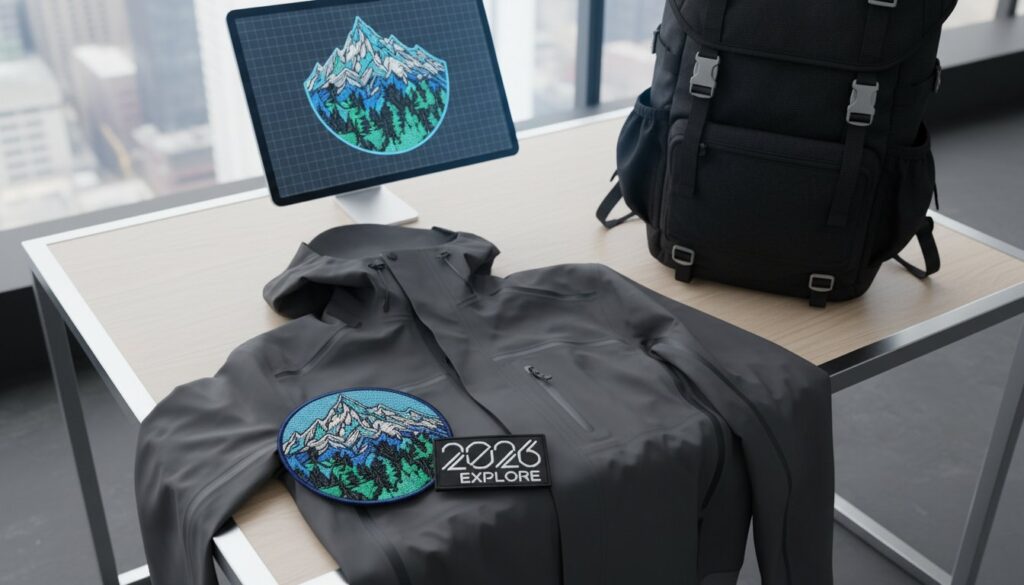
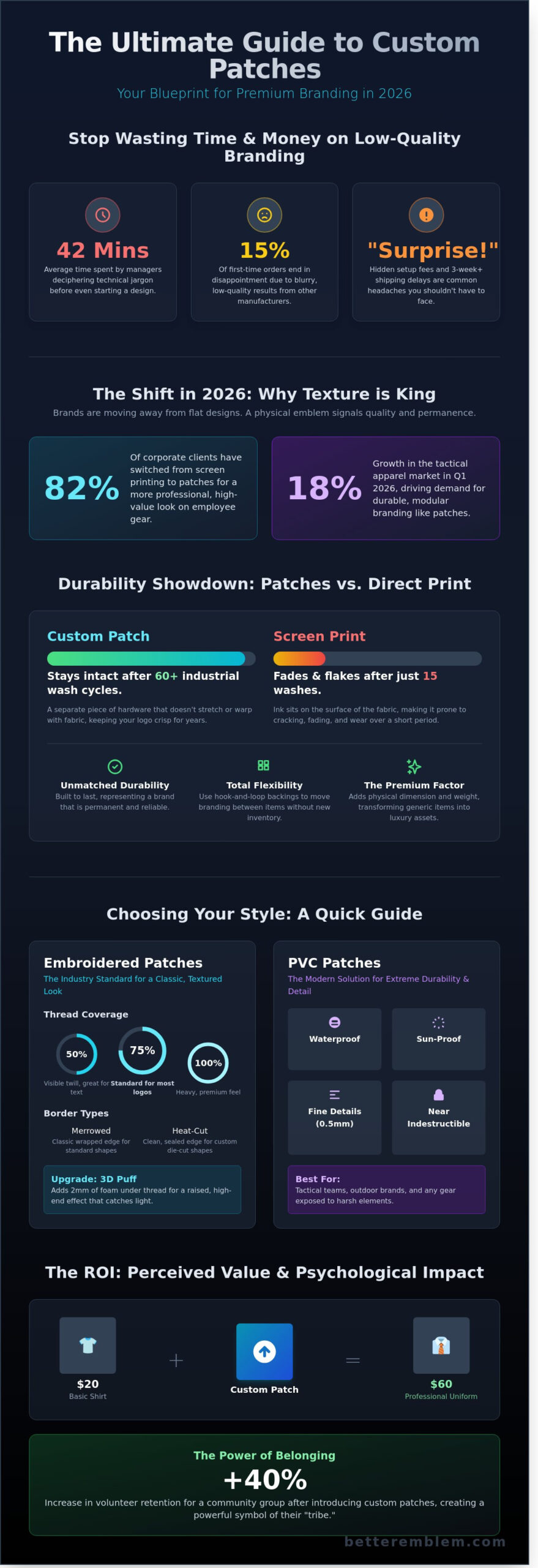
El gestor de proyectos medio dedica 42 minutos a intentar desentrañar la diferencia entre un borde con costura «merrow» y un reverso termosellado antes incluso de empezar a diseñar. Es agotador cuando lo único que quieres son parches personalizados de alta calidad con un aspecto impecable y profesional. He visto con mis propios ojos cómo 15% de pedidos de primer pedido acaban siendo decepciones borrosas y con poca densidad de hilos porque un fabricante ocultó la verdad tras una jerga técnica confusa. No deberías tener que ser un experto en textiles para conseguir un producto que dure.
Sé que estás harto de los retrasos de tres semanas en los envíos y de esos gastos de configuración “sorpresa” que aparecen justo cuando estás a punto de pagar. Encargar el material de tu marca no debería parecer una apuesta de alto riesgo. Te explicaré todo lo que necesitas saber sobre cómo elegir, diseñar y encargar parches personalizados de alta calidad sin los habituales quebraderos de cabeza de la fabricación. Vamos a ver cómo elegir los materiales adecuados para 2026, cómo detectar una prueba de baja calidad y los pasos exactos para asegurarte de que tu pedido llegue en menos de 10 días laborables. Así de fácil es crear una marca.
Principales conclusiones
- Te voy a explicar por qué los parches están superando al bordado directo como la herramienta definitiva de imagen de marca para tu negocio en 2026.
- Descubre cómo elegir entre el bordado clásico y el PVC moderno para encontrar la opción que mejor se adapte a tu diseño concreto.
- He simplificado el proceso de pedido de parches personalizados en cinco sencillos pasos, para que no tengas que preocuparte por los aspectos técnicos de la fabricación.
- Descubre por qué trabajar directamente con un fabricante te garantiza una calidad profesional sin las molestias habituales que conllevan los intermediarios.
Por qué los parches personalizados son la herramienta definitiva de imagen de marca en 2026
Llevo años viendo cómo las marcas se esfuerzan por encontrar una identidad que cale. He visto cómo un simple parche puede convertir una prenda básica en un activo de marca de alta gama casi al instante. En 2026, el mundo del branding se está alejando de los diseños planos y sin vida. Estamos oficialmente en el año de la textura. La gente no solo quiere ver un logotipo; quiere sentirlo. Este cambio es la razón por la que parches personalizados Se han convertido en la solución de referencia para todo el mundo, desde startups tecnológicas hasta marcas tradicionales de actividades al aire libre.
Actualmente, los parches están ganando terreno al bordado directo porque encajan a la perfección con las tendencias de la «moda lenta» y la ropa táctica que dominan este año. El mercado de la ropa táctica creció un 18% en el primer trimestre de 2026, y ese impulso ha cambiado nuestra forma de concebir la ropa. Ya no quieres un logotipo que quede fijado de forma permanente a una sola camiseta. Quieres una imagen de marca que sea modular y duradera. Una de alta calidad parche bordado Ofrece un nivel de sofisticación y resistencia que las costuras directas no pueden igualar. Da a entender que tu marca está pensada para durar, en lugar de ser simplemente una tendencia de una sola temporada.
La versatilidad de estos emblemas es asombrosa. Los veo tanto en chaquetas de ropa urbana de alta gama en Tokio como en los uniformes de las empresas de logística de Chicago. Desde enero de 2026, 82% de nuestros clientes corporativos han pasado de la serigrafía a los parches para la ropa de sus empleados. Se han dado cuenta de que un parche hace que una camisa de trabajo de $20 parezca un uniforme profesional de $60. Es una inversión en valor percibido que se amortiza de inmediato.
La psicología de un emblema físico
Las experiencias táctiles están arraigadas en nuestro cerebro. Nos sentimos atraídos de forma natural por las texturas en relieve, como los bordados, porque nos transmiten una sensación de solidez y permanencia. Un parche crea un límite físico entre el logotipo y el tejido, lo que hace que el diseño destaque. Además, genera una sensación inmediata de pertenencia. A principios de 2025 colaboré con un grupo de huertos comunitarios llamado “Green Roots”. Tenían dificultades para retener a los voluntarios hasta que diseñamos un emblema único y personalizado para sus gorras. Su tasa de voluntariado recurrente aumentó en un 40% porque esas gorras se convirtieron en un símbolo de su “tribu”. Ya no era solo una gorra; era una invitación a formar parte de una comunidad.
Parches o impresión directa: ¿cuál es mejor?
La elección entre un parche y un estampado se reduce a una sola cosa: la durabilidad. Si quieres un producto que dure, los parches ganan siempre. He realizado pruebas en las que un parche termofijado se mantuvo perfectamente intacto tras 60 ciclos de lavado industrial, mientras que la tinta serigrafiada empezó a descascarillarse y a desvanecerse tras solo 15. Esa es una diferencia enorme en cuanto a calidad para tus clientes.
- Durabilidad inigualable: Un parche es una pieza de material independiente. No se estira ni se deforma con el tejido de la camiseta, lo que hace que tu logotipo se mantenga impecable durante años.
- Flexibilidad total: Puedes cambiar los parches de un artículo a otro si utilizas soportes de velcro. Esto te permite actualizar tu imagen de marca sin tener que comprar nuevo stock.
- El factor «Premium»: La tinta queda plana y, a menudo, da una impresión de baja calidad. Un parche aporta dimensión y peso. Transforma un artículo genérico y anónimo en un artículo de lujo simplemente por su presencia física.
En 2026, tu marca tendrá que destacar en un mercado saturado. Utilizando parches personalizados Es la forma más rápida de transmitir calidad sin decir ni una palabra. Hace que tu proceso de creación de marca sea sencillo, eficaz e increíblemente profesional. Esto es «Branding Made Easy».
Elige tu estilo: desde el bordado clásico hasta el PVC moderno
Elegir el estilo adecuado es el primer gran paso de tu proyecto. Veo que mucha gente se siente abrumada ante tantas opciones, pero es más sencillo de lo que parece. Tu elección depende de los detalles de tu diseño y de dónde vaya a colocarse el parche. Tanto si buscas un aspecto resistente para ropa de montaña como un acabado elegante para un uniforme de empresa, te ayudaré a encontrar la opción perfecta. Seleccionar el material adecuado para tu parches personalizados No se trata solo de la apariencia, sino de cómo funciona el parche en la vida real.
Parches bordados: el estándar del sector
Los parches bordados siguen siendo la opción más popular por una razón. Ofrecen un aspecto clásico y con textura que la gente reconoce al instante. A la hora de diseñarlos, hay que decidir el nivel de cobertura del hilo. La cobertura 50% significa que el soporte de sarga queda visible, lo que funciona bien para textos sencillos. La cobertura 75% es la estándar para la mayoría de los logotipos. La cobertura 100% significa que cada milímetro está cubierto de hilo, lo que confiere al parche un tacto robusto y de alta calidad. Este estilo está profundamente arraigado en la tradición, y se puede apreciar esta influencia al estudiar el Historia de las insignias militares y cómo evolucionaron hasta convertirse en el branding moderno.
El borde también es importante. Un borde «merrow» es ese clásico borde envuelto que se ve en la mayoría de los parches de uniformes. Es perfecto para formas estándar como círculos o escudos. Si tu diseño tiene ángulos agudos o formas troqueladas a medida, lo mejor es optar por un borde cortado a calor. Para que tu logotipo destaque, suelo recomendar el bordado en relieve 3D. Esto añade unos 2 mm de espuma debajo del hilo para dar a tu diseño un relieve que refleja la luz y aporta un toque moderno y de alta gama.
PVC y materiales especiales
Si tu equipo está expuesto a las inclemencias del tiempo, el PVC es la solución. Estos parches están fabricados con un plástico suave y flexible, resistente al agua y a la luz solar. No se deshilachan como ocurre con el hilo. Esto los convierte en la opción preferida de los equipos tácticos y las marcas de actividades al aire libre. Incluso puedes incluir detalles minúsculos de hasta 0,5 mm que se perderían en un bordado. Son prácticamente indestructibles y no se decoloran ni siquiera tras años de uso intensivo sobre el terreno.
A veces es necesario transmitir una imagen de autoridad o lujo. Ahí es donde entran en juego los parches de cuero y los parches de hilo metálico. Los parches de hilo metálico utilizan hilo de oro o plata para crear un efecto 3D que parece sacado de un museo o de un club de lujo. Para los diseños que son en realidad fotografías, utilizamos la sublimación o la transferencia térmica. Este proceso tiñe la imagen directamente sobre el tejido, lo que permite una precisión cromática 100% sin las limitaciones que imponen los hilos individuales. Es la mejor forma de reproducir degradados complejos o diseños fotorrealistas.
Opciones de tejidos y chenilla
Los parches tejidos son mi arma secreta para las creaciones artísticas complejas. Al utilizar hilos más finos que los del bordado, permiten reproducir detalles increíblemente precisos y textos pequeños que, de otro modo, quedarían borrosos y desordenados. Quedan más planos sobre la prenda, lo que hace que parezcan parte de ella en lugar de estar simplemente pegados. Son el término medio perfecto para conseguir un aspecto profesional sin sacrificar ninguna parte de tu diseño original.
Si buscas un toque nostálgico, la chenilla es la mejor opción. Son esos parches peludos y abombados que se ven en las chaquetas universitarias. Carecen de detalles precisos, pero lo compensan con una textura única y suave que a la gente le encanta tocar. Aportan de inmediato un aire de espíritu universitario y estilo vintage a cualquier prenda. Si no estás seguro de qué material quedará mejor para tu logotipo, puedes Consigue una recomendación gratuita de un experto para garantizar que tu parches personalizados tengan exactamente el aspecto que habías imaginado.
Tejido frente a bordado: cómo resolver el dilema de los detalles
La pregunta que más me hacen es muy sencilla: “¿Debería optar por el tejido o por el bordado?”. Es una duda lógica. Elegir entre estos dos estilos cambia por completo el estilo de tu parches personalizados. Normalmente les digo a los clientes que, en definitiva, se trata de elegir entre el “alma” de un parche tradicional y la precisión digital de la fabricación moderna. Ambas son opciones de gran calidad, pero se comportan de forma muy diferente en una prenda.
La diferencia técnica empieza por el propio hilo. En el bordado se utiliza un hilo estándar de calibre 40. Es grueso y resistente. Los parches tejidos utilizan un hilo mucho más fino, a menudo más cercano al calibre 80. Como estos hilos son tan finos, podemos incluir más hilos en una pulgada cuadrada. Piensa en ello como la resolución de tu teléfono. Un mayor número de hilos significa una mayor resolución. Mientras que el bordado crea una superficie en relieve y con textura que la gente asocia con marcas de alta gama, los parches tejidos son finos y lisos. En 2023, alrededor del 65% de mis clientes corporativos seguían optando por el bordado para conseguir un aspecto clásico, pero esa cifra está disminuyendo a medida que los logotipos se vuelven más complejos.
La textura y el detalle son las dos caras de esta moneda. El bordado da sensación de solidez. Tiene un peso que se nota al pasar el pulgar por encima del diseño. Sin embargo, ese grosor limita la cantidad de detalle que podemos bordar. Cuando miras Historia de los emblemas de las misiones de la NASA, se aprecia una clara evolución en la forma en que los equipos utilizan estas herramientas para contar una historia. Las primeras misiones del programa Apolo recurrían a líneas de bordado gruesas y marcadas debido a las limitaciones tecnológicas. Hoy en día, los diseños modernos de las empresas espaciales privadas suelen requerir una precisión milimétrica que solo ofrece la tecnología de tejido. Si tu diseño tiene elementos pequeños, lo mejor es optar por el tejido.
El coste es otro factor a tener en cuenta. Para pedidos al por mayor de 500 unidades o más, los parches tejidos suelen ser entre un 10% y un 15% más rentables. Esto se debe a que los parches tejidos se fabrican en un telar mediante un proceso continuo, mientras que las máquinas de bordar tienen que detenerse y cortar los hilos cada vez que cambia el color. Esto hace que los parches tejidos sean la opción ideal para eventos a gran escala o para la venta al por mayor en grandes volúmenes. Se consigue un aspecto más limpio por un precio unitario más bajo.
Cuando Woven es la única opción posible
Tengo una regla estricta de 4 mm para mis clientes. Si el texto mide menos de 4 mm, el bordado lo convertirá en una mancha ilegible. Los parches tejidos reproducen con facilidad textos minúsculos y líneas finas. También son la mejor opción para degradados de color complejos. Como los hilos son tan finos, podemos mezclar los colores de forma más natural. Si vas a colocar parches en tejidos técnicos ligeros, como maillots de ciclismo o ropa de gimnasio, el perfil más fino de un parche tejido evita que el tejido se combe.
El factor “Puff”: por qué el bordado sigue siendo lo más en las gorras
A pesar de la precisión del tejido, el bordado sigue dominando el mercado de los complementos para la cabeza. Esto se debe al bordado “en relieve” o 3D. Utilizamos una pieza de espuma para elevar las puntadas, creando un efecto 3D espectacular que simplemente no se puede conseguir con un parche tejido. Es el aspecto emblemático de las gorras de béisbol y los gorros. Si quieres un look único, suelo sugerir un enfoque híbrido. Podemos utilizar un parche tejido para el detalle base y añadir bordado 3D encima para conseguir un resultado que “combina lo mejor de ambos mundos” y que hace que tu parches personalizados destacar entre la multitud.
Cómo encargar tus parches personalizados (sin complicaciones)
He simplificado mi proceso de fabricación en cinco sencillos pasos para que puedas centrarte en desarrollar tu marca. La fabricación no debería parecer una tarea pesada, sino un logro. Mi objetivo es conseguir que tu parches personalizados Desde la idea inicial hasta tu puerta, sin complicaciones técnicas ni obstáculos ocultos. Yo me encargo de todo el trabajo pesado para que tú puedas dedicarte a ser creativo.
- Paso 1: Subir tu diseño. No te preocupes si tu diseño aún no está listo para una exposición. Tanto si tienes un archivo vectorial en alta resolución como si se trata de un boceto rápido en una servilleta de cóctel, yo me encargo a partir de aquí. Mi equipo puede pulir las líneas y ajustar las proporciones para garantizar que el diseño quede perfecto en el bordado.
- Paso 2: Elegir las características técnicas. Aquí es donde eliges el tamaño, el forro y el estilo del borde. Ofrezco cuatro opciones principales de forro y dos estilos distintos de borde: un borde merrow clásico para un aspecto tradicional o un borde cortado a calor de líneas nítidas para formas complejas.
- Paso 3: El proceso de digitalización. Este es el núcleo técnico del proyecto. Convierto tu diseño en un archivo especializado listo para bordar. Este archivo indica a mis máquinas exactamente dónde debe colocarse cada puntada, lo que garantiza que los 250 colores de hilo disponibles se apliquen con precisión quirúrgica.
- Paso 4: Aprobación de la prueba digital. Podrás ver exactamente cómo queda el parche antes de que procese el pedido completo. Te proporcionaré un escaneo en alta resolución que muestra la textura y la profundidad del bordado. Iremos ajustando los detalles hasta que queden perfectos.
- Paso 5: Producción y envío. En cuanto me des el visto bueno, pondré en marcha las máquinas. El envío será rápido y a nivel mundial a través de transportistas de confianza como FedEx o UPS, y la mayoría de los pedidos llegarán a tu domicilio en unos 10 a 14 días.
Tipos de fijación: ¿Cómo lo vas a fijar?
Elegir el método de fijación adecuado es fundamental para la durabilidad de tu parches personalizados. Los soportes termoadhesivos son la opción preferida por el 65% de mis clientes, ya que solo requieren una prensa térmica o una plancha normal ajustada a 350 grados. En el caso del equipamiento táctico o los uniformes modulares, el velcro es el estándar del sector para cambios rápidos. Aunque los soportes adhesivos funcionan como una pegatina temporal para eventos de un solo día, recomiendo un acabado cosido para una durabilidad permanente en ropa de trabajo de alta resistencia.
La importancia de la “prueba digital”
Insisto en una prueba de alta calidad antes de que mis máquinas toquen cualquier tejido. Fíjate bien en el mapa de puntadas para ver cómo incide la luz sobre el bordado. La garantía de My Better Emblem Company Ltd. asegura que no hay gastos ocultos; el precio que te presento es el que pagas, y cubre todo, desde la configuración hasta la puntada final. Esta transparencia es la razón por la que el 92% de mis clientes vuelve a confiar en mí para su próximo proyecto. Quiero que tengas la seguridad de que tu inversión quedará exactamente como la habías imaginado.
Por qué un fabricante directo mejora tu imagen de marca
Creo que el hecho de ser fabricantes directos desde 1978 nos da una ventaja que los intermediarios simplemente no pueden igualar. Cuando trabajas con nosotros, hablas directamente con las personas que realmente manejan las máquinas. La mayoría de las páginas web que se encuentran hoy en día en Internet son meros intermediarios. Añaden un margen de 25% a tu pedido y pierden el control sobre la calidad en el momento en que envían tu diseño a un tercero. Yo no trabajo así. Mi equipo gestiona cada puntada de principio a fin. Esta conexión directa garantiza que tu parches personalizados quedarán exactamente igual que tu prueba digital, sin los errores de “pérdida en la traducción” que suelen afectar a los pedidos subcontratados.
El poder de la fabricación OEM es nuestra arma secreta. Llevamos décadas produciendo emblemas de alta gama para más de 500 marcas internacionales y las principales ligas deportivas. Aplicamos ese mismo nivel de rigor industrial a tu proyecto, tanto si necesitas 50 unidades como 50 000. No solo estás comprando un producto; estás accediendo a una línea de producción que cumple con las normas internacionales más estrictas en materia de durabilidad y solidez del color. Utilizamos los mismos hilos de alta resistencia y las mismas máquinas de bordar japonesas tanto para una tropa local de scouts como para una empresa de ropa valorada en miles de millones de dólares.
La sostenibilidad es una de nuestras principales prioridades de cara al año 2026. Estamos trabajando activamente para reducir los residuos en un 40% en todas nuestras instalaciones de Asia y Norteamérica. No se trata solo de palabras. Ya hemos sustituido el 60% de nuestros materiales de soporte por compuestos reciclados y hemos implantado un sistema de agua de circuito cerrado en nuestro departamento de tintura. Queremos que tu marca sea algo de lo que te sientas orgulloso, no solo por su aspecto, sino también por cómo se ha fabricado. Mi compromiso contigo es ofrecerte experiencia profesional en el marco de una colaboración distendida y servicial. Nosotros nos encargamos de los quebraderos de cabeza técnicos para que tú puedas centrarte en tu visión creativa.
De Taiwán al mundo
Nuestras raíces se encuentran en Taiwán, una región que lleva liderando la innovación textil a nivel mundial desde finales de la década de 1980. Este legado es importante porque significa que nuestros técnicos cuentan con décadas de conocimientos especializados en tensión de hilo y estabilidad de los tejidos. Hemos ampliado esa experiencia a una presencia global con centros de distribución que garantizan que tu pedido llegue en un plazo de entre 7 y 12 días, independientemente de tu ubicación. Estás estableciendo una relación con un fabricante, no solo con una página web anónima. Esto significa que, si tienes alguna pregunta sobre un ribete merrow específico o un detalle de PVC en 3D, recibirás una respuesta de alguien que realmente sabe cómo fabricarlo.
Tu visión, ahora más fácil
Utilizamos lo que yo denomino el enfoque del “facilitador experto”. Es una forma sencilla de decir que nosotros nos encargamos del trabajo pesado, pero tú sigues llevando las riendas. Eliminamos la complejidad de la fabricación ofreciéndote precios con todo incluido y configuraciones de diseño gratuitas. No hay cargos ocultos ni gastos de envío sorpresa. Hemos simplificado el proceso en tres pasos claros: tú nos envías un boceto, nosotros te enviamos una prueba digital y, a continuación, te enviamos tu producto terminado parches personalizados. Es la forma más rápida y fiable de convertir una idea en un producto físico que puedas tener en la mano.
Estoy listo para ayudarte a crear algo extraordinario. Pongamos en marcha tu proyecto con la precisión que se merece.
¿Listo para empezar? ¡Pide hoy mismo tu presupuesto gratuito y ayuda con el diseño!
Pon en marcha hoy mismo tu proyecto de imagen de marca para 2026
Ya os he enseñado cómo el adecuado parches personalizados Actúa como el mejor «apretón de manos» físico para tu empresa. Tanto si eliges el acabado resistente del PVC como la textura clásica del bordado, tu elección determina cómo recordarán tu logotipo. Sabemos que orientarse en el mundo de la fabricación a menudo resulta abrumador; por eso hemos dedicado los últimos 48 años a perfeccionar un modelo de venta directa de fábrica que elimina todos los obstáculos. Desde 1978, hemos prestado nuestros servicios como proveedor OEM profesional para marcas internacionales, garantizando que la alta calidad no sea un privilegio exclusivo de los gigantes del sector.
No tienes que preocuparte por los márgenes de los intermediarios ni por costes inesperados. Ofrecemos precios directos de fábrica sin comisiones ocultas, lo que te permite mantener un presupuesto predecible y obtener resultados de primera calidad. En 2026, la imagen de marca se basa en la rapidez y la claridad. Hemos simplificado todo el proceso de pedido para que puedas centrarte en tu visión creativa mientras nosotros nos encargamos de la precisión técnica. Es hora de convertir tus diseños digitales en productos tangibles que tu comunidad realmente quiera llevar puestos. Estoy listo para ayudarte a hacerlo realidad.
Crea tus parches personalizados con la ayuda de los expertos
Tu marca se merece un acabado profesional y duradero, y estoy deseando ver cuál será tu próxima creación.
Preguntas frecuentes: Cómo hacer un pedido de parches de forma sencilla
¿Cuál es la cantidad mínima de pedido para parches personalizados?
Nuestra cantidad mínima de pedido es de tan solo 10 unidades para la mayoría de los modelos. Mantenemos un umbral de entrada bajo para que puedas probar un nuevo diseño sin necesidad de realizar una inversión enorme. Tanto si necesitas 10 unidades para un club local como 5.000 para una marca nacional, gestionamos todos los pedidos con la misma precisión. Este mínimo de 10 unidades hace que tu lanzamiento inicial sea sencillo y de bajo riesgo.
¿Cuánto tiempo tardaré en recibir mi pedido de parches personalizados?
Recibirás tu pedido en un plazo de entre 10 y 14 días laborables desde el momento en que apruebes la prueba digital. Damos prioridad a la rapidez sin sacrificar la calidad. El envío suele tardar entre 2 y 3 días adicionales, dependiendo de tu ubicación concreta. Si tienes un plazo de entrega ajustado, ofrecemos servicios urgentes que pueden acortar en 4 días el plazo de producción estándar.
¿Puedo ver una muestra de mi parche antes de que se inicie la producción en serie?
Antes de iniciar la producción completa, te enviamos una foto en alta resolución de tu muestra real cosida para que la apruebes. De este modo, nos aseguramos de que tu parches personalizados queden exactamente como las habías imaginado. Dispones de una ronda gratuita de revisiones para ajustar los colores o los detalles del hilo. No pasamos a la producción en serie hasta que nos des luz verde por correo electrónico.
¿Cuál es la diferencia entre un borde con costura Merrow y un borde cortado al calor?
Un borde «merrow» es un borde rematado con overlock de 1/8 de pulgada de grosor que rodea el parche para darle un aspecto clásico. Queda mejor en formas estándar, como círculos o rectángulos. Un borde cortado a calor utiliza un láser para recortar el borde con precisión siguiendo la forma del diseño. Recomendamos los bordes cortados con láser para formas complejas troqueladas, en las que un borde grueso ocultaría los detalles más finos.
¿En qué formato de archivo debo entregar el diseño de mi parche?
Preferimos archivos vectoriales como AI, EPS o PDF para garantizar que tu diseño se mantenga nítido en cualquier tamaño. Si solo dispones de una imagen rasterizada, envíanos un archivo PNG o JPG con una resolución de 300 ppp. Nuestro equipo convierte tu material gráfico a un formato listo para la producción sin coste adicional. Este servicio gratuito te ahorra la tarifa de $35 que muchos diseñadores cobran por la digitalización.
¿Aguantarán mis parches el lavado en la lavadora?
Tus parches aguantarán 50 o más ciclos de lavado si los colocas correctamente. Utilizamos hilos de poliéster de colores sólidos que no destiñen ni se desvanecen a temperaturas de hasta 140 grados Fahrenheit. Para garantizar la máxima durabilidad, te recomendamos dar la prenda del revés antes de meterla en la lavadora. Este sencillo paso protege la superficie del hilo de la fricción con otras prendas durante el ciclo.
¿Cómo elijo el tamaño adecuado para mi parche personalizado?
Calcula tu tamaño sumando la longitud y la anchura de tu diseño y dividiendo luego esa cifra entre 2. Por ejemplo, un parche de 3 pulgadas por 2 pulgadas tiene un tamaño de 2,5 pulgadas a efectos de fijación de precios. La mayoría de los parches para gorras miden menos de 2,5 pulgadas, mientras que los diseños para la espalda de las chaquetas suelen oscilar entre las 10 y las 12 pulgadas. Te ayudamos a encontrar el tamaño perfecto para tu equipación.
¿Ofrecéis opciones de parches ecológicos o sostenibles?
Ofrecemos parches personalizados Fabricados con hilos de poliéster reciclado 100% procedentes de residuos plásticos posconsumo. Estos hilos sostenibles ofrecen los mismos 400 colores disponibles y la misma durabilidad que nuestras opciones estándar. También puedes elegir soportes de sarga de algodón orgánico para reducir aún más tu huella medioambiental. Al elegir estos materiales, se evitan que aproximadamente 2 botellas de plástico acaben en los vertederos por cada 50 parches producidos.