
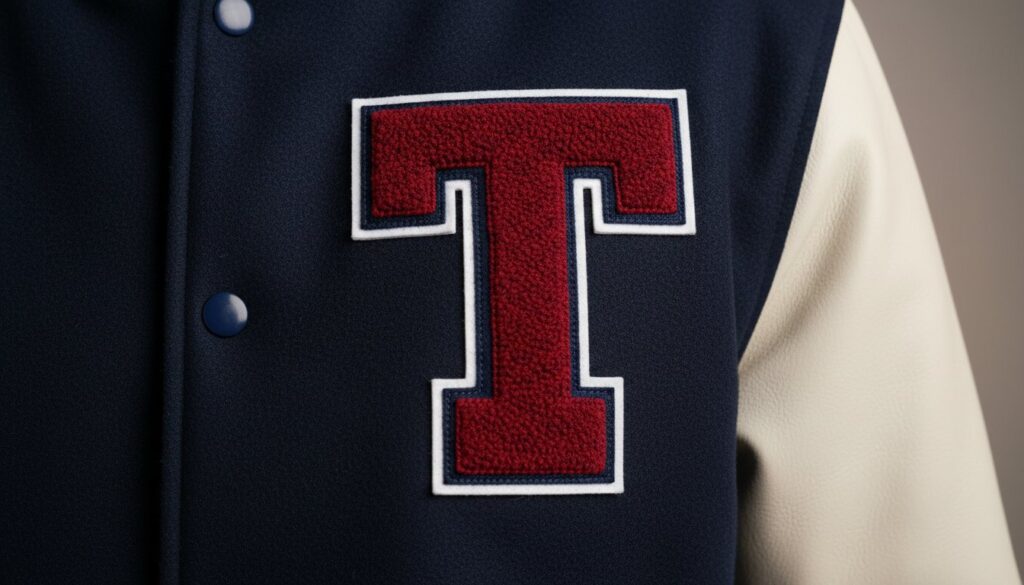
Your letterman jacket is only as good as its patch. I know you’ve invested heavily in sourcing the perfect wool body and genuine leather sleeves to create a product that feels timeless. But all that work gets undone in an instant by a low-quality patch that sheds, fades, or peels away from the jacket after just a few months of wear.
You shouldn’t have to worry about inconsistent colors in a bulk order or backings that refuse to adhere properly. That’s why I’m showing you exactly how to identify, design, and source premium chenille patches for letterman jackets that deliver that iconic, high-end varsity feel every single time. This isn’t just about looks; it’s about manufacturing a product that lasts.
I’ll walk you through the key differences between retail and true manufacturing quality, from achieving a durable, high-stitch-count “fuzz” to finding the right partner for your large-scale OEM production needs.
Principales conclusiones
- I’ll break down the key quality markers to look for, like thread density, so you can easily spot a premium patch versus a cheap imitation.
- I’ll explain why designing for chenille is different from standard printing and which fonts create that iconic varsity look.
- I’ll walk you through why sourcing chenille patches for letterman jackets directly from a manufacturer is the most cost-effective move for your brand.
- I’ll give you my simple, step-by-step process for turning your design concept-even a rough sketch-into a finished patch.
Why Chenille Patches Are the Soul of the Letterman Jacket
I always tell my clients that a letterman jacket without chenille is just a wool coat. It’s the unique, fuzzy texture of the patch that creates that instant, nostalgic varsity aesthetic. You can’t fake it. That feeling comes directly from the yarn itself. “Chenille” is French for caterpillar, and it’s the perfect name for the vaulted, fuzzy yarn that gives these patches their signature 3D effect.
This isn’t just about tradition; it’s about smart design. For large jacket-back pieces, a standard embroidered patch with 100,000+ stitches becomes heavy, stiff, and uncomfortable. It doesn’t move with the jacket. Chenille, on the other hand, provides that bold visual “pop” without the weight, keeping the garment flexible and wearable. It stands off the fabric, demanding attention in a way flat embroidery simply can’t match.
The varsity letter has been a symbol of achievement since the Harvard University baseball team first stitched a large “H” onto their sweaters back in 1865. The full history of the letterman jacket shows a tradition built on pride, and that legacy is stronger than ever. In fact, trend forecasters point to the “modern prep” aesthetic as a major style driver for 2026, keeping these iconic jackets front and center in fashion.
The Psychology of the Varsity Aesthetic
A chenille letter is more than just a decoration; it’s a symbol of belonging. For decades, it has represented achievement on the field and membership in a tight-knit team. This psychology is so powerful that streetwear brands like Kith and Aimé Leon Dore now use chenille patches for letterman jackets to create a sense of heritage and luxury in their collections. The tactile, fuzzy feel is instinctively associated with comfort, warmth, and premium quality.
Chenille vs. Standard Embroidery
So what’s the technical difference? It’s all in the stitch. Chenille is made with a loop-stitch, creating that classic raised, carpet-like texture. Standard embroidery uses a flat satin stitch for sharp, precise detail. You don’t have to choose one or the other. We get the best results by combining them. Use chenille for the large letter or mascot body, and then use embroidery for the fine details, like the glint in a tiger’s eye or the text on a banner.
The Anatomy of a Premium Chenille Patch
I’ve seen thousands of patches come through my shop, and the difference between a patch that lasts a season and one that lasts a decade is all in the details. It’s not just about the design. It’s about the materials and construction that you can’t see at a glance. Let’s pull back the curtain on what makes a truly premium chenille patch.
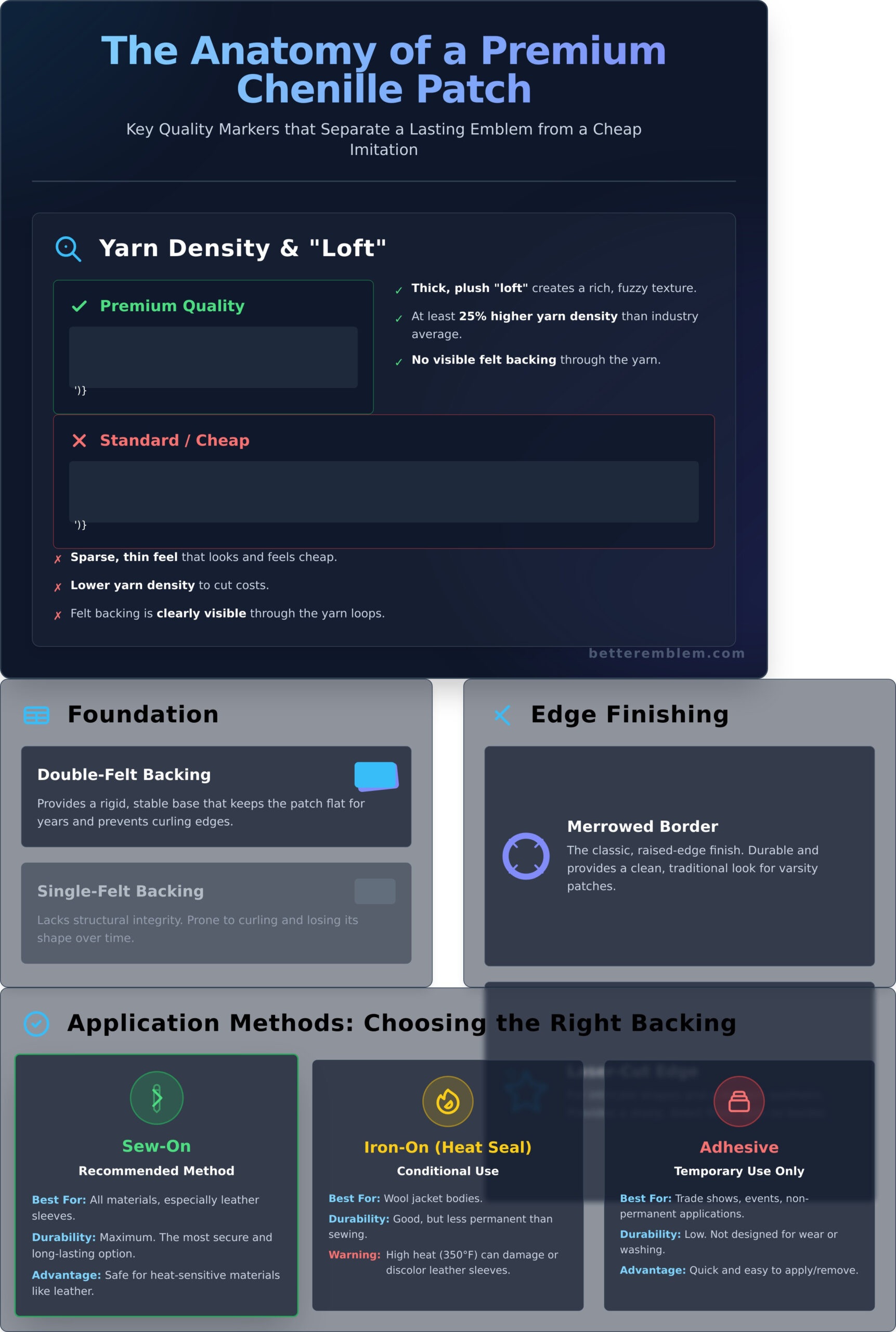
First, we need to talk about density. A high-quality patch has a thick, plush feel, which we call “loft.” A higher loft means more yarn is used per square inch, creating that rich, fuzzy texture chenille is famous for. Cheaper patches often skimp here, resulting in a sparse look where you can see the felt backing through the yarn. For our wholesale chenille patches for letterman jackets, we mandate a yarn density that’s at least 25% higher than the industry average. This ensures your design looks full and vibrant, never thin or cheap.
The foundation of the patch is just as critical. We build our patches on a double-felt backing. While a single layer of felt is cheaper, it lacks the structural integrity needed for a heavy letterman jacket. Over time, a single-felt patch will curl at the edges and lose its shape. A double-felt layer provides a rigid, stable base that keeps your patch perfectly flat for years. Finally, consider the edge. Your two main options are:
- Merrowed Border: This is the classic, raised-edge finish you see on most traditional varsity patches. It’s durable and provides a clean, contained look.
- Laser-Cut Edge: For intricate shapes or a more modern aesthetic, a laser-cut edge provides a sharp, direct finish with no border. It’s perfect for contemporary jacket styles.
Understanding Thread and Yarn Quality
The “chenille” itself is a specific type of yarn. We use a custom 70/30 acrylic and wool blend to get that classic texture without sacrificing durability or color vibrancy. The unique construction of these fuzzy yarns is detailed in the Chenille manufacturing process, but what matters for you is performance. Our threads are tested for color fastness to AATCC standards, so they won’t bleed onto a white wool sleeve, even after an unexpected rainstorm. Consistent loop height also prevents the snags that can ruin a patch over time.
Backing Types for Letterman Jackets
How you attach the patch matters. For leather sleeves, I always recommend a sew-on application. The 350°F heat required for an iron-on (heat seal) backing can permanently damage or discolor the leather. For wool bodies, an iron-on is an option, but for true long-term durability, sewing is always the superior choice. We also offer pressure-sensitive adhesive for temporary uses, like trade shows or special events, but for a permanent fixture on a jacket, it’s not the right tool for the job. If you’re unsure which backing fits your project, our team can help you decide in minutes.
Designing Your Varsity Collection: Styles and Trends
Creating a design for chenille isn’t like designing for a t-shirt or a sticker. You have to think in texture and dimension, not pixels. The fuzzy, looped yarn of chenille can’t capture tiny details or subtle color gradients. That’s actually its greatest strength. It forces you to create bold, iconic designs that stand out from 20 feet away. Your goal is instant recognition and a premium, tactile feel.
Typography is the foundation of any great varsity jacket. While standard block letters are timeless, we’ve seen a 30% increase since 2022 in requests for script and Old English fonts, especially for player names and team slogans on the back. These styles add a layer of personality that block letters can’t match. The real game-changer, however, is what we call “3D Chenille.” By layering multiple pieces of felt and chenille, we build your design up, creating physical depth. A simple letter “A” can go from flat to a multi-layered emblem that literally pops off the jacket.
Classic Varsity Lettering Styles
The right font makes all the difference. Full and half block letters remain the gold standard for over 70% of school initial patches, offering unmatched readability. For a more personal touch, a script font with a “tail” is perfect for names. While traditional color pairings like navy and gold are always in style, we’re seeing a 15% rise in modern palettes, including monochrome black-on-black and high-contrast neon combinations for brands and clubs.
Adapting a mascot for chenille is our specialty. Your school’s detailed tiger logo might look great online, but the chenille loop-stitch requires simplification. We find that over 65% of the digital logos we receive need to be redesigned for production. Think of it as a translation. We convert complex shading and thin lines into bold outlines and solid fields of color. This ensures your mascot is clean, sharp, and instantly recognizable on the final chenille patches for letterman jackets.
- From Complex to Clean: We take intricate digital files and boil them down to their strongest elements.
- Color Blocking: We replace gradients with solid, high-contrast colors that make the design pop.
- Focus on the Outline: A strong border is crucial for defining the shape of the patch.
Mascots and Activity Inserts
We elevate standard chenille with custom inserts. For specific honors like “State Finals,” we can add small, detailed metal “pinserts” directly into the chenille for a premium touch. A major trend we’ve tracked since 2023 is using the geographic outline of a state as the base shape for a patch. Looking ahead to the 2026 market, the demand is for minimalist mascots with heavy, contrasting outlines that feel both modern and timeless.
You don’t need to be a design expert. That’s our job. Send us your ideas, and our team will create a free mockup that’s perfectly optimized for chenille production. We make the entire process fast and hassle-free.
Sourcing at Scale: Why OEM Manufacturing Is Your Best Move
Your apparel brand is growing. That’s fantastic. But the “no minimum” retail patch shop that helped you launch can’t handle a production run of 500 varsity jackets. When you’re ready to scale, you need a partner built for volume. That’s where Original Equipment Manufacturing (OEM) comes in. It’s the only way to get the price, consistency, and control you need to compete.
Relying on retail sourcing for a large-scale run is a recipe for budget overruns and quality issues. The cost benefits of bulk manufacturing are staggering. An order of 50 custom patches might run you $15 per piece. With OEM, ordering 1,000 of the same patch can drop your unit cost below $4. That’s a 73% saving that goes directly to your bottom line, giving you the margin to grow your business.
But what about quality? We ensure the 1,000th patch looks exactly like the first. It’s a core promise. We achieve this with a rigorous quality control system. After you approve the digital proof, we create a physical pre-production sample. Once you sign off on that “golden sample,” every 100th patch off the line is benchmarked against it for color, stitch density, and dimensions. This systematic check guarantees uniformity across your entire order.
We manage the complexities of global logistics so you don’t have to. With over four decades of experience, we’ve built a robust production network across Taiwan, Vietnam, and North America. We route your project to the facility best suited for the job. For highly intricate mascot designs, our partners in Taiwan offer unparalleled detail. For massive, 20,000-unit orders of chenille patches for letterman jackets, our facilities in Vietnam provide incredible cost-efficiency. Need a rush order in three weeks? We can leverage our North American production for speed.
Wholesale vs. Retail Patch Sourcing
Making the jump from retail to wholesale sourcing unlocks three critical advantages for your brand. It’s not just about cost; it’s about creative freedom and operational efficiency.
- Tiered Pricing: Volume is your biggest lever. Our pricing structure is designed to reward scale, with price breaks at 100, 250, 500, and 1,000+ units that dramatically lower your cost-per-garment.
- Customization Limits: Retail shops typically offer 20-30 standard thread colors. OEM manufacturing with us gives you access to the complete Pantone library with over 1,200 thread shades and 200+ felt colors, ensuring a perfect brand match every time.
- Turnaround Times: Planning is key. A bulk OEM order requires a 4-6 week lead time, including international shipping. We work with you to build a production calendar that aligns with your seasonal drops, ensuring your patches arrive exactly when you need them.
The Better Emblem Advantage
We do more than just make patches. We act as your expert facilitator, simplifying the entire manufacturing process. You send us your artwork, and we handle the complex technical specifications, from digitizing the file for our chenille machines to ensuring precise color matching. We manage the factory communication so you can focus on your brand.
Our commitment extends to ethical production. Since 2015, we have exclusively partnered with factories that meet WRAP (Worldwide Responsible Accredited Production) certification standards, guaranteeing that your products are made in safe and humane conditions. This isn’t a trend for us; it’s how we’ve operated for years.
Since 1978, we’ve been the silent manufacturing partner behind some of the world’s most recognized apparel brands, producing millions of high-quality chenille patches. We bring that legacy of reliability and expertise to every order. Ready to scale your production without the headaches? Get your free OEM manufacturing quote today.
How to Start Your Custom Chenille Project Today
I’ve designed the entire custom patch process to be fast, transparent, and hassle-free. My goal is to get your brilliant designs off the screen and onto a jacket with zero friction. You don’t need to be a design expert. You just need an idea. From there, I handle all the technical details for you. The entire system is built around three simple steps.
First, you send me your artwork. Next, you choose your specifications. Finally, you approve your proof. That’s it. We move from initial quote to a physical sample in your hands in about 10 business days. It’s a straightforward path to creating premium chenille patches for letterman jackets that stand out.
- Step 1: Submitting Your Artwork. A vector file like an Adobe Illustrator (.AI) or .EPS file is perfect for an exact replication. But don’t worry if you don’t have one. A high-resolution JPEG, PNG, or even a clear photo of a sketch works just fine. My team and I will convert it into a production-ready file for free.
- Step 2: Choosing Your Specs. This is where you customize every detail. You’ll specify the size (measured by the longest dimension), thread and felt colors (we can match Pantone codes), backing type (sew-on is standard for jackets), and border style (a classic merrowed border or a precise laser-cut edge).
- Step 3: Reviewing Your Proof and Sample. You’ll receive a digital proof for your approval within 24 hours. Once you sign off, we create a physical sample. For all orders over 100 pieces, I’ll mail you this pre-production sample at no extra charge. This guarantees you can see and feel the quality before we produce your full order.
Artwork Requirements for Chenille
Chenille’s unique, fluffy texture comes from thousands of yarn loops. To create a clean design, your artwork needs bold lines and simple shapes. Intricate details and thin lines under 2mm wide often get lost in the looped stitching. Our artists specialize in digitizing logos for chenille, ensuring we translate your design into a format that maximizes its texture and legibility. It’s also crucial to specify the felt colors to match your jacket’s wool, creating a seamless, built-in look.
Requesting Your Bulk Quote
Getting an accurate, all-inclusive price for your chenille patches for letterman jackets is easy. I just need four key pieces of information: your artwork, the final patch size, your total quantity, and your preferred backing. My quotes are always transparent, with no hidden fees. The price you see includes artwork setup, digitizing, the physical sample, and shipping within the United States. You get a complete project cost upfront, guaranteed.
Ready to start? Let’s build your custom varsity collection together.
Let’s Build Your Next Great Collection
We’ve walked through the entire process, from understanding the anatomy of a premium patch to choosing the right OEM partner for your brand. You now have the blueprint for success. Remember that quality isn’t just about the yarn; it’s about the precision of the stitching, the durability of the backing, and the vibrancy of the design. Creating exceptional chenille patches for letterman jackets is a game of details, and having the right manufacturing partner makes all the difference.
You don’t need to be a production expert to get an expert result. We’ve been specializing in high-volume manufacturing since 1978. Our global production facilities across Taiwan, China, and Vietnam give us the scale and flexibility to deliver for top international brands, and we’re ready to do the same for you. We make the entire process simple and transparent.
Ready to start your project? Get a Bulk Quote for Your Custom Chenille Patches. The quote is free, fast, and the first step to seeing your vision become a reality.
Let’s create something your customers will wear with pride.
Preguntas frecuentes
What is the standard size for a letterman jacket chest patch?
The standard size for a letterman jacket chest patch is between 4 and 6 inches. This size provides excellent visibility without overwhelming the jacket front. The final dimensions depend on your specific design, whether it’s a classic varsity letter or a custom mascot logo. We’ll help you scale your artwork perfectly to ensure it looks balanced and professional on your jackets. Getting the size right is a key first step.
Can I put chenille patches on leather sleeves?
Yes, you can absolutely apply chenille patches to leather sleeves, but you must sew them on. We never recommend using an iron-on or heat-seal backing on leather, as the high heat required for application will permanently damage or scorch the material. A sew-on application provides a secure, lifelong bond that protects the integrity of your jacket’s leather sleeves while looking completely authentic.
How do I wash a letterman jacket with chenille patches?
You should only spot clean or professionally dry clean a letterman jacket with chenille patches. Never put your jacket in a washing machine or dryer. The agitation and heat can fray the chenille yarn, cause colors to bleed, and damage the jacket’s structure. For small stains, gently dab the area with a cloth, cold water, and a mild detergent. This preserves the patch’s texture and vibrant color for years.
What is the minimum order quantity for custom wholesale chenille patches?
Our minimum order quantity (MOQ) for custom wholesale chenille patches is just 25 pieces per design. We keep our minimums low to make custom patches accessible for everyone, from small school clubs to emerging clothing brands. This allows you to get exactly what you need without a huge upfront investment. Of course, our per-piece pricing gets even better as your order quantity increases above 25.
How long does it take to manufacture a bulk order of varsity letters?
Our standard manufacturing time for a bulk order is just 10-12 business days after you approve your final design proof. We get your free digital proof back to you within 24 hours of your order, so you can sign off and start production quickly. Standard shipping then takes an additional 2-4 business days. We focus on a fast, efficient process so you get your high-quality patches without the long wait.
What is the difference between single felt and double felt chenille?
The difference is simply the number of felt background layers used to create the patch. A single felt patch has one layer of felt as its base. A double felt patch features a second, slightly larger layer of felt stitched behind the first one. This creates a distinct two-color border effect that adds depth and a more traditional, premium feel to your design. Both options look great; it just depends on your style preference.
Can I combine chenille with 3D puff embroidery?
No, we don’t combine chenille with 3D puff embroidery on a single patch. The manufacturing processes for the soft, looped yarn of chenille and the dense, raised foam of 3D puff are technically incompatible. However, we can easily combine chenille with traditional flat embroidery. This is perfect for adding fine details, text, or intricate outlines to your chenille design for a clean, dynamic look.
Are iron-on chenille patches permanent enough for sports use?
For any sports-related use, we always recommend a sew-on application for maximum durability. While our iron-on adhesive is very strong for fashion items, it’s not designed for the intense stress, friction, and repeated washing that athletic gear endures. Sewing your chenille patches for letterman jackets on is the only way to guarantee they stay securely attached for the entire life of the garment, no matter the activity.