
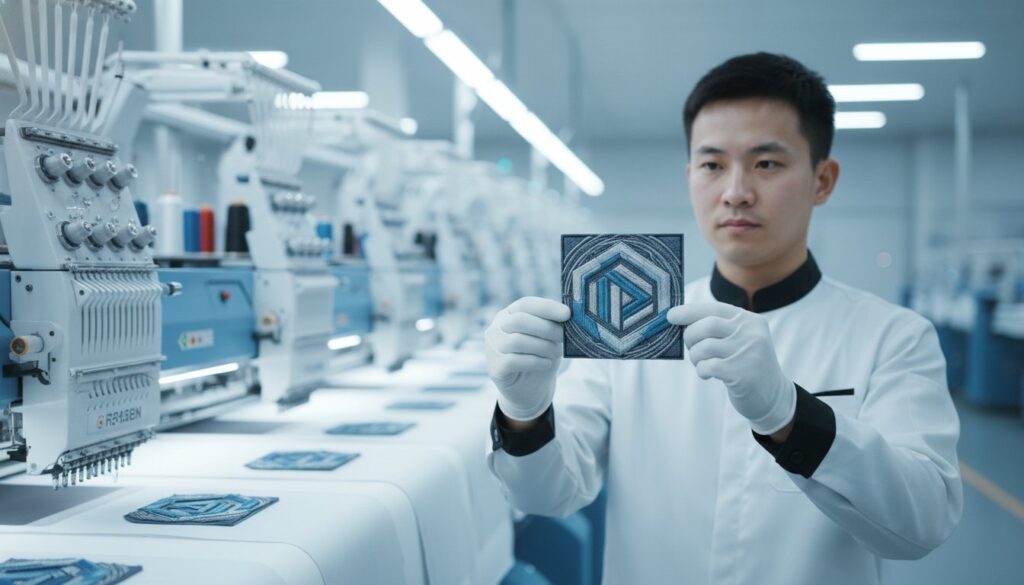
What if the lowest quote you just received is actually the most expensive mistake your brand will make this year? I’ve seen it happen too often. You find a factory that promises the world, but your bulk order arrives with blurred embroidery or leather patches that don’t match your original vision. It’s frustrating to deal with communication gaps and those surprise customs fees that appeared after the de minimis exemption was suspended. I understand that choosing a patch manufacturer in asia feels like a high-stakes gamble when you’re trying to maintain quality across 5,000 units while managing the 10% global tariff reality of 2026.
I’m here to simplify the process. I’ll show you how to find a reliable partner that delivers premium results without the usual sourcing headaches. We’ll walk through how to vet technical talent, navigate new trade regulations, and ensure your 3D embroidery or woven patches look exactly like your digital proofs every single time. It’s time to move past the “cheap” broker trap and build a partnership that actually scales with your business.
Principaux enseignements
- I’ll show you how to spot the technical markers and digitizing skills that separate a professional masterpiece from a low-quality “blob.”
- Learn why your choice between manufacturing hubs should depend entirely on your product, such as heading to Taiwan for high-detail woven patches.
- Discover my fail-safe sampling process that uses digital mock-ups and thread maps to catch errors before you ever commit to a bulk order.
- Understand how choosing a patch manufacturer in asia with a transparent workflow can turn your production from a source of stress into a reliable asset for your brand.
Why Asia Remains the Hub for Custom Patches (and the “Cheap” Trap)
I’ve spent years watching brands scale up or stall out based on their production choices. I’ve seen how the right Asian partner can transform a brand’s bottom line by providing consistent, high-end results that just aren’t possible elsewhere. While the history of embroidered patches is rooted in traditional hand-stitching, the modern industry is all about precision technology and massive infrastructure. The Asia-Pacific region dominated the market with a 38.2% revenue share in 2025, and that lead is only growing as we move through 2026.
The Infrastructure Advantage
The reason I always look toward these specialized hubs is the sheer density of specialized machinery. You aren’t just hiring a person with a sewing machine. You’re accessing entire floors of high-end Tajima and Barudan embroidery machines. These tools allow for the crisp 3D embroidery and intricate woven patches that modern brands demand. Because these factories are clustered together, they source specialized threads and backings in hours rather than weeks. This supply chain density ensures your production never hits a wall because a specific color of thread is out of stock. You get a specialized labor force that understands intricate textile art as a professional standard, not a luxury.
Recognizing the Middleman vs. the Factory
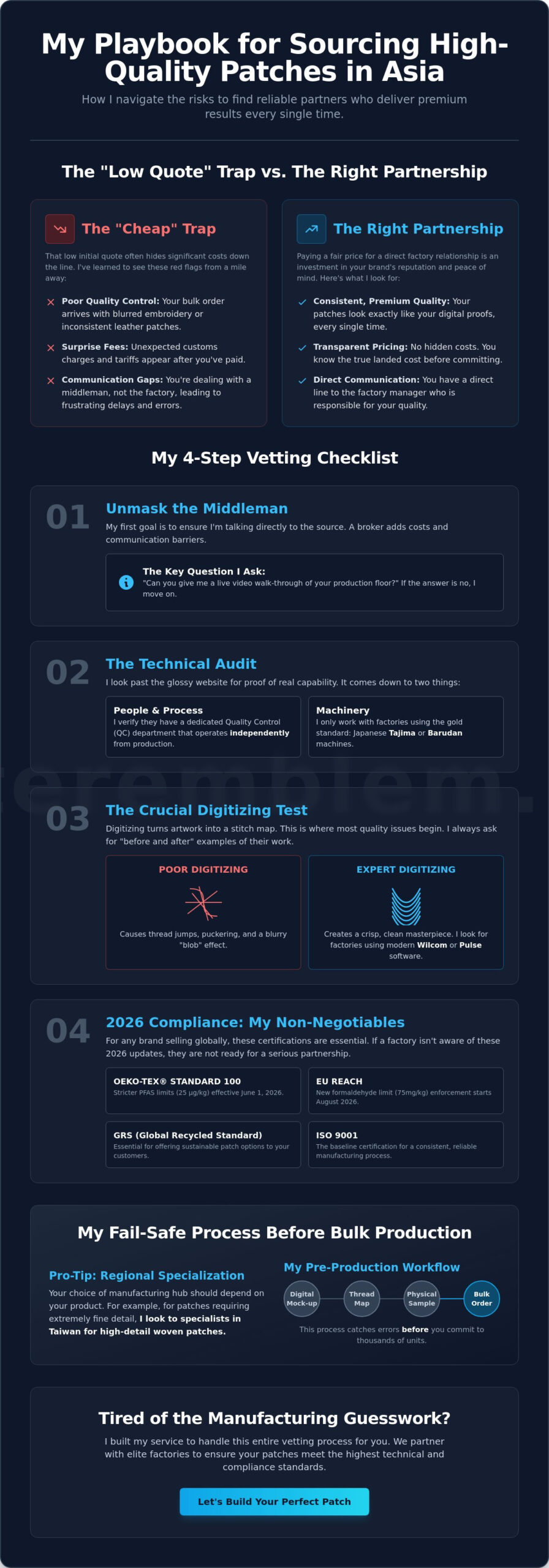
When you’re choosing a patch manufacturer in asia, you have to be careful about the “cheap” trap. I’ve noticed that a small price difference per patch often signals a middleman or a broker who outsources work to small, unequipped workshops. This is where quality falls apart. You want to speak directly to the source. I always recommend asking for a live video walk-through of the production floor. If they can’t show you the machines running your PVC patches or chenille patches in real-time, they’re likely a trading company. A direct relationship with a factory manager is safer because it offers transparency. You’ll know exactly who is responsible for your quality control.
The global supply chain has shifted significantly leading into 2026. With the 10% global tariff under Section 122 and the suspension of the de minimis exemption in 2025, every cent counts. However, cutting corners on the manufacturing price often leads to hidden costs in the form of rejected bulk orders. It’s better to pay a fair, transparent price for reliability than to risk your reputation on a batch that doesn’t match your samples. I believe that manufacturing should be the easiest part of your business. Finding a partner who values your time and your brand’s integrity is the only way to navigate these new trade realities successfully.
Technical Vetting: How to Spot a High-Quality Factory from Your Desk
I’ve learned that choosing a patch manufacturer in asia requires looking past the glossy homepage. You can’t just rely on a “since 1998” badge. I look for specific technical markers that prove a factory can handle the tight registration of 3D embroidery or the fine lines of woven patches. When you’re vetting a partner, you need to see their organizational chart. If they don’t have a dedicated Quality Control (QC) department that operates independently from the production team, that’s a red flag. I also ask about the age and brand of their machines. I focus on whether they use Tajima or Barudan equipment. These Japanese brands are the gold standard for a reason. They handle high-velocity production without sacrificing the detail in your leather patches or epaulettes.
The Digitizing Test
Digitizing is the secret sauce of the patch world. It’s the technical process of turning your artwork into a map of stitches. I always ask to see a “before and after” of a complex 3D embroidery project. Look closely at their portfolio photos for pathing logic. If you see thread “jumps” or uneven stitch density, your bulk order will likely suffer from puckering and thread breaks. Poor digitizing is why some patches look like a blurry blob instead of a crisp masterpiece. I prefer factories that use updated Wilcom or Pulse software to ensure the pathing is efficient and clean. Your success in choosing a patch manufacturer in asia depends on spotting these digital red flags before you send a deposit.
Certifications That Actually Matter in 2026
Compliance is no longer optional for serious brands. As of June 1, 2026, the OEKO-TEX STANDARD 100 has stricter limits on PFAS, with a new threshold of 25 µg/kg. You must verify that your partner meets these standards, especially if your patches have direct skin contact. I also watch for the new EU REACH regulation enforcement starting in August 2026, which sets a formaldehyde limit of 75mg/kg. If a factory isn’t talking about these updates, they aren’t ready for the global market. I also look for the Global Recycled Standard (GRS) if you want to offer sustainable options to your customers.
Reliability is about more than just machines. The landscape of Southeast Asian manufacturing is changing fast due to shifting trade policies. This is why I value factories with ISO 9001 certification. It’s the baseline for consistent manufacturing processes. If you want to skip the guesswork and ensure your brand meets these 2026 standards, you can check out our streamlined production process at Better Emblem. We handle the heavy lifting of technical vetting so you can focus on your designs.
Regional Specialization: Taiwan vs. Mainland China for Your Patches
I’ve found that where you go depends entirely on what you’re making. It is a common mistake to treat all of Asia as one giant factory floor. In reality, different regions have spent decades perfecting specific techniques. When you are choosing a patch manufacturer in asia, you need to match your design’s complexity to the region’s technical strengths. I always suggest looking at this guide to finding an overseas manufacturing partner to understand the broader strategy, but for patches, the choice usually comes down to Taiwan versus Mainland China.
Taiwan: The Precision Powerhouse
I recommend Taiwan for écussons tissés that feature tiny text or complex gradients. The manufacturing culture here focuses heavily on research and development. This is the destination for specialty techniques like high-density 3D embroidery. Better Emblem’s roots are planted here. Our 45 years of experience in Taiwan shapes our approach to quality and precision. While a reciprocal trade agreement signed in February 2026 establishes a 15% all-in tariff for most goods from Taiwan, many brands find the superior detail and lower defect rates are worth the investment. It’s about getting a premium product that represents your brand correctly the first time.
Mainland China: The Scale Master
Mainland China remains unbeatable for massive volume and high-speed production. I point clients toward China when they need patchs personnalisés spécialisés like bulk PVC or simple promotional embroidery. The infrastructure in the Pearl River Delta allows factories to churn out tens of thousands of units with incredible efficiency. You do need to be mindful of the current trade landscape. As of June 2026, goods from China face a 10% global tariff plus existing Section 301 duties. Some apparel duties can reach 30% to 50%. If you are choosing a patch manufacturer in asia for a high-volume run, these fees must be part of your initial budget calculations.
I also tell my clients to watch the calendar closely. Regardless of the region, the Lunar New Year can halt production for weeks. I’ve seen many brands miss their launch dates because they didn’t account for this break. I suggest finalizing your designs and sampling at least two months before any major regional holiday. This buffer ensures your lead times remain manageable and your shipping stays on track. Balancing these regional strengths with seasonal timelines is the key to a stress-free supply chain.
The Sampling Process: Your Fail-Safe Against Bulk Order Disasters
I never let a client move to bulk production without a rigorous sampling phase. It is the only way to protect your investment. When you are choosing a patch manufacturer in asia, the sampling stage is where you find out if they are truly capable or just good at sales. I’ve seen brands skip this to save a few days, only to end up with 5,000 unusable units. It’s a mistake that costs more than just money; it costs you your reputation.
The process starts with the digital mock-up. You must check the “thread map” closely. This shows the pathing logic and stitch direction. If the digital file looks chaotic, the physical patch will have thread breaks or uneven surfaces. Once the digital proof is perfect, you move to the physical sample. Don’t just look at a photo of it. You need to hold it, feel the weight, and check the flexibility of the materials.
Critiquing the Physical Sample
I tell my clients to treat the physical sample like a prototype, not a gift. You need to stress test it. Check the merrowed border for consistency. If you see gaps where the base fabric peeks through, the tension is wrong. I also perform a “Pull Test” to check the backing adhesion for patchs personnalisés. If the heat-seal or hook-and-loop backing peels off with a light tug, it won’t survive real-world use. Always use Pantone references for color matching. Screen colors are deceptive; a Pantone bridge is the only way to ensure your brand colors are exact.
Communication Best Practices
Your feedback needs to be surgical. I use clear, annotated photos for every revision. Circle the problem areas and explain the fix in technical terms. Instead of saying “it looks off,” tell them to “increase the stitch density in the logo center.” This precision is vital when choosing a patch manufacturer in asia because it removes any ambiguity from the production process. This is why having a dedicated account manager who speaks your language is so important. They act as the bridge between your vision and the floor manager.
You should also set firm “Go/No-Go” dates. This keeps your 2026 launch on schedule and prevents endless revision loops. Finally, follow the “Golden Sample” rule. I keep one perfect sample in my office, and the factory keeps an identical one. This serves as the ultimate quality benchmark for the entire bulk run. If the final order doesn’t match the Golden Sample, we have a clear standard for corrections. If you want to see how we handle this level of detail, start your sampling process with us today.
Scaling Your Brand with a Trusted Asian Partner
I believe manufacturing should be the easiest part of your business. When you are choosing a patch manufacturer in asia, you aren’t just looking for a vendor to fill a single order. You are looking for a long-term partner who understands your growth trajectory and your brand’s voice. At Better Emblem, we bridge the gap between high-end Asian production and the high-velocity expectations of Western brands. We offer a comprehensive suite of products to meet every branding need. This includes everything from classic patchs chenille for athletic apparel to high-detail impression par transfert thermique for technical gear. Having one reliable source for multiple styles simplifies your supply chain and ensures your quality remains consistent across your entire product line.
Transparency in pricing and shipping is my non-negotiable standard. In 2026, you cannot afford to guess about landed costs. With the shifting tariff landscape and new customs regulations I discussed earlier, you need a partner who provides a clear, all-in view of your investment. We strip away the complexity of international logistics by providing comprehensive pricing models. This reliability ensures you can calculate your retail margins with total confidence. You shouldn’t have to worry about hidden hurdles when you are trying to scale a professional brand.
Beyond the Patch: Long-Term Growth
I’ve found that the most successful brands prioritize inventory management to stay agile. We offer “just-in-time” delivery options to help you grow without drowning in excess stock. We handle all the technical heavy lifting, from the initial digitizing to the final quality control checks, so you can focus entirely on your creative designs. We have been building these types of professional relationships for over 45 years. Our goal is to act as an expert facilitator in your journey. We are the reliable professionals who get the job done right the first time, allowing you to maintain a friendly but focused demeanor with your own customers.
Ready to Start Your Sourcing Journey?
My “Made Easy” philosophy is built on removing every barrier to entry for your brand. Choosing a patch manufacturer in asia should be an encouraging step forward, not a source of stress. When you reach out to me for a quote, I provide a breakdown that includes all relevant logistics fees. There are no surprise costs or communication delays here. I invite you to reach out for a personal consultation to discuss your specific project needs. Whether you need PVC patches, leather patches, or complex epaulettes, I am ready to show you how seamless manufacturing can be. Let’s make your next bulk order the most successful one yet.
Build Your Brand with Confidence in 2026
I believe that manufacturing should empower your creativity, not drain your energy. We’ve covered how to spot technical talent and why the distinction between regional hubs like Taiwan and Mainland China matters for your specific design. By mastering the sampling process and sticking to the “Golden Sample” rule, you can eliminate the stress of bulk order surprises. It’s about shifting your mindset from a simple price hunt to a long-term technical talent search.
Better Emblem is ready to act as your expert facilitator in this journey. We bring over 45 years of OEM expertise to the table with a global footprint that includes factories in Taiwan, China, and North America. Our commitment to quality is backed by Oeko-Tex and Sedex certifications; this ensures your brand stays compliant with the latest 2026 regulations. Choosing a patch manufacturer in asia is a major milestone for your brand, and it is one you don’t have to navigate alone.
I’m here to ensure your 3D embroidery, woven patches, or PVC designs arrive exactly as you envisioned. Let us handle your Asian manufacturing—get a transparent quote today! I look forward to helping you scale your business with ease and reliability.
Questions fréquemment posées
How do I verify if an Asian patch factory is ethical?
I verify ethical standards by looking for Oeko-Tex Standard 100 and Sedex certifications. These documents prove a factory follows international safety and labor guidelines. I also suggest asking for an ISO 9001 certificate to ensure consistent quality management. Ethical factories are usually proud to share these credentials. They won’t hesitate to show you their production floor via a video walk-through to prove their standards are real.
What is the typical lead time for custom patches from Asia in 2026?
You should expect a lead time of roughly 3 to 4 weeks for most custom orders. This includes the time for digital proofing, physical sampling, and bulk production. Shipping by air usually adds another 5 to 7 days. I always remind clients to build in a buffer for regional holidays like Lunar New Year. These events can halt production for two weeks or more if you don’t plan ahead.
Can I get a physical sample before I pay for a full bulk order?
I never move to bulk production without a physical sample in my hands. You start with a digital mock-up to confirm the layout and colors. After that, the factory should ship a tangible prototype for you to stress test. This step is vital for checking backing adhesion and border consistency. It is the only way to ensure 5,000 units meet your brand’s specific quality standards.
What are the main differences between patches made in Taiwan and China?
Taiwan is my top choice for high-detail woven patches and complex 3D embroidery due to their focus on precision. Mainland China is the global leader for massive scale and PVC production. China offers incredible speed for promotional items, while Taiwan excels in specialty techniques. Your decision should match your design complexity. If you need tiny, legible text, Taiwan’s technical infrastructure is usually the better investment.
How do I handle customs and import duties when ordering from Asia?
You must calculate your landed cost by including the 10% global tariff and any relevant Section 301 duties. Since the de minimis exemption ended in August 2025, all commercial imports now face customs scrutiny. I recommend working with a partner who provides transparent, all-in pricing. This prevents surprise fees when your shipment arrives at the border. Always verify the current HTS codes for apparel to avoid overpaying.
Why do some patches from Asia arrive with blurred text or poor detail?
Blurred text is almost always the result of poor digitizing or low stitch density. If the “thread map” isn’t created with precision, the needles won’t follow a clean path. This causes colors to bleed and fine lines to disappear. Choosing a patch manufacturer in asia that uses high-end Tajima or Barudan machines solves this problem. These machines maintain crisp detail even on intricate designs like epaulettes or small lettering.
Is it better to use a trading company or go direct to a factory?
I always recommend going direct to the factory to avoid the “cheap” broker trap. Trading companies often act as middlemen and outsource your order to smaller, less-equipped workshops. This lack of transparency leads to inconsistent quality and communication delays. Choosing a patch manufacturer in asia with their own facility gives you a direct line to the floor manager. You get better accountability and more competitive direct-to-factory pricing.
What file formats should I provide for the best embroidery results?
I need vector files like AI, EPS, or high-resolution PDFs to get the best results. These formats allow our digitizers to map out the stitches without any pixelation. If you provide a blurry JPEG, the final embroidery will likely lack sharpness. Clear artwork is the foundation for premium 3D embroidery and woven patches. It ensures the pathing logic is clean and your brand colors match your original vision.