
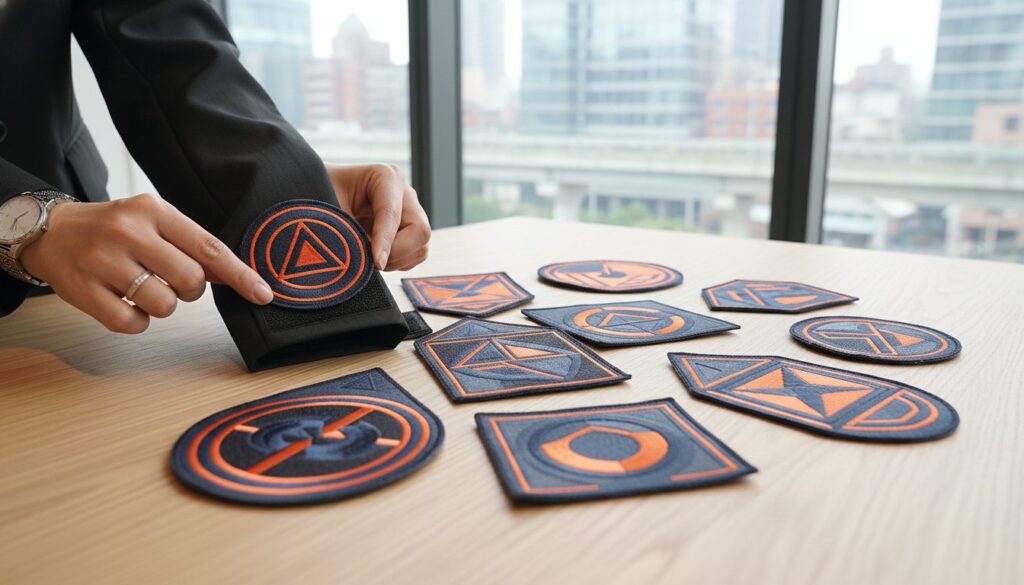
Your brand’s reputation shouldn’t peel off just because a hook-and-loop fastener failed after three washes. I’ve seen too many professional teams settle for subpar quality that frays at the edges or loses its grip when things get tough. You want your gear to look sharp and stay put, whether it’s on a tactical vest or a corporate jacket. It’s a common struggle to find custom embroidered patches with velcro backing that actually hold up to heavy use without looking like a cheap afterthought.
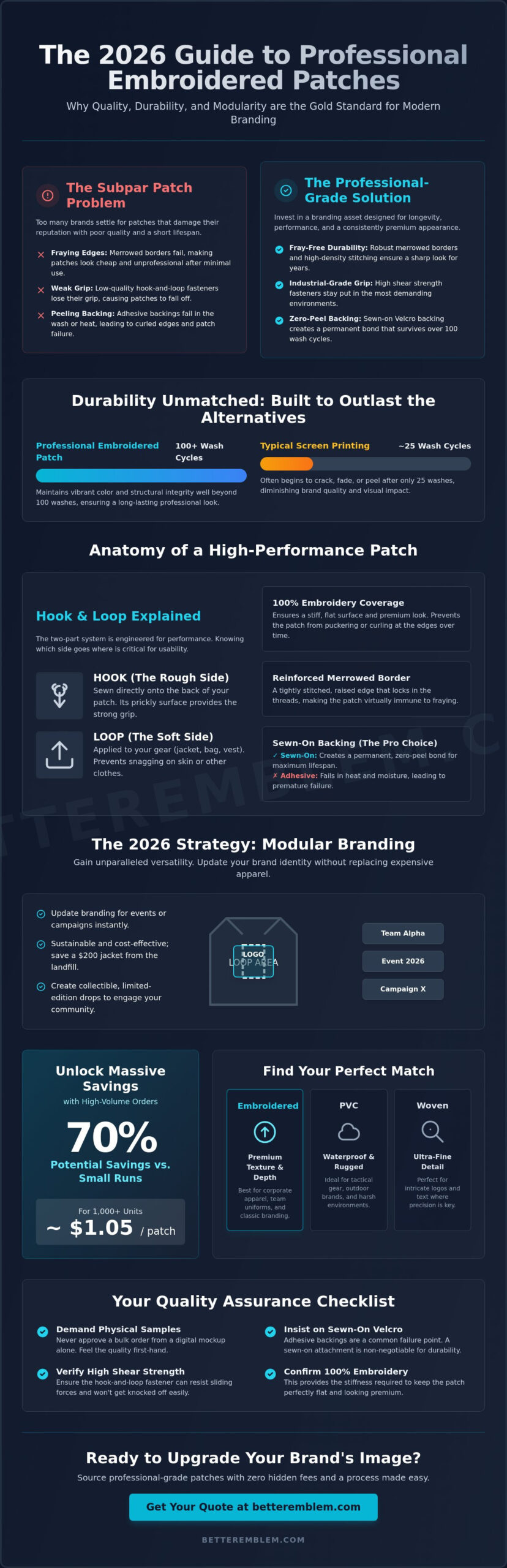
I know you need reliability, and I’m here to promise a better way. In this 2026 guide, I will show you how to source professional-grade patches that survive over 100 wash cycles and match your brand colors with total precision. We will look at the latest manufacturing trends, from free digitizing services to bulk pricing where 1,000 patches cost about $1.05 each, saving you up to 70 percent compared to small runs. You’ll learn how to navigate the ordering process with zero hidden fees and get the exact specs your project requires. I’ve simplified the technical details so you can focus on your brand. Let’s make your next bulk order the easiest one yet.
Principaux enseignements
- Learn how to distinguish between hook and loop components to ensure your patches perfectly match your existing gear and apparel.
- Discover the design secrets, like the merrowed border, that keep custom embroidered patches with velcro backing looking professional and fray-free through years of use.
- Master the high-volume ordering process with my checklist for vetting manufacturers and securing physical pre-production samples.
- Find out why modular branding is the essential strategy for 2026 and how it offers more versatility than traditional permanent attachments.
- Explore how to scale your brand using our Made Easy philosophy to remove the usual manufacturing hurdles and hidden costs.
Why Custom Embroidered Patches with Velcro Backing are the Gold Standard for 2026 Branding
I’ve watched the history of embroidered patches move from strictly military utility to a high-end branding powerhouse. It’s no longer just about identifying a unit; it’s about creating a modular identity that grows with your business. A custom embroidered patch with velcro backing is a smart, two-part fastening system. It combines high-density thread work with a hook-and-loop attachment that’s built for the long haul. I’ve seen global brands switch to this model because it allows them to update a logo or change a campaign message without tossing a $200 technical jacket. It’s a solution that values both your budget and your brand’s visual impact.
The modular advantage is the biggest reason I recommend this setup for high-volume orders. You get the ability to swap logos instantly, which is perfect for teams that rotate through different projects or seasonal events. In 2026, durability is a non-negotiable metric. While traditional screen printing often starts to crack or fade after 25 washes, a professional-grade embroidered patch survives 100 or more wash cycles while maintaining its color. This longevity ensures your brand stays sharp even in the most demanding environments. When you order in bulk, like a 1,000-unit run at approximately $1.05 per patch, you’re investing in a branding asset that outlasts the garment it’s attached to.
The Shift Toward Modular Apparel
Techwear and outdoor brands are leading the charge by integrating Velcro-heavy designs into their core lines. It’s a smart move for sustainability. Instead of discarding gear because a logo is outdated, you just swap the patch. I’ve also noticed a massive “collectibility” factor. Communities and organizations now create limited-edition drops, turning a simple piece of equipment into a canvas for a rotating collection of brand assets. It turns your apparel into a conversation piece rather than just a uniform.
Embroidery vs. Other Patch Types
Embroidery still feels like the premium choice because of its distinct texture and classic depth. If you want that extra “pop” that stands out in a crowd, I always suggest looking at our guide on 3D embroidery to see how raised stitching adds a luxury feel. While PVC is great for waterproof tactical gear and woven patches excel at ultra-fine detail, embroidery remains the most versatile option for corporate apparel. It strikes the perfect balance between a high-end look and rugged, everyday performance. We make the choice simple by focusing on high-quality thread that doesn’t fray, ensuring your investment looks as good in year two as it did on day one.
The Technical Anatomy: Hook, Loop, and Embroidery Density
I believe the secret to a great patch is hidden in the materials you can’t see. Most people focus on the colors or the logo, but the foundation is what keeps your brand looking professional after months of hard use. When you order custom embroidered patches with velcro backing, you are actually buying a complex stack of textiles engineered for performance. If the foundation is weak, the embroidery will eventually sag or fray, no matter how good the design looks on a screen.
You need to know which side goes where before you place a bulk order. The “hook” is the rough, prickly side. In 99 percent of cases, this side is sewn directly onto the back of your patch. The “loop” is the soft, fuzzy side that stays on your jacket, bag, or hat. This setup is intentional. If the hooks were on the garment, they would snag your skin or ruin other clothes in the wash whenever the patch is removed. It’s a small detail that prevents a massive headache for your end users.
Thread count is another area where I never cut corners. For professional-grade emblems, 100 percent embroidery coverage is essential. This means every millimeter of the background twill is covered in high-density stitching. This isn’t just for looks. A fully embroidered surface provides the structural stiffness needed to keep the patch flat. Without this density, the velcro backing can cause the fabric to “pucker” or curl at the edges, which immediately kills the premium aesthetic you’re aiming for.
Hook and Loop Quality Tiers
Industrial-grade fasteners are built to survive thousands of attachment cycles. Consumer-grade options might feel fine at first, but they quickly lose their “grab” in extreme heat or cold. I always look for high shear strength in a manufacturer’s specs. Shear strength refers to the resistance of the two surfaces to sliding against each other. High shear strength ensures your patch won’t get knocked off if someone brushes against a doorway or a heavy backpack strap. If you want to see how these high-end materials feel in person, you can request a sample pack to test the grip yourself.
Backing Application Methods
For high-volume OEM projects, sewn-on Velcro is the only way to go. Some shops use adhesive-backed Velcro because it’s faster to produce, but that glue often fails after a few cycles in a hot dryer. I prioritize double-stitching the edges of the fastener to the patch. This creates a zero-peel bond that lasts for the life of the emblem. We also use precision die-cutting to ensure the backing matches the embroidery shape perfectly. This prevents any ugly backing overhang, which is a common flaw in cheap, mass-produced patches.
Design Secrets for Premium Tactical and Corporate Patches
I’ve found that the best designs for custom embroidered patches with velcro backing follow a few strict rules of thumb to ensure a clean, professional finish. When you’re designing for a removable system, you have to think about how the patch will be handled. Since users will be pulling on the edges to swap them out, the design needs to be as functional as it is beautiful. I always tell my clients to start by looking at their gear. Tactical bags and uniforms often have standardized loop fields, usually 2×3 or 3×5 inches. If you design outside these dimensions, your patch might overhang, which leads to snagging and premature peeling.
Color consistency is another area where I see brands struggle. Thread doesn’t behave exactly like ink on paper. To keep your brand identity intact, I use a Pantone-to-thread conversion process. This ensures that the “Navy Blue” on your website matches the thread on your patches. We match your brand colors to specific thread spools before the first stitch is even digitized. This attention to detail is what separates a premium corporate emblem from a generic giveaway item. It makes the transition from digital art to physical product completely seamless.
Edge Finishing: Merrow vs. Laser Cut
A merrowed border is the absolute best friend of a Velcro patch. It is a classic, heavy wraparound stitch that seals the embroidery and the backing together into one solid unit. This border acts as a protective bumper, preventing the Velcro from fraying at the corners when it’s pulled off a garment. For complex, non-geometric shapes that can’t be merrowed, I suggest using heat-cut edges. These are precision-trimmed with a laser to prevent unraveling. You can explore more unique edge ideas in my guide to patchs personnalisés spécialisés to see which style fits your brand’s aesthetic.
Optimizing Logos for Embroidery
Small text is the natural enemy of high-quality embroidery. If your font is smaller than 0.25 inches in height, the thread will likely bunch up and become unreadable. I recommend simplifying your logo for smaller patches by using negative space. Letting the background show through actually helps your main design elements pop against the thread texture. This is where a skilled digitizer becomes your most valuable partner. They don’t just click a button to convert your file; they manually map out every stitch direction and density to ensure your custom embroidered patches with velcro backing look crisp and professional at any scale.
Your High-Volume Ordering Checklist: What to Ask Your Manufacturer
Ordering in bulk shouldn’t feel like a gamble. When you’re responsible for a run of 5,000 units, a small mistake in the backing can turn into a massive logistics headache. I’ve found that the most successful projects follow a strict checklist to keep the process seamless. Your goal is to move from a design file to a physical product without any hidden hurdles or quality drops. If you want to master the full lifecycle of a project, I recommend reading the complete guide to ordering custom patches for a deeper dive into the logistics.
Start by requesting a physical pre-production sample. A digital mockup is fine for a quick color check, but it doesn’t tell you anything about the “grab” of the fastener or the stiffness of the embroidery. I always insist on seeing the actual stitch work before the full production run begins. Once you have the sample, verify the hook-and-loop brand and its durability rating. You want a system that can withstand thousands of attachment cycles without losing its grip. In 2026, professional buyers look for all-inclusive pricing. This means your quote should cover everything from the initial digitizing to the final shipping costs. Many top-tier manufacturers now offer free digitizing to avoid those annoying $30 fees that used to clutter up invoices.
Finally, confirm your lead times and international shipping logistics. High-volume orders often involve complex supply chains. You need to know exactly when your crate will land so you can coordinate your product launch or team rollout. If you are ready to see how a streamlined process works, you can get a transparent quote today and skip the typical manufacturing stress.
Evaluating OEM Quality Control
A “clean back” is a sign of a high-quality manufacturer. When you flip the patch over, the stitching should be tidy and fully covered by the hook-and-loop material. Any loose threads or messy knots can interfere with the attachment strength. I suggest testing the “pull strength” on the first 100 units of any large batch. If the Velcro starts to separate from the embroidery with minimal force, the sewing tension was likely off during production. We prioritize a double-stitch method to ensure the two layers act as a single, indestructible unit.
Sustainability and Compliance
I always ask about OEKO-TEX certified threads. This certification ensures the materials are safe for skin contact and free from harmful chemicals, which is a requirement for many modern apparel brands. Factory audits are another critical factor. Verified audits ensure that the facility follows ethical labor practices and maintains consistent environmental standards. This transparency builds long-term partnership stability and protects your brand’s reputation in a market that increasingly values ethical manufacturing.
Scaling Your Brand with Better Emblem: The Expert Facilitator
Since 1978, I have seen how the right manufacturing partner can change a brand’s trajectory. We don’t just make emblems; we solve branding problems for organizations that can’t afford a quality failure. While many shops focus on selling a single “morale patch” to an individual, we’ve built our reputation on helping global brands scale their identity through high-volume production. My goal is to make the process of sourcing custom embroidered patches with velcro backing as simple and reliable as possible. We call this our “Made Easy” philosophy. It’s about stripping away the technical hurdles so you can focus on your creative vision while we handle the heavy lifting.
Our reach is truly global. With specialized facilities in Taiwan and a streamlined logistics network, we ensure a fast turnaround that meets the demands of international distributors. We’ve optimized every step of the textile production chain to guarantee that your 5,000th patch looks exactly like your first. This consistency is why organizations trust us as their expert facilitator. We understand that a patch isn’t just a piece of fabric; it’s a modular branding system that represents your professional standards in the field. We prioritize efficiency and clarity so you never have to guess about the status of your order.
Le Meilleur Avantage d'Emblème
Choosing us means you get professional OEM services tailored for the scale of your business. You won’t be talking to a sales bot. Instead, you get direct access to manufacturing experts who understand the nuances of thread density and backing durability. We are also committed to 2026 sustainability standards, ensuring that our high-end production doesn’t come at the cost of the environment. We use efficient processes and ethical labor practices because we believe a premium product should be built on a foundation of integrity. This approach ensures long-term partnership stability and a product you can be proud to attach to your gear.
Ready to Start Your Project?
Getting started is the easiest part of the journey. You can submit your artwork for a professional review today, and my team will provide a digital proof within 24 hours. We’ll check for readability, color matching, and technical feasibility before we ever touch a needle. This proactive approach prevents costly mistakes and ensures you get exactly what you need on the first try. We handle the complexity so you can enjoy the results. Let’s make your custom Velcro patches easy and high-quality.
Future-Proof Your Branding with Modular Precision
I’ve shown you how the right materials and design choices turn a simple emblem into a professional branding tool. You now understand that high-density stitching and industrial-grade fasteners are the keys to surviving the rigors of daily use. By following my high-volume checklist, you can avoid the common pitfalls of poor quality control and unexpected costs. It’s clear that custom embroidered patches with velcro backing offer the modular flexibility that modern brands need to stay relevant in 2026. This system allows your identity to evolve without the need for a total gear overhaul.
We have been manufacturing experts since 1978. Our global OEM production facilities are built to handle your largest projects with speed and total accuracy. I believe in complete transparency, which is why we offer no hidden digitizing or setup fees. I’m ready to help you turn your complex designs into a durable reality that your team or customers will be proud to wear. Let’s make your next production run the easiest one yet.
Get a hassle-free quote for your bulk Velcro patches today. I look forward to partnering with you on your creative journey.
Questions fréquemment posées
Can I wash garments with Velcro patches still attached?
I recommend removing your patches before washing to keep the thread looking crisp. If you decide to leave them on, turn the garment inside out and make sure the patch is firmly attached. This prevents the hooks from snagging other fabrics in the machine and protects the embroidery from excessive friction.
What is the standard size for tactical Velcro patches?
Most tactical gear uses standardized loop fields measuring 2×3 or 3×5 inches. Sticking to these dimensions ensures your custom embroidered patches with velcro backing fit perfectly on any standard bag or uniform. If you go larger than these sizes, you risk the edges overhanging and snagging on your equipment.
Do I need to provide the “loop” side for my custom order?
We include both the hook and loop sides with every order. You don’t need to source the fuzzy loop side separately unless your gear already has it pre-installed. Providing both pieces ensures the two surfaces have a 100 percent compatible grip and a matching color profile.
How many times can a Velcro patch be removed before it loses its grip?
Industrial-grade fasteners are designed to last through 5,000 to 10,000 attachment cycles. If you pull your patch off once a day, it would take over 13 years to wear out the grip. We use high-shear strength materials to guarantee this longevity even in rugged environments.
Can I get 3D embroidery on a Velcro-backed patch?
Yes, 3D embroidery works exceptionally well with a Velcro backing. The rigid hook-and-loop material actually helps support the extra height of the 3D foam, keeping the design stable. This combination is a favorite for brands looking for a high-end, tactile finish that stands out from the fabric.
What is the difference between hook-and-loop and genuine Velcro?
Velcro is a specific brand name, but hook-and-loop is the general name for the technology. I source industrial-tier fasteners that provide a professional-grade grip equal to or better than name-brand options. These materials are built to perform in extreme temperatures ranging from -20 to 200 degrees Fahrenheit.
How long does it take to manufacture 1,000 custom Velcro patches?
Our standard production time for a 1,000-unit order is 10 to 14 business days. This timeline starts once you approve your final physical sample. We then coordinate fast shipping from our global facilities to get the finished product to your door within 3 to 5 additional days.
Are there any shape limitations for Velcro-backed emblems?
You can choose almost any shape, but simple geometric borders are the most durable for daily use. Sharp, narrow points on a custom embroidered patches with velcro backing can snag on equipment and start to peel at the corners. I suggest using a merrowed border on rectangles or circles for the best zero-peel performance.