
Did you know that as of June 2026, the total tariff on certain goods from China can stack up to over 60%? It’s a massive shift that has many brand owners feeling like the era of easy, low-cost imports is over. You’re likely tired of seeing a great factory quote for sourcing patches from china manufacturer get ruined by the new Section 122 surcharges or the sudden need for a customs broker now that the $800 de minimis exemption is gone. It feels like every shipment is a gamble where the house always wins.
I’ve spent years in the production trenches, and I can tell you that working with overseas partners is still your best bet for scale if you know the 2026 rules. I’m going to show you exactly how to manage these complexities to ensure you get premium quality and predictable lead times without the usual headaches. We’ll dive into mastering HTS codes, avoiding communication breakdowns, and ensuring your 3D embroidery or PVC patches arrive retail-ready and exactly as you pictured them.
ประเด็นสำคัญ
- China remains the global powerhouse for specialized textile machinery, giving you access to materials and scale you won’t find anywhere else.
- You’ll learn why using vector files is the only way to ensure your 3D embroidery or PVC designs scale perfectly without losing detail.
- I’ll share my strategy for sourcing patches from china manufacturer by spotting the difference between a real factory and a trading company.
- Production times aren’t delivery times, so I’ll teach you how to plan around holidays like Golden Week to avoid shipping delays.
- I’ll explain how we’ve used our experience since 1978 to bridge the gap between your creative vision and high-end manufacturing.
Why Sourcing Patches from a China Manufacturer is Still the Smartest Move in 2026
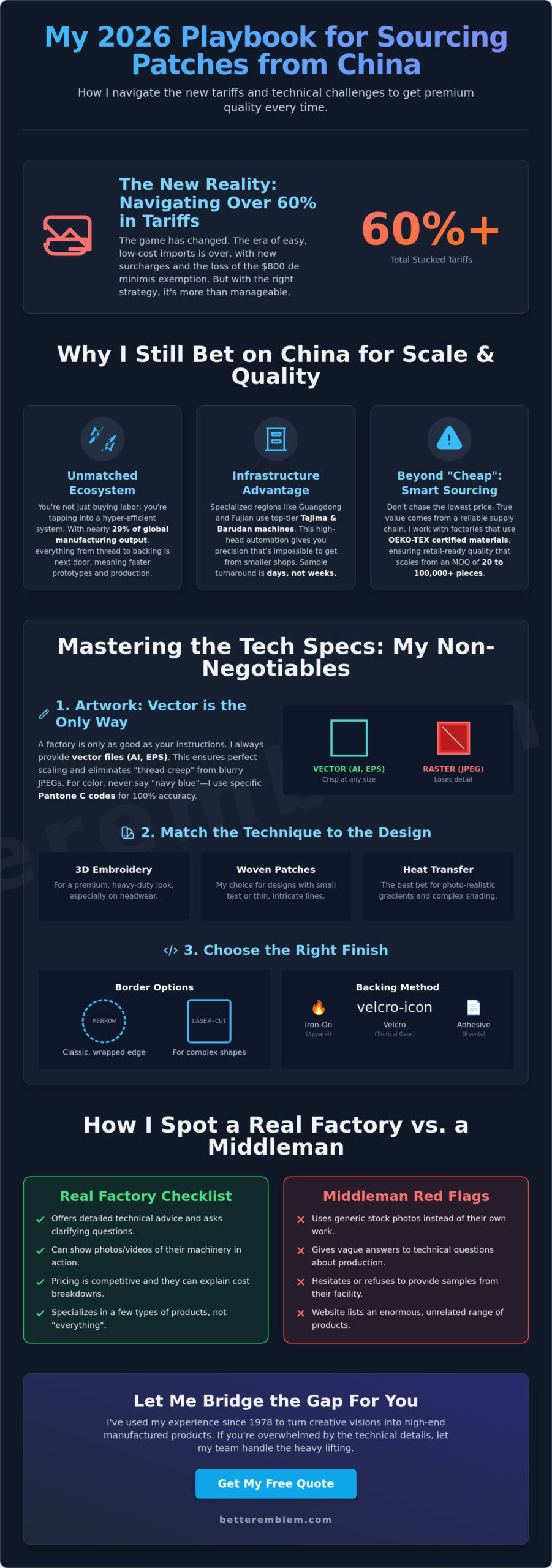
I get it. With the 2026 tariff changes, you might be looking at other countries to avoid the extra costs. But the truth is, China still produces nearly 29% of the world’s manufacturing output for a reason. When you are sourcing patches from china manufacturer, you aren’t just buying labor; you’re buying into a massive, hyper-efficient ecosystem. Local shops are great for a dozen units, but they can’t match the speed of a factory that has every thread color and backing material sitting in a warehouse next door. This proximity allows for rapid prototyping that local boutique shops simply cannot match. You get to see a digital proof and a physical sample in record time because the raw materials are already on-site and ready to go.
The Infrastructure Advantage
I’ve spent a lot of time looking at how these hubs operate. In regions like Guangdong and Fujian, the specialization is incredible. These factories use top-tier Tajima and Barudan machines that provide precision you just can’t get from hobbyist equipment. When sourcing patches from china manufacturer, I always prioritize those who invest in this level of automation. While the ประวัติของแผ่นปัก shows how much has changed from hand-stitched origins, the modern reality is all about high-head automation. Because the thread and stabilizer suppliers are often in the same zip code, the turnaround for a complex 3D embroidery or PVC patch sample is days, not weeks. This setup reduces lead times significantly compared to manufacturers who have to import their components from other regions.
Balancing Cost and Quality
Don’t fall into the trap of thinking “China” always means “cheap.” I’ve seen brands get burned because they chased the lowest possible price and ended up with patches that unraveled after one wash. True cost-efficiency comes from the supply chain, not just low wages. In 2026, many reliable factories have adopted OEKO-TEX standards, ensuring their materials are safe and eco-friendly. This matters if you’re aiming for retail-ready quality that meets international regulations. Whether you need an MOQ of 20 pieces for a test run or 100,000 for a national rollout, the scalability is unmatched. You can start small with a batch of Chenille or Woven patches and ramp up your volume without ever switching partners. It’s about building a relationship with a technical partner who can grow with your brand while maintaining a consistent standard of excellence.
Mastering the Technical Specs: What Your Manufacturer Needs to Know
A factory is only as good as the instructions you provide. When sourcing patches from china manufacturer, I’ve seen too many projects fail because of vague details. You’re the architect of the project; the factory is the execution team. If you leave a detail to chance, the factory will make a guess, and it usually won’t be the one you wanted. Being specific from the start is the best way to avoid expensive mistakes and ensure your final product matches your vision.
Start with your artwork. I always recommend providing vector files like AI or EPS for perfect scaling. These files allow the factory’s digitizer to see exactly where every stitch needs to go without the blurriness of a standard image. If you send a low-res JPEG, the digitizer has to guess where a line ends or a curve begins. This often leads to “thread creep” where the design looks muddy. According to U.S. trade data on textile imports, the demand for high-precision custom goods is rising, and technical accuracy is the only way to stay competitive. To keep your brand consistent, use Pantone matching. Don’t just say “navy blue.” Give them a specific Pantone C code. It’s the only way to ensure the thread color matches your digital proof exactly.
Choosing the Right Patch Technique
Not every logo works with every style. I suggest แพทช์ทอ if your design has small text or thin lines that traditional embroidery can’t handle. For a premium, heavy-duty look on headwear, การปักสามมิติ is the gold standard. If you’re looking for photo-realistic gradients or complex shading, การพิมพ์ถ่ายเทความร้อน is your best bet. Matching the technique to your design is the first step toward a retail-ready product.
ตัวเลือกการรองหลังและขอบ
Borders define the finished look of your patch. A Merrow border gives that classic, “wrapped” edge you see on scout patches, while a laser-cut border is better for complex, custom shapes. You also need to decide on the attachment method early. Iron-on backings are great for retail apparel, but Velcro is the standard for tactical gear. Adhesive backings work well for temporary events or one-time use. I suggest specifying whether you want a “twill background” where some fabric shows or a “fully embroidered” patch in your initial quote. This choice directly affects the “percentage of embroidery” pricing model factories use. If you’re feeling overwhelmed by these technical specs, you can always let us handle the technical heavy lifting for you.
Vetting Your Supplier: How I Spot a Real Factory vs. a Middleman
I’ve learned the hard way that a “Verified” badge on a sourcing platform doesn’t always mean you’re talking to the person owning the machines. Many entities you’ll encounter while sourcing patches from china manufacturer are actually trading companies. These middlemen add a markup and often lack direct control over the production floor. To get the best results, you need a specialist. If a supplier’s catalog includes everything from 3D embroidery to umbrellas and coffee mugs, they aren’t a factory. They’re a generalist. I always look for a partner focused entirely on textiles and emblems. They’ll have a deeper understanding of thread tension, substrate compatibility, and the nuances of high-end manufacturing.
One trick I always use is the “Live Video Tour.” It’s simple. Ask your contact for a quick, three-minute walk-through of the production floor via a video call. A real factory manager can do this almost instantly. A middleman will make excuses about “security protocols” or “busy schedules” because they’d have to drive two hours to the actual facility. Beyond the tour, requesting physical samples is non-negotiable for large-scale orders. Digital proofs are great for speed, but you can’t feel the weight of a Chenille patch or the texture of a Bullion border through a screen. Seeing the physical quality in your hands is the only way to ensure the final units match your brand’s standards.
Red Flags in Communication
Watch out for the “Yes-man” trap. If a supplier agrees to an impossible deadline or a complex technical request without asking a single follow-up question, be careful. Real experts will push back. They might suggest a different digitizing density to prevent the fabric from puckering. They’ll tell you if a font is too small for a woven patch. You want an account manager who understands Western brand standards and isn’t afraid to give you technical advice. It’s better to have a difficult conversation during the design phase than to receive a shipment of unusable goods.
The Hybrid Sourcing Model
This is where our approach at Better Emblem Company Ltd. changes the game. We operate on a hybrid model that gives you the best of both worlds. We are a Taiwan-headquartered company, which means our management and quality control systems follow strict international standards. We handle the technical guesswork and bridge the language gap for you. By utilizing the production scale of our Asian facilities while maintaining Taiwan-level oversight, we ensure your PVC or Leather patches are retail-ready every time. You get the efficiency of a global supply chain with the reliability of a partner who understands international trade law and your specific branding needs. It’s a low-friction way to scale your production without the typical sourcing stress.
Navigating Lead Times, Shipping, and Hidden Costs
Shipping is where many brand owners get caught off guard. When you are sourcing patches from china manufacturer, you will often see a “7-day” turnaround promise. Don’t be fooled. That usually only covers the time the embroidery machines are running. It does not include the time for digitizing, sample approval, or the transit time across the ocean. I always tell my clients to add at least 10 to 14 days for air express delivery and customs clearance. If you are planning a launch, start your production at least six weeks out to be safe.
You also need to watch the calendar. China shuts down for Golden Week in October and Chinese New Year in January or February. If your order isn’t out the door before these holidays, it will sit in a warehouse for weeks. I’ve seen brands miss entire seasonal launches because they didn’t factor in these breaks. Beyond the calendar, you must understand Incoterms. EXW means you handle everything from the factory door. FOB gets it to the port. DDP (Delivered Duty Paid) is my favorite for sourcing patches from china manufacturer because the maker handles the taxes and delivery straight to your door. It’s the most transparent way to avoid hidden fees.
The True Cost of a Patch
Calculating the unit price is just the start. You need to know your “landed cost,” which includes the factory price, shipping, and import duties. A professional partner for แพตช์สั่งทำพิเศษ will help you navigate this paperwork so you aren’t surprised by a bill from customs. I always suggest keeping a 5% to 10% buffer in your logistics budget. This covers unexpected shifts in fuel surcharges or port congestion that can happen without warning in the global supply chain.
Quality Control Checkpoints
I use a strict three-step QC process to ensure perfection. First, you approve a digital digitizing proof. Second, you see a pre-production sample. A pre-production sample is the final physical contract between buyer and maker that confirms colors, textures, and borders. Finally, you should receive a bulk photo of the finished order before it ships. If you spot a defect in a high-volume shipment, a reliable partner will credit you or replace the units in your next run. If you want to skip the logistics stress, you can view our streamlined shipping options to see how we handle the heavy lifting for you.
How We Simplify Your Sourcing Journey at Better Emblem Company Ltd.
I’ve spent this guide showing you the gears behind the curtain. From dodging middlemen to navigating the 2026 tariff landscape, it’s a lot to manage alone. That is why Better Emblem Company Ltd. exists. We have been refining this process since 1978, acting as the technical translator between your creative team and the production floor. When you are sourcing patches from china manufacturer through us, you aren’t just getting a supplier; you’re getting a decade-tested system designed to absorb the complexity so you can focus on your brand.
We oversee the entire lifecycle of your order, whether you are launching vintage-style แพทช์ผ้ากำมะหยี่ or intricate bullion emblems. Our team ensures that the technical nuances I mentioned earlier, like digitizing density and border finish, are handled correctly the first time. It’s about creating a high-velocity production experience without the friction of traditional overseas sourcing.
Our OEM Expertise
Our digitizing team doesn’t just copy your art; they optimize it for the specific substrate you’ve chosen. We look at your design and suggest adjustments that improve durability and visual impact, effectively boosting your ROI. We operate with a global production footprint, ensuring that your leather or PVC patches are manufactured where the expertise is highest and the logistics are most efficient. We don’t just take orders; we act as consultants to ensure your branding stands out in a crowded market.
พร้อมเริ่มโปรเจ็กต์ของคุณแล้วหรือยัง?
Getting a quote shouldn’t be a chore. We use a transparent, three-step process to get your project moving. You send us your vector files, we provide a comprehensive cost breakdown with no hidden surprises, and we move straight into sampling. This transparency is why international brands have trusted us for decades. If you’re ready to see how easy this can be, start your custom patch journey with us today.
Take Your Branding to the Next Level
Sourcing patches from china manufacturer doesn’t have to be a high-stakes gamble if you treat the process as a technical partnership. We’ve walked through the vital importance of prep work, from providing vector files to understanding the true landed cost of your goods in a shifting tariff landscape. By vetting your partners for direct factory access and looking past the “7-day” production myths, you position your brand for consistent, retail-ready results that local shops simply cannot match at scale.
I’ve seen brands transform their product lines once they stop guessing and start leveraging a decade-tested manufacturing system. Since 1978, Better Emblem Company Ltd. has specialized in premium OEM services with global production facilities designed to remove the friction from your creative journey. Whether you need 3D embroidery or high-end leather patches, we ensure your vision is executed with absolute precision. Let us handle your sourcing—get a pro quote from Better Emblem Company Ltd. today. You focus on the design; we’ll handle the logistics to bring it to life.
คำถามที่พบบ่อย
Is it safe to pay a China manufacturer via wire transfer?
Wire transfers are the industry standard for bulk orders, but I only recommend them for factories you have already vetted. For your first time sourcing patches from china manufacturer, use a payment platform with buyer protection. Once you establish trust, a 30% deposit and 70% balance via T/T is common. Always double-check the bank details directly with your account manager via a second communication channel to avoid potential phishing scams.
How can I ensure my brand colors are matched perfectly in China?
Pantone matching is the only way I ensure brand consistency across different materials. Screens display colors differently, so I never approve a design based on a monitor alone. Provide your manufacturer with specific Pantone Solid Coated codes. They will match these to the closest available thread or PVC color. This step is vital for 3D embroidery where the thread sheen can slightly alter the perceived shade under different lighting.
What is the typical lead time for a bulk order of embroidered patches?
Expect a total turnaround of 14 to 28 days for most bulk orders. Production usually takes 7 to 10 days after you approve the pre-production sample. The rest of the time is spent on digitizing and air express shipping. If you choose sea freight for larger volumes, your lead time will jump to 35 or 45 days depending on current port congestion and the specific shipping route used.
Do Chinese patch manufacturers provide design services?
Most factories offer digitizing services to turn your artwork into a machine-ready file, but they aren’t creative agencies. I suggest having your vector art finalized before you reach out. While we provide design consultations to optimize your ROI, a factory usually expects you to provide the core logo. They excel at technical execution rather than conceptualizing your brand from scratch or creating new artwork for you.
What are the most common mistakes when sourcing patches from China?
The biggest mistake I see when sourcing patches from china manufacturer is failing to account for total landed cost. Many buyers look only at the unit price and ignore the 2026 tariff surcharges or broker fees. Another common error is skipping the physical sample phase. A digital proof cannot show you the stitch density or the stiffness of the backing, which are critical for ensuring retail-ready quality.
Can I get eco-friendly or sustainable patches from a China factory?
Sustainable options are becoming much easier to find as factories modernize. I’ve seen a surge in suppliers offering recycled polyester threads and OEKO-TEX certified materials. You can also request organic cotton twill or biodegradable backing for your woven patches. Just be sure to ask for the specific certifications upfront to verify their green claims are legitimate before you place a large-scale order.
How do I handle customs and import duties for my patch order?
You’ll need to classify your goods with the correct Harmonized Tariff Schedule (HTS) code to determine your specific duty rate. Since the de minimis exemption was abolished in 2025, every shipment now requires a formal customs entry. I recommend working with a customs broker or choosing a DDP (Delivered Duty Paid) shipping option where the manufacturer handles the paperwork and fees for you to avoid unexpected bills.
What is the minimum order quantity (MOQ) for custom patches in China?
Minimum order quantities in China are more flexible than they used to be. While 50 to 100 pieces is the standard for most, some specialized factories now offer MOQs as low as 20 units. Keep in mind that your per-piece price drops significantly as your volume increases. A small run of 25 patches can cost five times more per unit than an order of 1,000 pieces due to setup costs.