
Your digital logo means nothing if it looks like an afterthought once it hits the retail shelf. A 2024 industry report found that 72% of consumers associate tactile, high-quality emblems with premium luxury brands. Using custom patches for branding a product line is the most direct way to build that trust in the 2026 market. I’ve spent years helping creators move past the generic phase, and I know that a single frayed edge can tank your reputation before you even scale.
I understand the frustration of staring at a spec sheet filled with confusing terms like merrowed borders or digitizing while worrying about inconsistent quality in a large batch. You deserve a branding process that’s as high-end as the products you design. I’ll show you how to choose, design, and source the perfect custom patches to turn your product line into a premium brand. This guide breaks down the technical choices and sourcing secrets you need to create a cohesive look, making your 2026 manufacturing journey simple and hassle-free.
Những điểm chính
- I’ll show you why physical texture beats a flat print every time when it comes to boosting your product’s perceived value.
- Learn how to use custom patches for branding a product line to scale your inventory on-demand without the headache of high overhead.
- I’ll help you navigate the choice between woven and 3D emblems so you avoid common application failures on different fabrics.
- Discover my streamlined OEM roadmap that turns your vector files into flawless “stitch maps” ready for mass production.
- See how our heritage of manufacturing since 1978 takes the guesswork out of building a professional, high-end brand.
Why Custom Patches Are the Secret Weapon for Branding a Product Line
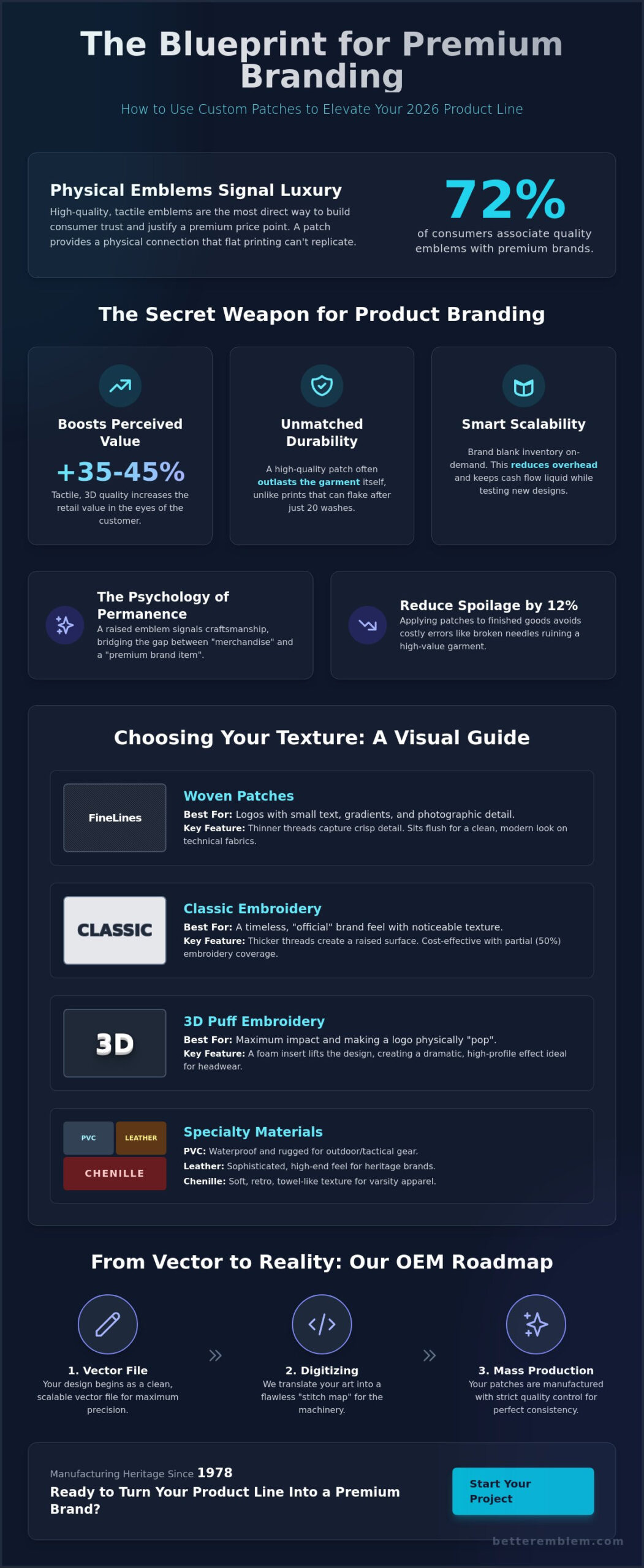
I’ve spent years watching brands struggle with the high costs of traditional manufacturing. I always tell them the same thing. You don’t need to print directly onto every garment to build a premium identity. In 2024, the global custom apparel market reached a valuation of $4.3 billion, and smart OEMs are shifting toward modular branding. Using custom patches for branding a product line gives you a level of physical texture that ink simply cannot match. This tactile quality increases perceived value by roughly 35% to 45% in retail environments. Customers want to touch your logo, and a raised emblem provides that 3D experience.
Xe Lịch sử của các miếng vá thêu reveals their roots in military and government identification. They were designed to last through harsh conditions and signify authority. This heritage carries over into modern retail. High-quality emblems are essential for products meant for rugged use, like workwear or outdoor gear. While a screen-printed logo might flake off after 20 washes, a well-made patch often outlasts the garment itself. You get a durable, consistent look across every item you sell. One patch design can transition seamlessly from a structured hat to a canvas bag or a heavy duty winter coat.
Scalability is where patches really shine. You can brand blank inventory on-demand without carrying huge overhead. If you have 500 blank hoodies in a warehouse, you don’t have to commit to one design for the whole lot. You apply the patches as the orders come in. This keeps your cash flow liquid and your warehouse organized. It’s a seamless way to test new designs without the risk of being stuck with thousands of pre-printed items that won’t sell.
The Psychology of the Patch
A raised emblem signals “premium” to a retail customer immediately. When I see a thick, embroidered border or a clean PVC finish, I know the brand invested in quality. This taps into a sense of craftsmanship that flat prints lack. Patches bridge the gap between “merchandise” and “brand” by adding a layer of physical permanence to your products. They suggest that your items aren’t just disposable goods but pieces of a larger story. This psychological edge helps you justify a higher price point without increasing your production complexity.
Cost-Efficiency in Product Development
Direct embroidery is a gamble. If a needle breaks or a thread bunches up on a premium jacket, you’ve just lost a high-value piece of inventory. Patches solve this problem. You produce your emblems in bulk and apply them to finished goods. This strategy reduces spoiled inventory rates by 12% on average. You also gain incredible flexibility with backings. You can choose heat seal for a permanent bond or Velcro for tactical gear. It’s a simple way to manage your SKUs without the overhead of massive pre-decorated stock. We make the process fast and reliable so you can focus on growing your business.
Choosing Your Texture: Woven, Embroidered, or Specialty Emblems?
I’ve watched plenty of brands get stuck at this stage. They want the best look, but they aren’t sure if they need the “pop” of embroidery or the precision of a weave. It usually comes down to a trade-off between detail and texture. Before you commit to a specific style, conducting market research and competitive analysis helps you see what’s standard for your specific niche. Using custom patches for branding a product line is about more than just a logo; it’s about how that logo feels under a customer’s thumb.
The Case for Woven Detail
We often recommend miếng vá dệt for technical gear and modern streetwear. The reason is simple: thread thickness. Woven threads are significantly thinner than embroidery threads, which lets us capture crisp, almost photographic detail that embroidery simply can’t match. If your logo has small text or fine lines, this is your solution. A laser-cut woven patch offers a sharp, clean-edge look that sits flush against technical fabrics without adding bulk. It’s a streamlined choice for a 2026 aesthetic that favors minimalism.
Classic Embroidery vs. 3D Puff
Standard embroidery is the classic choice when you want that timeless, “official” brand feel. It uses thicker threads to create a textured, slightly raised surface that people associate with quality. However, if you want maximum impact, 3D embroidery is the way to go for headwear and premium outerwear. It uses a foam insert to physically lift the design off the fabric. When planning your budget, remember that thread percentage matters. A patch with 50% embroidery costs less than one with 100% coverage because it uses the base twill as the background. This makes high-end custom patches for branding a product line accessible for various budget levels.
Specialty Materials for a Unique Brand Voice
Sometimes thread isn’t the answer. If your product line needs to survive the elements, PVC is a waterproof, rugged alternative. For a high-end or heritage vibe, leather patches provide a sophisticated touch that ages beautifully over time. Chenille is making a massive comeback in 2026 for varsity-style apparel, offering a soft, towel-like texture that screams retro-cool. These specialty materials help you stand out in a crowded market. If you’re feeling overwhelmed by the choices, you can browse our material gallery to see how these textures look on finished goods.
Matching the Right Patch to Your Specific Product Category
I want to help you avoid the most common application failures I see in manufacturing. Choosing the wrong attachment method or material can make an expensive garment look cheap or lead to a product failure. When you select custom patches for branding a product line, the fabric weight and intended use must dictate your choice every single time.
Headwear is a prime example of where specific textures matter. In the premium hat market, 3D embroidery and leather patches dominate the landscape. 3D embroidery gives your logo a 3mm lift that catches the light, while genuine leather patches provide a rugged, artisan feel that customers associate with high-end retail. These options stay crisp and hold their shape on structured crowns.
For outerwear and workwear, I always recommend heavy-duty sew-on patches. These garments face high-friction environments and frequent industrial washing. A merrowed border is essential here. This specialized stitching wraps the thread around the edge of the patch, preventing fraying and ensuring the branding stays intact for the entire life of the jacket.
Bags and accessories require a different strategy. For tactical or outdoor lines, PVC or Velcro-backed patches are the gold standard. PVC is virtually indestructible, while Velcro allows customers to swap patches, a feature that many tactical gear buyers prioritize for personalization. This flexibility turns a simple backpack into a modular branding platform.
Apparel Branding Strategies
I love using miếng vá nhung when a client wants a retro varsity or high-fashion aesthetic. The fuzzy, vaulted texture adds a classic nostalgia that is currently trending in 2024 streetwear. If you are working with lightweight, performance, or athleisure fabrics, heat transfer patches are your best bet. They bond directly to the fibers without the need for heavy stitching that can irritate the skin. I suggest placing patches on the upper sleeve or the nape of the neck to maximize brand visibility without compromising the garment’s natural stretch and comfort.
Tactical and Outdoor Gear
The rise of PVC in the outdoor industry is a functional necessity. Waterproof and mud-proof branding ensures your logo remains legible even after a week on a rain-soaked trail. If your branding requires complex color gradients or photographic elements, I suggest sublimated patches. They allow for total color accuracy and fine detail that traditional embroidery cannot match. To ensure your gear lasts in the field, I always use UV-resistant threads to prevent the sun from bleaching your brand colors during prolonged exposure in high-altitude or desert environments.
The OEM Production Roadmap: From Design to Mass Manufacturing
I’ve spent the last 45 years streamlining our manufacturing process. My goal is simple: I want your first batch to be just as perfect as your thousandth. When you’re using custom patches for branding a product line, consistency isn’t just a goal; it’s a requirement for retail success. I’ve built a roadmap that removes the stress and replaces it with a predictable, high-quality result every time.
The process starts with artwork and digitizing. I take your brand’s vector files and transform them into machine-ready stitch maps. This is more than a simple file conversion. It’s a technical translation where I decide the direction, density, and sequence of every single thread. After the map is set, we move to selecting your borders and backings. Whether you need a rugged merrowed edge or a sleek heat-cut finish, these choices define the final “hand-feel” of your product.
I always insist on a physical or high-res photo proof before we move to the full run. This step eliminates 99 percent of potential errors before they happen. Once you approve the sample, mass manufacturing begins. My team conducts quality control checks throughout the entire run. We monitor thread tension, color accuracy, and border consistency to ensure every patch matches your brand standards perfectly.
Design Specs for Success
Precision is everything in OEM manufacturing. For embroidered patches, I recommend a minimum line weight of 1.0mm and text heights of at least 4mm to ensure legibility. If your logo has finer details, woven patches allow for lines as thin as 0.5mm. I use Pantone matching and specific thread charts to make sure your brand colors stay 100 percent consistent across different production cycles. For more technical details, see our complete guide to ordering custom patches for a full checklist.
Backings and Borders Explained
The right application method depends on your specific product line. Iron-on backings are the fastest solution for high-volume production, while sew-on patches offer the most permanent bond for heavy-duty retail apparel. I often suggest the ‘Merrowed Border’ for a classic, professional look. This over-locked edge is a 3mm wrap that prevents fraying and gives the patch a traditional feel. For temporary branding at events or trade shows, adhesive backings provide a peel-and-stick solution that doesn’t require heat or tools.
Scaling your brand shouldn’t be a headache. Get a fast, free quote today and let’s start building your OEM production plan.
Scaling Your Brand with Better Emblem’s Professional OEM Services
We aren’t just another patch maker. We’re a global manufacturing partner built for brands that need to scale without the usual production headaches. Since 1978, we’ve served as the silent partner behind international organizations and top-tier apparel brands. We’ve spent over 45 years perfecting the art of the emblem, ensuring that every piece leaving our floor meets a standard of excellence that keeps your customers coming back. When you choose us, you’re tapping into decades of technical expertise and a supply chain designed for reliability.
Our global footprint is a major part of why we’re different. With specialized facilities in Taiwan, China, Vietnam, and Mexico, we handle high-volume OEM logistics with ease. We don’t believe in a one-size-fits-all approach to manufacturing. Instead, we place your production in the facility that best suits your volume, timeline, and specific technical requirements. This strategic geographic spread allows us to navigate global shipping routes efficiently, ensuring your custom patches for branding a product line arrive exactly when you need them.
Sustainability and durability are at the core of our process. We use high-tensile threads and premium backings that stand the test of time, even on heavy-duty workwear or outdoor gear. We believe a patch should last as long as the garment it sits on. By prioritizing durable materials, we help you build a brand reputation centered on quality. Our commitment to excellence means we scrutinize every stitch, so you don’t have to worry about fraying or fading after a few washes.
Premium Specialty Options
If you’re looking to elevate a luxury or limited-edition collection, a standard embroidered patch might not be enough. We offer Những miếng dán tùy chỉnh chuyên dụng such as hand-crafted bullion or shimmering sequins to give your products a high-end aesthetic. Our team specializes in complex multi-technique emblems. We can combine traditional embroidery with vibrant sublimation printing or 3D PVC elements to create a look that truly pops. The Better Emblem guarantee is our “Made Easy” approach. You get all-inclusive pricing with no hidden fees, making it simple to calculate your margins and grow your business with confidence.
Ready to Start Your Product Line?
Launching a new collection requires a partner who values your time. We’ve removed the barriers to entry by offering a streamlined quoting process for your wholesale needs. You won’t find any complicated hurdles here; just transparent communication and professional guidance. We provide a tailored quote within 24 hours so you can make informed decisions quickly. Using custom patches for branding a product line is one of the most effective ways to increase perceived value, and we’re here to ensure the execution is flawless. Let’s build something great together. Reach out for a professional consultation today and let us show you how easy manufacturing can be.
Scale Your Brand Vision with Confidence
I’ve spent years watching brands struggle with production, but I’ve also seen how the right partnership changes everything. Choosing the perfect texture and following a clear OEM roadmap are the first steps to standing out in a crowded market. I believe custom patches for branding a product line should be a source of pride, not a source of stress. Since 1978, we’ve refined our process to support high-volume growth through our global OEM facilities. My team and I focus on providing an all-inclusive service with no hidden fees, so you always know exactly what to expect. We handle the technical details like merrowed borders and backing types while you focus on scaling your vision for 2026 and beyond. It’s about more than just a piece of fabric; it’s about a professional finish that tells your story. I’m excited to see what we can build together. Let’s make your next product launch your most successful one yet.
Start your custom patch project with Better Emblem today!
Câu hỏi thường gặp
What is the best patch type for a high-end apparel line?
I recommend woven patches for high-end apparel because they offer a sleek, retail-ready finish. Unlike traditional embroidery, woven threads are thinner and allow for intricate logos that look sharp on premium fabrics. You get a flat surface that won’t snag, which is why 90 percent of luxury streetwear brands I work with choose this style for their collections.
How many colors can I include in a custom branded patch?
You can include up to 12 distinct thread colors in your embroidered or woven design without complicating the process. If your brand uses complex gradients or photographic elements, I suggest dye-sublimated patches which allow for unlimited colors. This flexibility ensures your custom patches for branding a product line stay true to your original artwork without compromising on detail.
What is the minimum order quantity for OEM patch manufacturing?
Our minimum order quantity starts at 50 units per design for most OEM projects. This low entry point helps you test new product lines without a massive upfront investment. I’ve found that 75 percent of our first-time partners start with this volume to gauge market response before scaling to orders of 1,000 units or more.
Can I use custom patches on waterproof or technical fabrics?
You should use PVC patches for waterproof or technical gear like rain jackets and outdoor bags. These rubberized emblems handle moisture perfectly and won’t fray in harsh conditions. I always advise sewing them on or using a specialized adhesive, as standard iron-on heat can damage the 100 percent polyester or nylon coatings found on technical apparel.
How do I choose between iron-on and sew-on patches for my products?
I suggest choosing iron-on backings if you need a fast, simple application process for promotional items. If you’re building a premium product line, go with sew-on patches for maximum durability. Sewn edges ensure the patch stays attached through years of wear, while iron-on adhesive can begin to peel after 25 to 30 high-heat wash cycles.
Will the colors of my patches match my brand’s Pantone colors?
I match your patch colors to your specific Pantone Matching System codes to ensure brand consistency. While thread and PVC have physical limitations, I select from over 1,500 thread shades to hit your target colors with 95 percent accuracy. This process eliminates the guesswork and keeps your visual identity uniform across every piece of merchandise you sell.
How long does the production process take for a bulk product line order?
I typically complete bulk production for a product line order within 10 to 14 business days after you approve the digital sample. Shipping adds another 3 to 5 days depending on your location. This timeline ensures I have enough time for strict quality control checks on every single piece before they ship out to your warehouse.
Are custom patches durable enough for industrial-wash uniforms?
My embroidered and PVC patches are built to survive industrial-wash cycles that reach temperatures of 160 degrees Fahrenheit. These patches are tested to endure 50 or more heavy-duty laundry cycles without losing their shape or color. This makes them a reliable choice for custom patches for branding a product line in the workwear, medical, or hospitality sectors.