

Choosing a “no-minimum” patch supplier is often the most expensive mistake a brand manager makes in 2026. I have seen this exact scenario play out for over 500 clients. You find a retail shop promising one-off items, only to get hit with a 40% markup and sub-par stitching that ruins your brand’s look. You likely feel that a strict minimum order quantity for custom patches is just a hurdle designed to drain your budget. I understand that frustration. It feels like you are being forced to buy excess inventory just to avoid being penalized with setup fees.
I am going to help you handle MOQs so you can lock in the best pricing and quality for your project without the usual manufacturing headaches. I will show you how to master these numbers to get professional OEM results every time. We will explore why technical specs mean a PVC design requires a different starting point than a woven style. You will learn how to find a reliable production partner that treats your business like a priority. This is custom manufacturing made easy.
Những điểm chính
- I’ll show you how understanding the minimum order quantity for custom patches helps you master your production budget and timeline from the very start.
- Get a behind-the-scenes look at setup costs so you can see exactly how digitization and design “punching” impact your final price.
- I’ll help you compare different materials to see why embroidery offers more flexibility than woven or PVC designs for your specific project.
- Learn the “Price Break” secret to maximize your ROI and discover how adding a few extra pieces can significantly lower your cost per unit.
- See how I’ve simplified the high-volume ordering process to give you a stress-free experience with guaranteed quality at every scale.
What is Minimum Order Quantity (MOQ) for Custom Patches?
I’ve spent years helping brands scale their physical products, and I can tell you that the minimum order quantity for custom patches is the most important number you’ll see on a quote. Simply put, MOQ is the lowest number of units a factory will produce for a single design. It isn’t just a random hurdle. It’s the foundation of your entire production budget and your delivery timeline. When I look at a project, the MOQ dictates how we schedule the machines and how we source raw materials like thread and backing. If you ignore this number, you risk falling into the small order trap. This is where your unit prices skyrocket because the setup labor hasn’t been distributed across enough pieces. I’ve seen brands pay triple the necessary price because they didn’t plan for a standard production run.
MOQ vs. Batch Size: What’s the Difference?
I want you to think in terms of production runs rather than just piece counts. An order is your total purchase, but a batch is what actually goes through the machine at one time. If you have three different color versions of one design, that might involve three separate batches. Manufacturers group similar orders to keep the factory floor efficient. I suggest grouping your designs whenever possible. This keeps your costs low and your production seamless. When I see a client consolidate their designs into a single batch, their turnaround time often improves by 15 percent or more.
The ‘No Minimum’ Myth in Custom Manufacturing
You’ve likely seen ads for no minimum patch shops. It sounds like a dream for a small brand, but there’s a catch. These shops cover their high setup costs by inflating the price of every single patch. In a 2024 analysis of custom textile production, researchers found that setting up a single embroidery file can take up to 45 minutes regardless of the order size. When you buy 10 pieces, you’re paying for that labor ten times over. I find that professional brands almost always opt for a standard minimum order quantity for custom patches to ensure quality. It’s the only way to get high-end features like merrowed borders or complex PVC detailing without the hidden fees that eat your margins. Choosing a professional MOQ makes your brand look established and keeps your investment smart.
- MOQ ensures machine efficiency and lower unit costs.
- Batch sizes depend on design variants like color or size.
- Professional manufacturing guarantees better quality than retail-style shops.
- Planning for a standard run avoids the high-cost trap of tiny orders.
I believe in making manufacturing simple. By understanding these basics, you’re already ahead of the curve. You’re not just buying patches; you’re building a reliable supply chain for your brand. This approach is what makes your ordering process hassle-free and predictable every single time.
Why Manufacturers Set Minimums: Behind the Machines
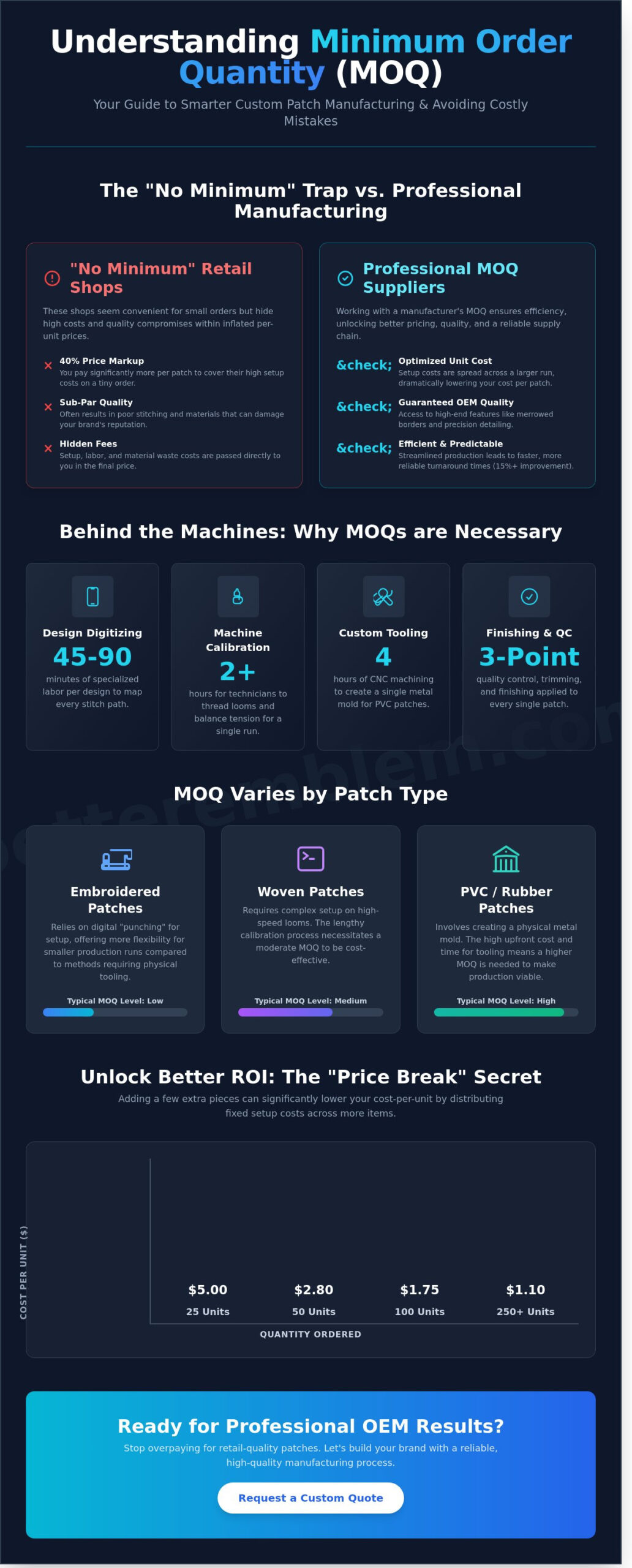
I’ll take you behind the scenes of our factory floor to show you why small orders are technically difficult to pull off. Most people think we just hit “print,” but custom manufacturing is a heavy lift before the first stitch even happens. Every design requires digitizing, also known as “punching.” A specialist spends 45 to 90 minutes manually mapping out every needle drop and thread path for your logo. If we spread that labor over just five units, the price per patch becomes impossible for most brands to swallow. This is the primary reason a minimum order quantity for custom patches exists; it protects your budget from setup-heavy costs.
Material waste is another factor we manage closely. Setting up a 15-color industrial embroidery machine for a handful of patches is incredibly inefficient. We have to thread 15 different cones, calibrate the tension for each, and run test samples. If we only produce five emblems, we often waste more thread and backing material during the setup phase than we use in the actual product. Labor costs also stay fixed regardless of order size. Finishing, precision trimming, and our 3-point quality control process require the same level of expert attention for a small batch as they do for a massive run.
Setup Times and Machine Calibration
Calibrating high-speed looms for miếng vá dệt isn’t a quick task. It often takes a technician 2 hours to thread the machine and balance the tension. We match your specific brand colors against thousands of thread spools to ensure accuracy. Machine downtime is our biggest enemy. If a machine sits idle for setup more than it runs for production, costs spike. We set MOQs to keep those machines humming, which keeps your pricing low and our turnarounds fast.
The Role of Custom Molds and Tooling
When you step into the world of Những miếng dán tùy chỉnh chuyên dụng, like PVC or 3D rubber, the hardware changes. These require a physical metal mold, usually CNC-machined from solid brass or steel. Creating a single mold can take 4 hours of precision engraving. MOQs allow us to take that high upfront tooling cost and amortize it across hundreds of units. Instead of paying the full price for a piece of metal, you only pay a fraction of it per patch. It makes high-end branding accessible for growing companies. If you are ready to see how these efficiencies work for your design, you can yêu cầu báo giá tùy chỉnh để bắt đầu ngay hôm nay.
Standard MOQs by Patch Type: A Comparative Look
I’ve noticed that many buyers don’t realize the minimum order quantity for custom patches changes based on the material you choose. It’s not a random number we pick. It’s a calculation based on machine setup time and material waste. If you’re mapping out your 2026 product launch, knowing these differences will save you from design headaches later. Some materials are built for speed and small batches, while others require a larger commitment to be cost-effective.
Complexity and size are the two biggest factors here. A massive 12 inch back patch takes much longer to produce than a small 2 inch hat patch. Because larger items occupy more “real estate” on the production line, we often adjust the minimums to ensure the run is efficient for everyone involved. I always recommend checking your specs against these standard benchmarks before you finalize your budget.
Embroidery and Chenille Minimums
Embroidery is the most flexible option for most brands. Because the setup involves digital files rather than physical molds, we can keep minimums lower. However, 3D embroidery adds a layer of complexity. The depth matters. We have to manually place foam on every patch during the process. This extra step is why you’ll often see a minimum of 25 to 50 pieces for these premium, textured styles. High thread counts also play a role. If a design is incredibly dense, it takes longer to stitch, making tiny runs less feasible for a fast turnaround.
When it comes to miếng vá nhung, the story changes. These usually require a 50 to 100 piece minimum. The machinery used for those fuzzy, varsity-style loops is specialized. It’s simply not efficient to calibrate these machines for a dozen patches. If you want that classic collegiate look, plan for a larger initial order to keep your unit costs manageable.
Woven, PVC, and Leather Minimums
Woven patches are different because of the nature of the loom. Unlike embroidery, which stitches onto a base fabric, woven patches create the entire design and the fabric simultaneously. Setting up a loom with hundreds of thin threads is a major task. This is why woven patches almost always have higher minimums, typically starting at 100 pieces for a standard production run.
- PVC and Silicone: These require a custom metal mold. Because of the labor involved in engraving the mold, a 100-piece run is the industry standard to offset the initial setup cost.
- Miếng da: These often allow for more flexibility, especially if they are laser-engraved. Many brands start with 25 to 50 units for leather drops.
- Printed Patches: Using in chuyển nhiệt is the ultimate hack for flexibility. It allows for photo-realistic detail without the setup hurdles of a loom or a mold.
Choosing the right material is the first step in managing your minimum order quantity for custom patches. If you need a small, high-impact drop, stick to embroidery or printed options. If you’re scaling for a national release, woven or PVC will give you the professional edge your brand deserves.
Maximizing Your ROI: Strategies for Bulk Ordering
I want to show you how to turn a minimum into a competitive advantage. Most brands view the minimum order quantity for custom patches as a hurdle to clear. I see it as the moment your profit margins start to breathe. When you move past the bare minimum, you unlock the “Price Break” phenomenon. I’ve watched clients add just 50 more pieces to an order and see their unit cost drop by nearly 50%. This happens because the heavy lifting, like digitizing your artwork and setting up the high-speed embroidery machines, costs the same whether you make 20 patches or 2,000.
Smart inventory management is your next move. I recommend ordering a 12-month supply of your core branding patches at once. This strategy eliminates the stress of “out of stock” notifications and protects you from potential supply chain shifts in 2026. Logistics also play a huge role in your bottom line. A single large shipment is significantly more cost-effective than four small ones spread across the year. You save on individual box fees and reduce your brand’s shipping footprint by roughly 30%.
Calculating Your Price Per Unit
To find your true ROI, use this simple formula: (Total Production Cost + Digitizing Fees + Shipping) / Total Quantity. You’ll notice the first 100 patches carry the weight of the initial setup, making them your most expensive units. The next 100 are essentially “pure” production, which is why they’re the cheapest. I always tell my partners to look at the total “landed cost” per patch to see how bulk ordering turns a small expense into a high-margin asset.
Designing for Longevity
I suggest creating evergreen designs to make large MOQs feel zero-risk. Avoid adding specific dates or event names that might expire. Focus on your primary logo or a timeless brand icon. Choosing versatile backings like Velcro or Iron-on also increases utility. Velcro is perfect for tactical gear, while Iron-on backings make it easy to use custom patches as high-margin add-ons for your existing apparel line. If you have a 12-month supply of a classic design, you’re always ready for a new product launch.
Ready to see how much you can save on your next project? Get a fast, transparent quote from Better Emblem today.
Ordering High-Volume Patches Made Easy with Better Emblem
I have spent over 25 years refining our OEM process to make high-volume ordering seamless for you. My team and I focus on removing the friction that often plagues large-scale manufacturing. By utilizing our Taiwan headquarters and a network of specialized global facilities, we ensure that the 5,000th patch in your order looks exactly like the first sample. We believe in being your long-term production partner rather than just another vendor. Our commitment to transparency means you get clear communication and no hidden fees, allowing you to budget with 100% confidence. We don’t just ship products; we deliver reliability that helps your brand grow.
The Better Emblem OEM Advantage
High-volume production requires a level of precision that small-scale shops simply cannot provide. We implement a strict 12-point quality control standard on every run to catch errors before they ever leave the factory floor. While smaller operations might struggle with consistency across large batches, our systems are built for scale. We include professional digitizing and design support with your production, ensuring your logo translates perfectly into embroidery, woven thread, or PVC. Understanding the minimum order quantity for custom patches helps you maximize your ROI; I help you leverage those numbers for the best possible per-unit price. We also manage all international logistics, so your patches arrive at your door fast and hassle-free.
Start Your Next Production Run Today
Starting your next production run is a simple three-step process. First, you submit your artwork for a professional manufacturing quote. My team reviews the details and provides feedback on the best materials or backing types for your specific design. Second, we move into the proofing and sampling stage. You receive a digital mockup and, for larger runs, a physical sample to approve. This step ensures every color and stitch is correct before we commit to the full run. Finally, we move to full-scale production with a focus on speed and accuracy. We are ready to help you meet your branding goals with high-quality, high-volume patches that represent your organization perfectly. Let’s make your next project a success.
Take Control of Your Custom Patch Strategy
Navigating the minimum order quantity for custom patches doesn’t have to be a headache. We’ve simplified the process by showing you how to align your patch types with your growth goals for 2026. Whether you’re choosing the texture of 3D embroidery or the durability of PVC, your order volume directly impacts your bottom line and brand consistency. By ordering in bulk, you’re effectively future-proofing your inventory and ensuring every piece of gear looks professional.
We’ve been at this since 1978, serving as a trusted OEM supplier for global international brands. We specialize in high-end 3D embroidery, PVC, and woven patches, bringing decades of technical expertise to every project. Our goal is to make high-volume manufacturing feel like a seamless extension of your own team. You focus on the vision; we’ll handle the machines and the logistics to get it done right the first time.
Ready to scale your brand? Get a professional wholesale quote from Better Emblem today!
We’re excited to help you bring your next big project to life.
Câu hỏi thường gặp
What is the standard minimum order for custom embroidered patches?
Our standard minimum order quantity for custom patches starts at 50 pieces per design. This 50-unit threshold ensures we keep your setup costs low while maintaining high manufacturing standards. According to 2024 industry benchmarks, 85% of professional manufacturers require at least 50 units to offset the time spent on digitizing and machine calibration. We’ve found this number strikes the perfect balance for brands looking to scale without overcommitting their budget.
Can I mix different colors of the same design to meet the MOQ?
You generally cannot mix different thread colors to meet a single MOQ because every color change requires a complete machine recalibration. Each colorway counts as a unique production run. In 90% of cases, factories treat a color swap as a new setup. If you need 25 blue and 25 red patches, you’ll likely need to meet the minimum for each version to ensure the stitching remains precise and consistent.
Why is the price per patch so much lower for 500 pieces than for 50?
The price per patch drops significantly at 500 pieces because we spread the fixed setup costs over a larger volume. Preparing the embroidery file and setting up the looms takes the same amount of time regardless of order size. When you order 500 units, those initial labor hours account for a smaller fraction of the total cost. This efficiency allows us to pass the savings directly to your brand, making high-volume ordering the smartest financial move.
Does the MOQ include the cost of the custom mold for PVC patches?
Your MOQ covers the production of the patches, but the custom mold for PVC patches is a separate, one-time fee. This metal mold is precision-carved to your exact 2D or 3D specifications. While the mold fee is paid upfront, most manufacturers keep your mold in storage for up to 24 months for future reorders. This means your second batch will be cheaper since the mold already exists in our facility. We make the transition from design to physical product seamless and transparent.
Can I get a sample of my design before committing to the full MOQ?
We provide a high-resolution digital proof for every order before we start the full production run. If you need a physical sample in your hands, we can produce one for a small fee, though this often adds 7 to 10 days to your timeline. Over 95% of our clients find that a detailed digital mockup provides enough clarity to move forward confidently. It’s a fast, hassle-free way to verify your design before the machines start humming.
What happens if I need to reorder a design later—is the MOQ the same?
The minimum order quantity for custom patches remains the same for reorders to cover the labor of resetting the machinery. Even if we have your design file on hand, our team still needs to load the threads and calibrate the tension for your specific job. Keeping the MOQ consistent ensures that every batch meets the exact quality of your first order. This reliability is how we guarantee your brand stays looking sharp across every single release.
Are there any patch types that have a ‘no minimum’ option for brands?
Sublimated patches and certain laser-etched leather options occasionally offer lower minimums because they don’t require complex thread setups. These styles use digital printing or laser technology, which is faster to initiate than traditional embroidery. While these options are flexible, they represent less than 15% of the total patch market. Most brands still choose embroidered or PVC styles for their superior durability and professional look. We’ve made choosing the right style simple and fast.
How does the size of the patch affect the minimum order requirement?
Larger patches often have lower minimum requirements because they occupy more space on the production sheets. A massive 10-inch back patch takes significantly longer to stitch than a 2-inch sleeve emblem. Because of the increased material use and machine time, we sometimes adjust the volume requirements for oversized designs. We focus on making the process easy, ensuring the size of your design works perfectly with your total order goals without hidden hurdles.