
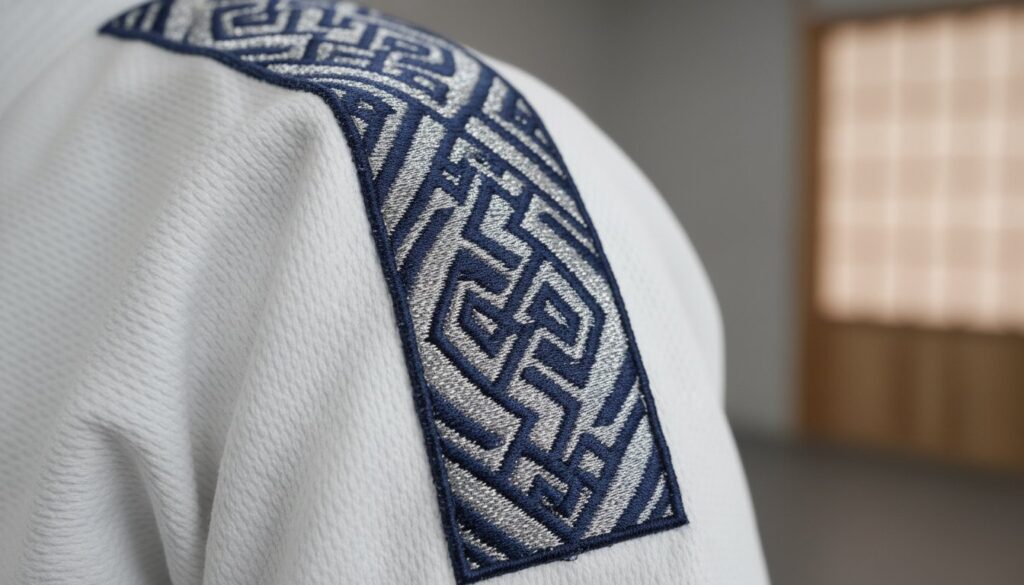
You step off the mats after a hard round of rolling only to find your academy logo peeling off and your pristine white gi stained by bleeding thread colors. I’ve seen it happen too often, and it’s a headache you don’t need when you’re focused on training. You need gear that works as hard as your students do. High-quality gear isn’t just about looks. A 2025 study of Melbourne academies found that 38% of gear-related skin issues were linked to deteriorating fabrics that trap bacteria. This is why choosing the right embroidered patches for martial arts gis is a matter of performance, not just decoration.
I’ll show you how to design and source patches that survive the toughest grappling sessions and look professional on every gi. We’ll walk through the best manufacturing methods for long-term durability and the specific 2026 IBJJF regulations regarding cotton fabric and placement. I’ll also help you decide if traditional embroidery, detailed woven patches, or rugged PVC options are the right choice for your brand. Let’s get your team looking sharp with patches that actually stay attached, roll after roll.
主要心得
- I’ll help you understand why standard patches fail on the mat and how high-tensile construction keeps your gear looking professional.
- You’ll learn the structural differences between woven and embroidered patches for martial arts gis to find the perfect fit for your academy.
- I’ll explain why the sew-on method is the only industry standard for patches that need to survive heavy grappling and hot washes.
- Use my “Finger-Catch” design rule to create custom shapes that won’t snag or tear during intense training sessions.
- Discover how to source bulk specialty patches through a reliable manufacturing partner that handles high-volume orders with ease.
What Makes Martial Arts Gi Patches Different?
I define gi patches as high-tensile textile emblems specifically engineered for combat sports. Unlike a patch you might find on a denim jacket or a backpack, these pieces of equipment have to survive literal war on the mats. When I design embroidered patches for martial arts gis, I start with the assumption that they will be pulled, stepped on, and soaked in sweat every single day. Standard “fashion” patches usually fail within weeks because they lack the structural integrity to handle that kind of abuse. They simply aren’t built for the friction of a double-leg takedown or the tension of a collar choke.
In any dojo or academy, your patches serve two main jobs. They build your brand and they identify student rank or team affiliation. If your logo is fraying or the colors are fading, it sends a message of poor quality to your students and competitors. That is why durability is the number one metric I prioritize. For a deeper embroidered patch overview, you can see how these items have evolved over time, but for martial arts, we have to push the manufacturing limits to ensure they don’t become a liability during training.
The Stress Test: Friction and Tension
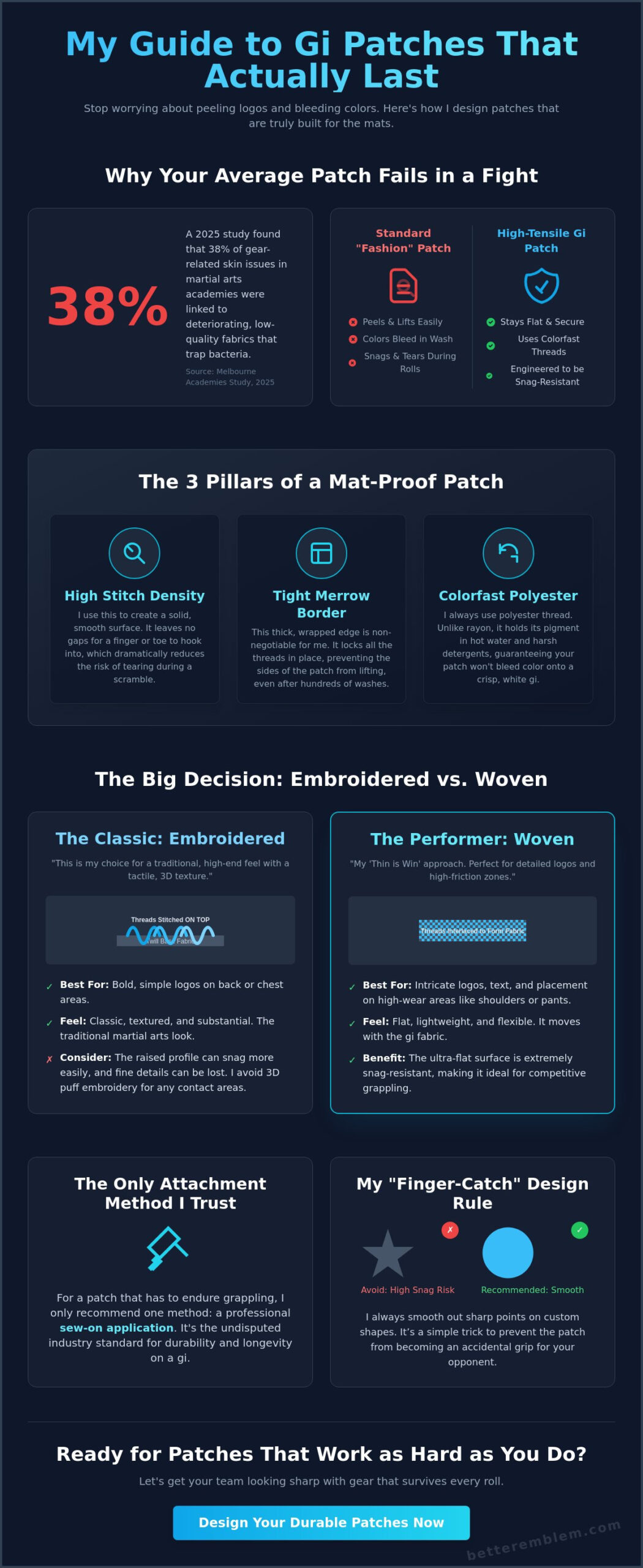
BJJ and Judo involve constant, aggressive pulling on the gi fabric. If a patch has a low stitch count, a stray finger or toe can easily hook into the threads and rip the design apart. I make sure our embroidered patches for martial arts gis use a high stitch density to create a solid, snag-resistant surface. I also insist on a tight merrow border. This thick, wrap-around edge locks the threads in place and prevents the sides of the patch from lifting. When the edges stay flat, there’s nothing for an opponent to grab onto by accident.
Washability and Heat Resistance
Martial arts gear lives in the laundry room. Between the sweat and the bacteria, gis need frequent high-temperature washes to stay hygienic. I’ve seen standard rayon threads bleed their colors onto a white gi, ruining a hundred-dollar uniform in a single wash cycle. I always use colorfast polyester threads for this reason. They hold their pigment even when you’re using harsh detergents or the occasional splash of bleach to keep your whites bright. It is about making sure the patch looks as good on day 300 as it did on day one, regardless of how many times it hits the dryer.
Embroidered vs. Woven Patches: Which Is Best for Your Gi?
When you’re choosing embroidered patches for martial arts gis, the first decision is usually between embroidery and woven styles. I see it as a choice between texture and precision. Embroidery uses a base fabric with threads stitched on top, creating a raised, tactile feel that most people associate with traditional martial arts. Woven patches are different because the warp and weft threads are interlaced together simultaneously to create both the design and the fabric. This fundamental difference affects how the patch feels against your skin and how it holds up during a scramble.
I often point to embroidery material science research to explain how thread density impacts fabric stiffness. On a heavy kimono, you want a patch that moves with the garment rather than acting like a stiff board. If you’re placing a large emblem on the back of a gi, embroidery gives that classic, high-end look that stands out in competition photos. It provides a level of depth that makes a brand feel established and professional.
The Case for Custom Woven Patches
I call this the “Thin is Win” approach for active gear. Because 編織補丁 use much thinner threads than embroidery, the final product is incredibly flat and lightweight. This is a huge advantage in high-friction areas like the shoulders or the shins. These patches don’t have a raised surface for an opponent’s fingers to catch on, which significantly reduces the risk of the patch tearing off mid-roll. It’s why many professional BJJ brands prefer them for intricate logos that need to stay crisp and legible even after months of abuse.
The Classic Appeal of Custom Embroidery
There’s something undeniably premium about the weight and texture of a high-quality embroidered patch. I recommend using 100% embroidery coverage for dojo logos that need a bold, traditional feel. However, you have to be careful with specialized styles. While 3D embroidery looks amazing, I suggest reserving it for non-contact areas like the gi bag or a coach’s jacket. On the mats, the extra height of 3D foam can be a liability because it snags easily. To get the best results, I balance the thread count to ensure the patch remains flexible. If you aren’t sure which style fits your academy’s needs, you can explore our manufacturing options to see the differences firsthand.
Choosing the Right Backing and Attachment Method
I believe the way you attach a patch is just as vital as the patch itself. You can have the most beautiful design in the world, but if it flies off during a heavy sparring session, it’s a failure. To understand why these garments require such heavy duty attachment, we have to look at the origin of the modern martial arts gi. These uniforms were designed to be armor, built from thick, reinforced cotton that resists tearing. Because the fabric is so dense, your attachment method needs to be equally rugged. I’ll be blunt: iron-on adhesives are a recipe for disaster in a grappling environment. The heat and friction of a roll will melt the bond, while frequent hot washes cause the edges to curl. For anyone serious about training, sew-on is the only industry standard that makes sense.
There are rare cases where hook-and-loop backings, often called Velcro, are useful. I usually see this in tactical martial arts programs or modular uniforms where instructors need to swap out rank patches quickly. However, for the average student, a permanent fix is always safer. It’s about safety as much as style. If a patch starts to lift, it creates a pocket where a finger can get caught, leading to potential injury. Choosing the right manufacturing process for embroidered patches for martial arts gis means planning for these high-stress moments before the patch even hits the sewing machine.
The Sew-On Standard for Durability
I always recommend custom sew-on patches for any academy owner who wants their gear to last for years. When you’re ready to attach them, I suggest using a tight zig-zag stitch along the merrowed edge. This specific stitch provides incredible lateral strength, allowing the patch to stretch slightly with the gi without snapping the threads. You should use a high-strength polyester thread for the sewing process. Unlike cotton thread, polyester won’t rot from sweat or weaken after dozens of trips through the laundry.
Backing Options: Plastic vs. Paper vs. None
The backing is the hidden layer that gives your embroidered patches for martial arts gis their structure. I usually recommend a thin plastic backing. It provides a waterproof barrier that helps the patch hold its shape without making it feel like a piece of cardboard. If you’re placing a patch on a curved area, like the top of the shoulder, I suggest going with “no backing” at all. This makes the emblem much more flexible, allowing it to wrap around the body naturally. I tell my clients to avoid thick, rigid paper backings. They tend to break down in the wash and can become abrasive, causing skin irritation through the gi fabric during long training sessions.
Design Tips for “Battle-Ready” Martial Arts Emblems
I’ve seen many great digital logos fail once they are translated into embroidered patches for martial arts gis. Designing for combat is different than designing for a standard corporate polo. You have to think about how the patch interacts with human hands, the floor, and the heavy weave of the kimono. A design that looks beautiful on a screen might become a liability if it isn’t optimized for the physical reality of a grappling session. I want your gear to look sharp, but I also want it to be safe and long-lasting.
I always use the “Finger-Catch” rule when I review a new design. If your patch shape has sharp, needle-like points or thin extensions, they are going to lift over time. Those points act like little hooks for an opponent’s fingers or toes during a scramble. I recommend using rounded corners or circular borders whenever possible. It keeps your students’ fingers safe and ensures the edges of the patch don’t peel away from the gi fabric after a few months of hard training.
Sizing is another area where I help academy owners avoid common mistakes. For a professional look, I suggest following these general dimensions:
- Back Patches: Large center emblems should stay between 10 and 12 inches wide to ensure they don’t interfere with the shoulder blades.
- Chest Logos: These work best at 3 to 4 inches in diameter for maximum visibility without being bulky.
- Pant Legs: Vertical text or logos should be about 8 to 10 inches long but kept narrow to avoid wrapping too far around the leg.
Simplifying for Success
Tiny text is the enemy of durable embroidery. In my experience, any lettering smaller than 0.25 inches tall will likely turn into an unreadable thread blob after a dozen wash cycles. I suggest using a thicker merrow border, usually about 1/8th of an inch, to provide a solid frame that resists fraying. For larger back patches, a twill background is a smart choice because it keeps the patch light and flexible. For smaller, high-impact chest logos, I prefer 100% embroidery fill to give the design a heavy-duty, premium feel that stands out from the sidelines.
Ensuring Colorfastness
This is where I see the most “bleed” issues on expensive white gis. I insist on using high-quality polyester threads because they are chemically resistant and won’t lose their pigment. Rayon threads might have a nice shine, but they often bleed their colors when they get soaked in sweat or meet a splash of bleach. I recommend testing your design for bleed potential by doing a small sample run before you commit to a bulk order. Industrial-grade dyes are essential for patches that undergo frequent sanitization. If you’re ready to create a design that looks sharp and stays that way, you can start your custom patch project here.
Why Better Emblem Company Ltd. is Your Partner for Bulk Gi Patches
Running a dojo is a full-time commitment. I realize you don’t have time to chase down vendors or worry about whether your next batch of embroidered patches for martial arts gis will match the quality of the last one. That is where I come in. At Better Emblem Company Ltd., we focus exclusively on high-volume OEM manufacturing. We’ve spent over 45 years refining our craft to help elite academies and global brands get the gear they need without the typical manufacturing headaches. This experience-driven approach ensures that your academy’s branding stays consistent across every single gi on your mats.
We don’t just handle standard designs. I help school owners navigate complex 訂製特種貼布, ranging from rugged PVC to high-detail woven styles. My primary goal is to remove friction from your supply chain. You receive direct factory pricing on all wholesale orders because we control the production process from start to finish. This transparency-centered model means you know exactly what you’re paying for. You get high-end results without the middleman markups that usually inflate costs for specialized gear.
From Concept to Dojo: Our Simple Process
I personally help you digitize your artwork specifically for the embroidery process. This ensures every stitch is optimized for the heavy, textured cotton of a martial arts gi. I take the Expert Facilitator approach to every project. This means I’m here to ensure your order is right the first time, every time. Global brands trust our production because we maintain centers in both Asia and North America. This global footprint allows us to handle massive volume with incredible efficiency. You get the reliability of a world-class manufacturer combined with the personal service of a partner who understands the dojo business.
Start Your Custom Project Today
You won’t find hidden hurdles or complex jargon here. I value your time and prioritize clear, direct communication. If you want to feel the durability of our work for yourself, I encourage you to request a sample. You can see how our embroidered patches for martial arts gis stand up to the intense friction and high-heat washing we discussed earlier. It is about building a long-term partnership that helps your gym grow and look professional. We handle the manufacturing-simplified details so you can stay focused on the training.
Ready to gear up your gym? Get a wholesale quote here!
Level Up Your Academy Branding
You’ve now got the blueprint for creating gear that stands up to the most aggressive rounds on the mat. From avoiding the “Finger-Catch” trap in your designs to choosing the rugged durability of a sew-on attachment, you’re ready to make a smart investment in your gym’s brand. Remember that high-quality embroidered patches for martial arts gis aren’t just about aesthetics; they’re performance equipment that represents your academy’s standards every time a student ties their belt.
I’ve been helping brands navigate these complex manufacturing details since 1978. As a trusted OEM supplier for global brands, I specialize in high-friction textile durability so you don’t have to worry about the technical hurdles. We strip away the complexity of bulk ordering to give you a reliable, direct-factory experience that fits your schedule and your budget. I’m excited to help you bring your vision to the mats with gear that survives the scramble and keeps your team looking sharp roll after roll.
Get a custom quote for your martial arts patches today!
常見問題
Can I iron on patches to my BJJ gi?
I don’t recommend using iron-on adhesives for any gear used in live training. The heat and friction of grappling quickly melt the bond, which causes the patch to peel off mid-session. I always suggest a permanent sew-on application for your embroidered patches for martial arts gis. This ensures the emblem stays secure through every takedown and guard pass without becoming a safety hazard for your training partners.
How do I stop my gi patches from fraying at the edges?
The best way to prevent fraying is to start with a high-quality merrowed border. This thick, wrapped edge acts as a protective frame for the internal threads. When you attach the patch, use a tight zig-zag stitch that overlaps the edge of the patch and the gi fabric. This technique locks the fibers down and prevents the friction of the mats from pulling the threads loose over time.
What is the best size for a back patch on a martial arts uniform?
I usually suggest keeping back patches between 10 and 12 inches in width. You want the design to be large enough for spectators to see, but it shouldn’t be so massive that it covers the shoulder blades or restricts movement. If the patch is too rigid and covers the entire back, it will make the gi feel stiff and uncomfortable during technical drills. A balanced size ensures both visibility and mobility.
Will the colors of the patch bleed into my white gi when I wash it?
Bleeding only happens if a manufacturer uses low-grade rayon threads or poor dyes. I insist on using 100% colorfast polyester threads for all martial arts gear. These threads are chemically resistant and won’t leak pigment even during hot washes or light bleaching. If you’re worried about a specific patch, try soaking it in warm water for thirty minutes to check for color transfer before sewing it on.
Are woven patches better than embroidered patches for Jiu-Jitsu?
Woven patches are often better for high-friction areas like the shoulders or shins because they have a flatter profile. This “thin is win” approach reduces the chance of fingers or toes snagging on the design. However, embroidered patches for martial arts gis are still the gold standard for back and chest locations where you want a traditional, textured look that feels premium and stands out in photos.
How many patches can I put on my gi for IBJJF competitions?
For 2026 competitions, the IBJJF focus is more on placement than a specific count. You are prohibited from placing patches adjacent to the gi lapel. They must be made of cotton fabric and properly seamed in authorized regions like the shoulders, back, and upper pants. I suggest reviewing the official IBJJF Rules Book before sewing to ensure your brand label doesn’t exceed the permitted 36 square centimeter limit on the pants leg.
Can I get custom patches made in small batches for my local club?
I specialize in high-volume OEM manufacturing for academies and brands looking for wholesale consistency. My process is built for efficiency, which helps keep your costs low as your team grows. While I don’t handle individual retail sales, I can help you scale your club’s branding with a reliable supply of bulk patches. This ensures every student has a uniform that matches the team’s professional standards.
What is the most durable thread for martial arts embroidery?
Polyester is the undisputed champion for durability on the mats. Unlike natural fibers, it doesn’t rot when exposed to constant sweat and moisture. It also maintains its tensile strength through hundreds of laundry cycles. When I manufacture patches, I use industrial-grade polyester to ensure the design doesn’t fray or snap when the gi fabric is stretched during a heavy collar tie or sleeve grip.