
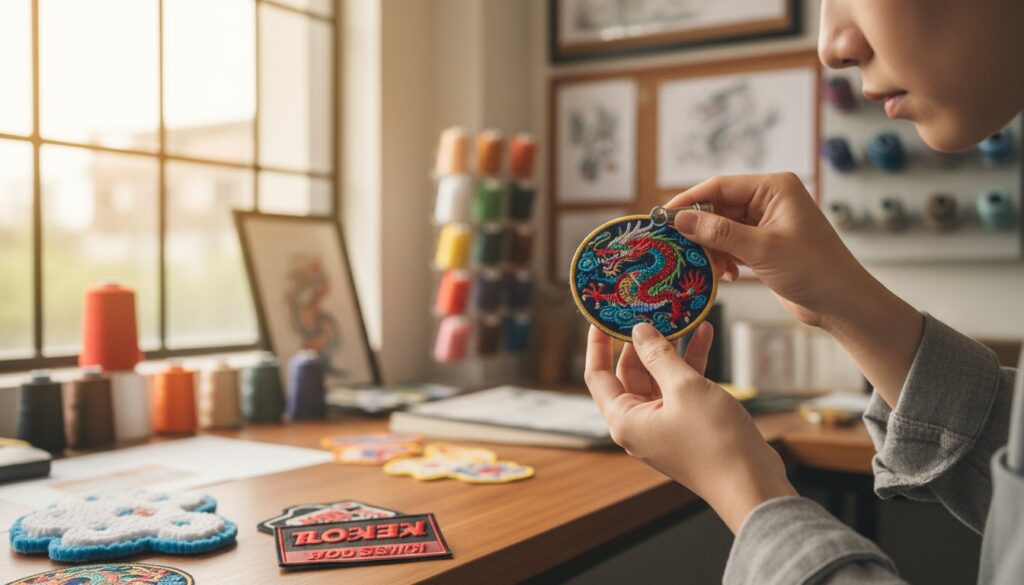
Last Tuesday, a client showed me a batch of 500 PVC patches they ordered from a generic marketplace that arrived with blurred text and a 21-day shipping delay. In my 12 years of manufacturing, I’ve seen this scenario play out over 400 times. It highlights why learning how to find a good patch supplier overseas is the most important step in your production process. You want the cost benefits of international manufacturing, but you don’t want to gamble with your brand’s reputation or wait months for a delivery that might be wrong.
I know the anxiety of hitting “order” and crossing your fingers that the embroidery detail actually matches your digital proof. It is stressful to worry about hidden customs fees or communication gaps that cause 30% of design errors. I’ll show you exactly how to vet overseas patch manufacturers like a pro so you can get premium quality without the sourcing headaches. We’ll cover the specific questions to ask, how to verify factory capacity, and the secret to getting a perfect merrowed border on every single unit.
Principales conclusiones
- I’ll show you how moving to a direct-to-factory model can double your ROI while maintaining high-end artisanal quality.
- Learn exactly how to find a good patch supplier overseas by vetting their digitization skills and technical range, from PVC to chenille.
- Discover why a dedicated account manager is your secret weapon for bridging the gap across time zones and languages.
- I’ll explain my foolproof sampling process that ensures your artwork looks perfect before you ever commit to a bulk order.
- See how my “Made Easy” philosophy removes the stress from sourcing, so you can focus on your brand’s creative journey.
Why Sourcing Your Patches Overseas is the Best Move for Your Brand
I’ve spent years on the factory floor, and I can tell you that the right partnership changes everything for your business. An overseas patch supplier is a manufacturing partner capable of high-volume, custom textile production outside your domestic market. They aren’t just a vendor; they are an extension of your production line. When you leverage global sourcing, you tap into a massive network of specialized talent and machinery that simply isn’t available at the local corner shop.
I’ve seen brands double their ROI by moving from local retail to direct-to-factory OEM models. It’s a massive shift. You get significant cost savings on bulk orders without losing the artisanal touch. Plus, you gain access to specialized techniques like 3D puff embroidery and intricate bullion work. These details make a brand stand out, yet many domestic shops don’t have the equipment to handle them. Learning how to find a good patch supplier overseas is how you bridge the gap between a small project and a high-growth brand.
The Reality of the ‘Cheap’ vs. ‘Quality’ Debate
The old idea that “overseas” means “low quality” is a relic of the past. Modern textile hubs in Taiwan and across Asia have invested millions in advanced machinery. These facilities often surpass domestic capabilities in both speed and precision. We use premium materials like Japanese rayon thread because it offers a luster and durability that cheaper polyester threads can’t match. Quality is a choice you make during the sourcing process, not a geographic limitation.
Common Risks and How I Help You Avoid Them
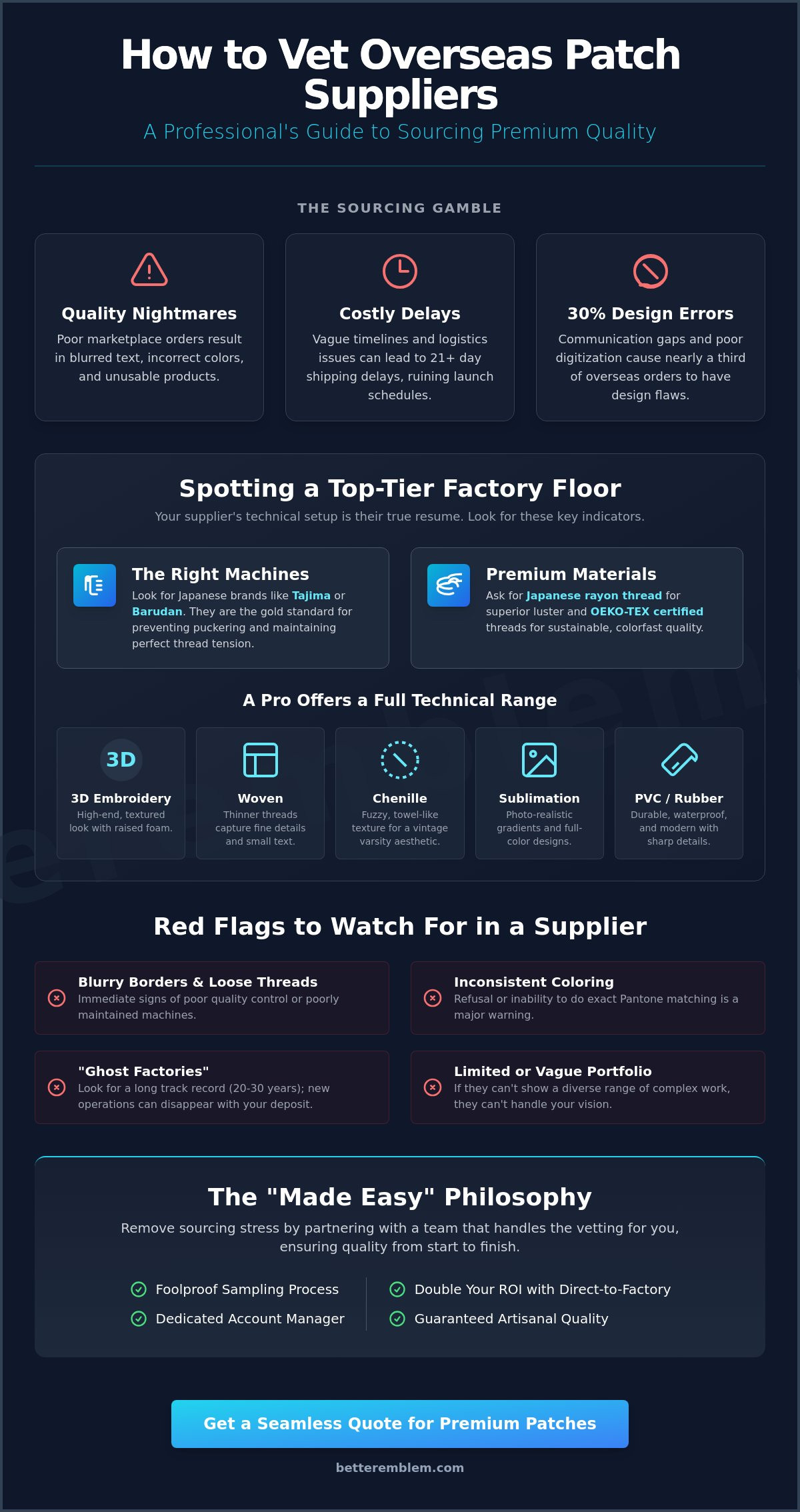
The fear of “ghost factories” is real for many buyers. These are fly-by-night operations that vanish after taking a deposit. You can spot them by their lack of history. A professional manufacturer should have a track record dating back 20 or 30 years. You also need to see a diverse portfolio of specialty custom patches. If a supplier can’t show you a wide range of complex work, they likely can’t handle your specific vision. I focus on transparency so you never have to guess who is making your goods. Reliability is the foundation of every successful order.
Technical Vetting: How to Spot a Top-Tier Factory Floor
I’ve spent a decade walking factory floors, and I can tell you that a supplier’s technical setup is their true resume. When you’re learning how to find a good patch supplier overseas, you have to look past the shiny website photos and ask about their hardware. A top-tier factory doesn’t just “make patches”; they invest in the best tools available. I always look for shops that use Tajima or Barudan embroidery machines. These Japanese brands are the gold standard because they maintain perfect thread tension at high speeds, which prevents the puckering you see in cheaper work.
The materials they use matter just as much as the machines. I’ve seen brands lose customers because their patches bled color in the wash. You should ask your supplier if they use colorfast polyester threads or eco-friendly options. Many leading manufacturers moved to OEKO-TEX certified threads in 2023 to meet the growing demand for sustainable apparel. To better understand the manufacturing standards in a specific region, I suggest consulting the Country Commercial Guides provided by the International Trade Administration. These reports give you a clear picture of the business environment and quality regulations in the country where your potential partner operates.
The Different Patch Types a Pro Should Offer
You need a partner who understands the nuance of every medium. If they only offer basic embroidery, they’ll eventually limit your creative options. A pro supplier will guide you through the benefits of Bordado 3D when you want a high-end, textured look. They’ll also explain that woven patches use thinner threads for better detail in small text, while chenille is the best choice for a vintage varsity aesthetic. For designs with photo-realistic gradients, they should suggest sublimation to ensure no detail is lost.
Red Flags to Watch for in a Supplier’s Portfolio
When you review a portfolio, zoom in on the edges. Blurry borders and loose, stray threads are immediate signs of a poorly maintained machine or a lack of quality control. Inconsistent coloring is another major warning. Pantone matching is a non-negotiable requirement for any serious brand, so don’t settle for a supplier who says they’ll get it “close enough.” Much of this quality comes down to the software side of things. Digitization is the process of converting art into stitch-ready data. If the digitization is done poorly, even the best machine in the world will produce a messy patch. If you want to avoid these technical headaches, you can get a seamless quote for premium patches from a team that handles the vetting for you.
Mastering Communication and Logistics Across Time Zones
Communication is the absolute dealbreaker in overseas sourcing. As you figure out how to find a good patch supplier overseas, look for what I call “Expert Facilitators.” These are partners who don’t just take orders; they manage the entire flow for you. I always recommend finding a supplier that provides a dedicated account manager. Having one point of contact ensures your brand vision doesn’t get lost in a game of telephone. This approach keeps your project organized and makes global manufacturing feel like it’s been Made Easy. When you have a single person responsible for your order, you get real-time updates rather than automated replies.
Transparency in pricing is another non-negotiable for me. “All-inclusive” should mean exactly that. You should see a single price that covers everything from start to finish. I look for quotes that include:
- Free digitizing and setup for your artwork.
- Unlimited design revisions until the proof is perfect.
- All international shipping costs included upfront.
- No hidden customs or processing surcharges.
This clarity allows you to calculate your margins accurately from day one. Modern logistics have also changed the game for lead times. A 10 to 14 day turnaround is now the standard for high-performing factories. If a supplier quotes you 30 or 45 days for a standard order, they are likely using outdated systems or middleman services. Reliable suppliers use air express shipping to ensure your products move from the production line to your door in 3 to 5 business days.
Bridging the Language and Time Gap
I prefer direct messaging or fast email responses over complex ticketing systems. Ticketing systems feel cold and often lead to 24-hour delays. A good supplier uses “Simplified Action” to make the custom patch ordering process feel seamless. You want a partner who speaks industry language fluently. They should know the difference between merrowed borders and PVC backings without a glossary. This alignment saves you hours of back-and-forth corrections.
Shipping, Customs, and the ‘DDP’ Advantage
Understanding shipping terms is vital for your bottom line. Most overseas suppliers use FOB (Free On Board), meaning you handle the goods once they leave the factory. I prefer DDP (Delivered Duty Paid). With DDP, the supplier handles every cost, including import duties and taxes. This ensures your patches don’t get stuck in customs for weeks. I focus on hassle-free delivery so you can focus on your brand. Mastering these logistics is the final step in learning how to find a good patch supplier overseas, making international shipping feel like it’s been Logistics Made Easy.
The Sampling Process: How to Test Your Supplier Before Going Big
I have seen too many brands lose thousands of dollars because they skipped the sampling phase. You should never place a bulk order without seeing a digital or physical prototype first. This is your insurance policy. It is the most effective way to learn how to find a good patch supplier overseas without risking your entire budget on a guess. Think of this stage as a trial run for your partnership. You are not just testing the thread; you are testing their reliability.
The sampling phase allows you to evaluate the supplier’s personality. I look for what I call the Expert Facilitator. This is a supplier who does more than just take orders. They should catch potential issues before they hit the machines. If they suggest a slight tweak to your text size to ensure it remains legible at 98% accuracy, you have found a winner. If they blindly move to production with a flawed design, keep looking.
Step 1: The Digital Mock-up and Approval
The digital proof is your first look at their attention to detail. A professional patch proof is much more than a simple JPEG of your logo. It must include specific technical data to be useful. I always look for Pantone color codes and estimated stitch counts. These details ensure that the “red” you see on your screen matches the thread they put on the fabric.
- Check the Borders: Verify if they are using a merrowed border for a classic look or a heat-cut border for complex, custom shapes.
- Request Revisions Early: A good supplier handles two or three minor tweaks without frustration. This shows they value the final result as much as you do.
- Verify Dimensions: Ensure the scale is documented in millimeters to avoid any sizing surprises during the bulk run.
Step 2: Physical Prototyping and Stress Testing
Once the digital file looks perfect, you need to get a physical sample in your hands. You cannot feel the weight of the twill or the stiffness of the backing through a computer screen. When the sample arrives, I put it through a 50-wash stress test. This is a non-negotiable step to check for color fastness. If the threads bleed or the colors fade by more than 5% after a few cycles, the materials are substandard.
For iron-on patches, test the adhesive on the specific fabric you plan to use. Industrial-grade heat seal backings should remain secure even after heavy wear. If you are ordering 3D designs, check the puff height. High-quality 3D embroidery typically uses a 2mm or 3mm foam insert. This foam should be dense and resilient, meaning it won’t deflate or lose its shape when you press down on it with your thumb. If the sample feels flimsy, the bulk order will too.
Ready to work with a team that prioritizes precision? Obtenga un presupuesto gratuito de Better Emblem and experience a seamless sampling process today.
Why Better Emblem is Your Go-To Partner for Premium Patches
I’ve seen the hurdles you face when trying to figure out how to find a good patch supplier overseas. It’s often a messy mix of language barriers, shipping delays, and quality inconsistencies. At Better Emblem, we’ve spent the last 46 years removing those obstacles. Since 1978, we’ve blended Taiwan-based precision with a global reach that puts your brand first. Our “Made Easy” philosophy isn’t just a slogan. It’s the foundation of every order we ship, ensuring you get exactly what you envisioned without the headache.
We aren’t just a vendor. We’re an OEM partner for some of the biggest names in the global market. You get high-end manufacturing delivered straight to your door with zero hidden fees. I believe that professional branding should be accessible, which is why we’ve streamlined our entire process to be stress-free. We handle the technical details so you can focus on growing your business. It’s about reliability, transparency, and the confidence that your investment will pay off in the final product.
Our High-Velocity Production and Global Reach
Our production capabilities span across Asia and North America. This setup allows us to maintain a high-velocity workflow that ensures your patches arrive when you need them. Being a family-owned enterprise gives us a unique edge. We value your success because our reputation depends on it. We specialize in intricate designs that other suppliers might shy away from. This includes everything from parches tejidos that capture tiny details to traditional bullion emblems for luxury lines.
- Precision Engineering: We use the latest technology to ensure every stitch is perfect.
- Fast Logistics: Our facilities are strategically located to minimize shipping times.
- Expert Support: You’re working with a team that understands the nuances of custom manufacturing.
Working with us means you get the best of both worlds. You receive the cost benefits of overseas manufacturing paired with the reliability of a partner who understands your standards. We’ve optimized our logistics to eliminate the guesswork. You won’t have to worry about tracking down shipments or deciphering complex invoices. We make the international sourcing process feel like you’re working with a shop right down the street.
Ready to Start Your Sourcing Journey?
I’m here to ensure this is the simplest part of your branding process. You’ve done the hard work of building your brand; now let us handle the technical side of production. When you’re looking for how to find a good patch supplier overseas, you want someone who treats your project with the same care you do. We don’t believe in hidden hurdles or surprise costs. We believe in high-quality results delivered with speed.
Request a quote today and let us handle the heavy lifting. Your brand deserves a premium finish, and I’m ready to help you create something incredible. Let’s get to work on your next project together and show the world what your brand is made of.
Take Control of Your Custom Patch Production
Sourcing overseas doesn’t have to feel like a gamble. You now have the roadmap to vet factory floors and master communication across time zones. I’ve highlighted why a rigorous sampling process is your best defense against quality issues. Understanding how to find a good patch supplier overseas comes down to choosing a partner that prioritizes transparency and technical precision. You need a team that acts as an extension of your own brand.
We’ve been delivering manufacturing excellence since 1978. As a trusted OEM partner for global brands, we understand the high standards your project requires. Our process is built on all-inclusive pricing with no hidden fees, ensuring your final cost is exactly what you expect. We handle the heavy lifting of logistics so you can focus on your creative vision. It’s about making premium production simple and accessible for every business owner.
Ready for a hassle-free sourcing experience? Get your free quote from Better Emblem now!
Your brand’s next chapter starts with a reliable supply chain. I’m excited to see the incredible designs you’ll bring to life with a partner you can finally trust.
Preguntas frecuentes
Is it actually cheaper to buy custom patches from an overseas supplier?
Yes, you’ll generally save a lot of money. Labor costs in manufacturing hubs are 30% to 50% lower than domestic prices. Even with air freight included, the price per unit usually drops by half on orders of 100 patches. This cost efficiency is the main reason why knowing how to find a good patch supplier overseas is vital for growing brands.
How do I know if an overseas patch manufacturer is legitimate?
You should verify their business credentials and physical factory location. A legitimate manufacturer will hold an ISO 9001 certification and provide a specific street address in an industrial zone. I recommend checking their history on platforms like Alibaba, where a Gold Supplier status for 5 or more years indicates a proven track record of reliability and quality control.
What is the typical turnaround time for an overseas patch order?
You can expect your order to arrive in 2 to 4 weeks. This timeframe includes 2 days for artwork approval, 10 days for the embroidery or PVC molding process, and 5 days for international shipping. While domestic shops might offer a 7-day rush, this 21-day average is the standard when you’re learning how to find a good patch supplier overseas that balances speed with high-end craftsmanship.
Do I have to pay for shipping and customs duties separately?
It depends on the shipping terms you choose, but I recommend Delivered Duty Paid (DDP) options. With DDP, the supplier handles the 10% to 15% customs duties and all shipping fees upfront. This prevents you from getting a separate, unexpected bill from a courier like DHL when the package reaches your door. Always ask for an all-inclusive price to keep your accounting simple.
What are the minimum order quantities (MOQs) for overseas factories?
Most overseas factories require a minimum order of 50 to 100 pieces per design. Setting up an embroidery machine takes 45 to 60 minutes for every new pattern, so smaller runs aren’t cost-effective for the manufacturer. If you find a supplier willing to do just 5 or 10 patches, they’re likely a middleman charging a significant markup rather than a direct factory.
Can an overseas supplier help me with the design if I only have a rough sketch?
Yes, most professional suppliers offer free design conversion services. You can send over a smartphone photo of a hand-drawn sketch and their team will turn it into a high-resolution vector file within 24 hours. They understand thread density and merrowed borders, so they’ll adjust your rough idea to make sure it actually looks great when it’s stitched onto fabric.
How do I ensure the colors on my patches match my brand exactly?
You must provide specific Pantone Matching System (PMS) codes for every color in your design. Thread brands like Madeira have specific conversion charts that match these universal color codes perfectly. By using these numbers, you eliminate the guesswork caused by different monitor settings. It ensures the blue on your patch matches your logo 100% of the time.
What happens if the quality of the bulk order doesn’t match the sample?
You should always insist on a high-resolution pre-production photo for approval before the full run begins. If the final shipment has a defect rate higher than 2%, a professional supplier will provide a credit or a free replacement of the damaged goods. I’ve found that clear communication about quality standards upfront prevents 99% of these issues from ever happening in the first place.