
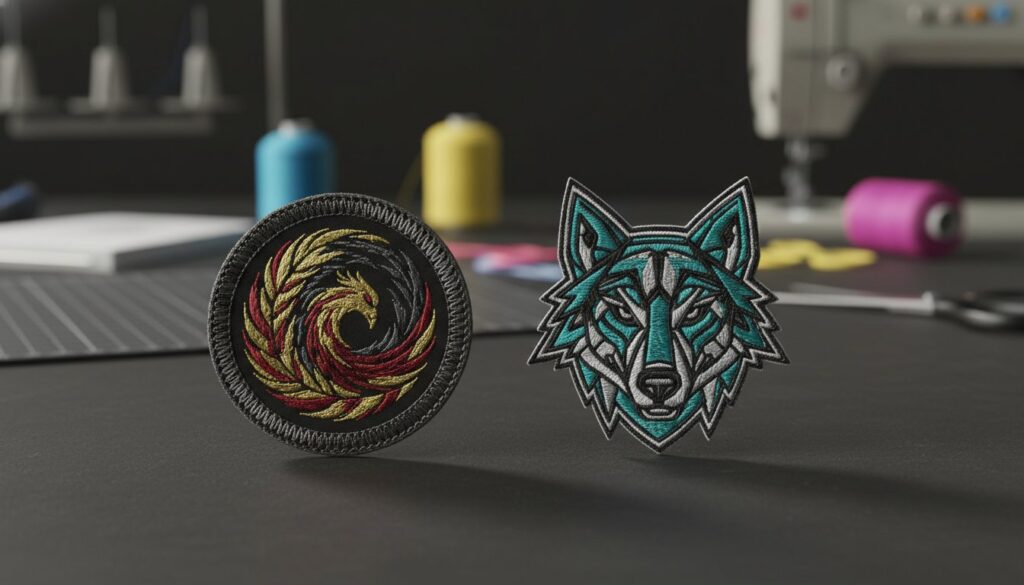
What if the edge of your patch is the only thing standing between a professional brand and a cheap-looking mistake? I’ve seen many creators worry that a complex logo won’t translate well or that the wrong choice in the merrowed border vs hot cut border debate will lead to fraying before the patch even hits its 50th wash. It is a common stress point when you’re trying to balance a high-end look with long-term durability. I know you want a final product that feels premium and stays that way.
I’m here to help you choose the perfect finish for your specific design. I will compare these two manufacturing styles by looking at design flexibility and structural strength. Whether you are designing 3D embroidery or PVC patches, I’ll show you which edge suits your logo shape best. You’ll finish this article with a clear plan for your bulk order and the confidence that your patches will look professional from the very first stitch.
要点
- I’ll show you why your patch border is the “frame” that defines your brand’s professional look and overall quality.
- Learn why I suggest the classic merrowed border for standard shapes like circles and rectangles to achieve a rugged, traditional feel.
- I’ll explain how a hot cut border handles complex logos with sharp angles and intricate details without sacrificing design precision.
- Get my 60-second framework for choosing a merrowed border vs hot cut border based on your specific logo shape and bulk order requirements.
- Discover how I use our 45-year manufacturing expertise to ensure your custom patches survive dozens of industrial wash cycles.
Why the Edge of Your Patch is More Than Just a Finishing Touch
I’ve seen it happen too many times. A client brings me a stunning logo, we spend hours perfecting the thread count, and then the wrong edge choice ruins the entire vibe. The border isn’t just a finishing touch; it’s the frame for your brand’s artwork. It dictates how your patch feels in the hand and how it looks on a jacket. If you choose an edge that doesn’t match your design, you risk your premium product looking unfinished or, worse, cheap. I don’t want that for your brand.
Beyond just looks, the border provides the structural integrity your custom patches need to survive. A high-quality 刺繍ワッペン should withstand over 50 industrial laundry cycles; the edge is the first line of defense against fraying. Your choice in the merrowed border vs hot cut border debate also determines if your patch sits flush against the fabric or has a classic, raised profile. It’s a functional choice as much as an aesthetic one.
The Anatomy of a Patch Border
I always recommend thinking about your border before you finalize your logo shape. A border is essentially a combination of the base material and a finishing thread that seals the edges. If you’re using a standard shape like a circle or shield, a thick thread wrap works beautifully. However, if your design has sharp points or complex cutouts, that same thread might overlap and look messy. It’s also vital to consider your backing. Velcro backings require a sturdier edge to handle being pulled on and off; iron-on backings need a clean finish to ensure the adhesive reaches the very edge.
Setting Your Branding Goals
Your branding goals should lead the way here. Are you looking for a rugged, tactical feel for outdoor gear? Or is your goal a sleek, modern finish for a tech company’s merch? The border choice directly impacts the perceived value of your order. For example, a heavy-duty edge on PVC patches creates a “built-to-last” impression. On the other hand, a thin, precise edge on woven patches feels sophisticated and high-tech. I’ve found that matching the edge style to the final application is the secret to a professional result. A raised edge looks great on a structured hat, but a flush edge is often better for a uniform where you want a low profile.
The Merrowed Border: Classic, Durable, and Rugged
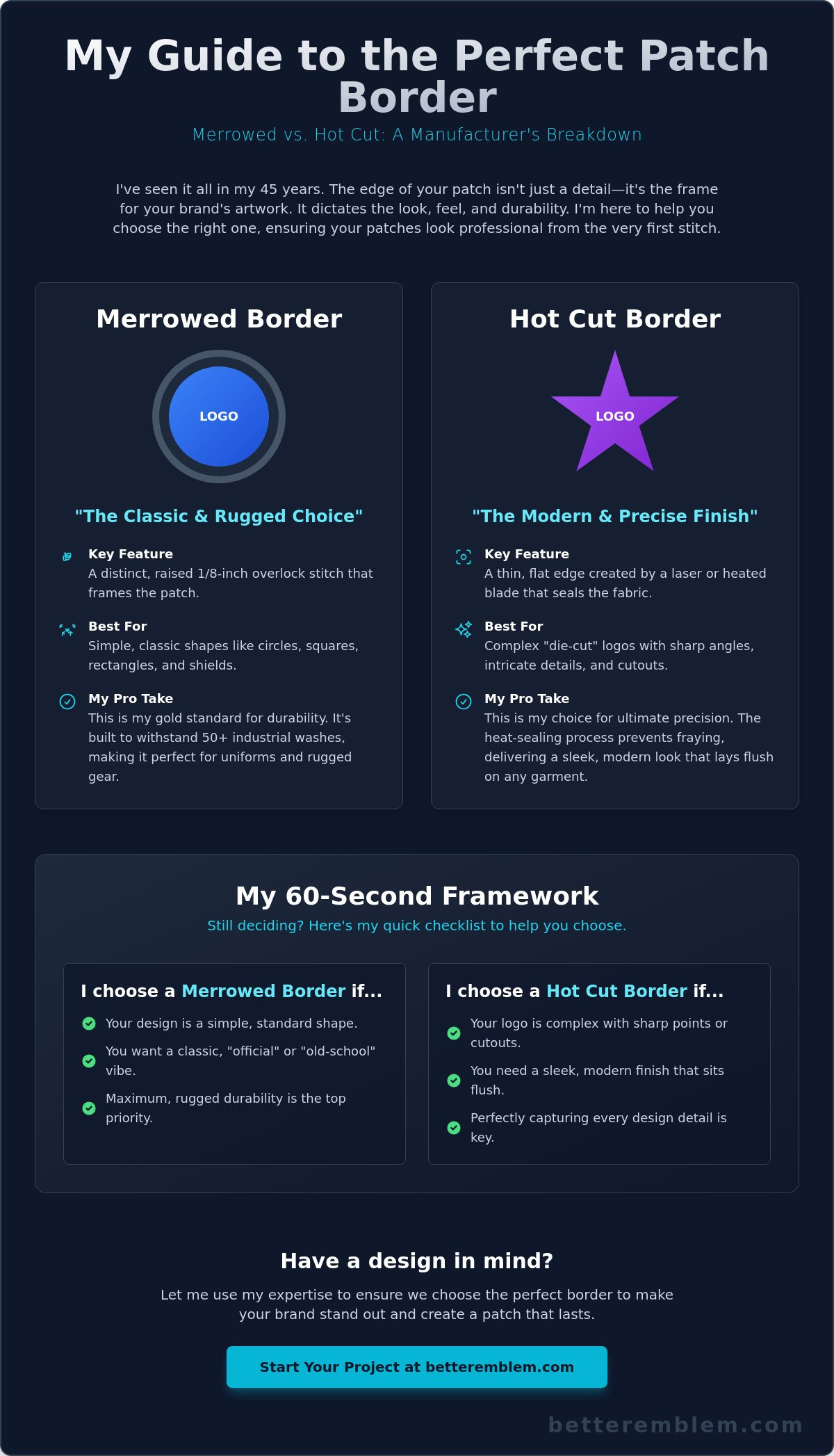
I consider the merrowed border the gold standard for traditional embroidered patches. It is a heavy, overlock stitch that wraps entirely around the edge of the patch material. This process creates a distinct, 1/8-inch raised lip that serves a dual purpose. First, it looks iconic. Second, it acts as a physical bumper that protects the patch from peeling or snagging. If you’re looking for a rugged feel that screams “official,” this is the finish you want.
I prioritize durability in every bulk order I handle. Merrowing is arguably the most resilient finishing method available in the industry. High-quality patches with this edge are designed to withstand over 50 industrial laundry cycles without the thread unraveling. This makes it a favorite for industries where gear takes a beating every day. If you are comparing a merrowed border vs hot cut border for work uniforms or tactical gear, the merrowed edge is almost always the winner for pure longevity.
When to Choose a Merrowed Edge
I recommend this style for standard shapes like circles, squares, rectangles, and simple shields. It’s the classic choice for scout patches and military emblems because of that thick, framed appearance. I also suggest this finish for 織りパッチ. Woven designs are thinner than embroidered ones, so adding a merrowed edge gives the patch more physical weight and a premium feel. If you’re planning a project for varsity-style apparel, this edge provides that authentic, “old-school” aesthetic that customers love. You can explore our full range of durable patch styles to see how this border looks on different materials.
Technical Limitations of Merrowing
While I love the look of a merrowed edge, it isn’t a “one-size-fits-all” solution. The merrowing machine uses a specific needle path that requires a continuous, smooth curve or straight line. This means I can’t use it for complex “die-cut” shapes or designs with sharp inner corners. If your logo has “nooks and crannies” or jagged points, the machine simply cannot navigate those tight turns. You are also locked into a fixed width of about 1/8 of an inch. You can’t make it thinner or thicker, which is a key factor to keep in mind during your initial design phase.
The Hot Cut Border: Precision for Complex Shapes
I use the hot cut border whenever a design refuses to play by the rules of standard geometry. While a merrowed edge is great for circles, it simply can’t handle a logo with “nooks and crannies” or sharp, jagged angles. To create this edge, I use a high-precision laser or a specialized heated blade to seal the fabric exactly at the design’s perimeter. This process results in a thin, flat edge that allows your patch to lay perfectly flush against any garment. It is the ultimate solution for brands that value precision over bulk.
There is a common myth that laser-cut edges are less durable than their stitched counterparts. I’ve found the opposite to be true when the process is handled correctly. The heat-sealing process actually melts the fibers of the base material and the embroidery threads together at the cut line. This creates a permanent bond that prevents the patch from unraveling, even after repeated wear. When you are deciding between a merrowed border vs hot cut border for a custom-shaped logo, the hot cut is the clear winner for maintaining the integrity of your artwork.
The Role of the Satin Stitch
I often see this style referred to as an “embroidered border” in the industry, and there is a good reason for that. To give the patch a professional, finished look, I typically add a thin satin stitch around the very edge. This embroidery hides the sealed fabric line and adds a pop of color that frames your logo. The best part? You aren’t stuck with a fixed width. Unlike the standard 1/8-inch merrowed lip, a hot cut border gives you the flexibility to choose a border as thin or as thick as you want. This level of customization is why I suggest it for high-detail projects.
Ideal Applications for Hot Cut Edges
I find that hot cut borders are the perfect companion for 立体刺繍. When you have significant depth in your design, a flat edge keeps the focus on the raised elements rather than a bulky border. Custom-shaped “die-cut” patches, such as a state outline or a lightning bolt, almost always require this method. It is also the go-to choice for modern streetwear and tech-focused branding where a sleek, low-profile aesthetic is preferred over a traditional rugged look. If your goal is a sharp, contemporary finish that mirrors your digital assets, this is the manufacturing style I recommend.
Side-by-Side Comparison: Which Border Wins for Your Brand?
I’ve built this framework to help you decide which edge fits your needs in under 60 seconds. When you’re managing a bulk order, efficiency matters just as much as aesthetics. In the merrowed border vs hot cut border comparison, the winner often depends on your specific manufacturing volume. For example, increasing a patch order from 50 to 500 units typically reduces the per-unit price by 40%. Because merrowing is the traditional finishing method for standard shapes, it remains the most cost-effective choice for large runs of circles or squares. Hot cut borders involve a laser setup that is necessary for custom shapes, but they offer a level of detail that standard machines simply cannot match.
The tactile feel is another major differentiator. A merrowed edge gives you that 1/8-inch 3D wrap that feels substantial and rugged. It frames the artwork with a physical border you can actually feel. Conversely, the hot cut edge provides flat precision. It allows the patch to blend into the garment rather than standing out as a separate, heavy layer. If you want a low-profile look that feels integrated into the fabric, the laser-cut path is your best bet.
The Durability vs. Aesthetics Debate
I’ve found that the material of your カスタムパッチ often dictates the best border. For instance, I almost always suggest a hot cut edge for 熱転写印刷 projects. This is because photorealistic designs need a sleek, modern frame that doesn’t distract from the multi-color detail. While a merrowed edge is the king of industrial durability for workwear, the hot cut edge is the queen of aesthetics for high-detail branding. It’s about balancing a vintage look with modern manufacturing techniques to get the exact result your brand deserves.
Design Checklist for Borders
I use this quick checklist to steer my clients toward the right choice. If your logo has sharp interior angles or a “die-cut” silhouette, you must go with a hot cut edge. If your patch is a simple geometric shape and you want that classic “scout” look, merrowed is the way to go. You should also consider where the patch is going. Heavy jackets and bags handle the bulk of a merrowed edge perfectly. If you’re putting the design on a thin t-shirt or a performance polo, the flat profile of a hot cut border will look and feel much better. Start your bulk order today and let me handle the technical details for you.
How We Manufacture Your Perfect Edge at Better Emblem Company Ltd.
I take immense pride in our 45-year history of perfecting these finishing touches at Better Emblem Company Ltd. Since 1978, we’ve focused on the small details that make a massive difference for global brands. When you’re weighing the pros and cons in the merrowed border vs hot cut border debate, I’m here to ensure the technical execution is flawless. We use high-speed, precision merrowing machines to create that heavy-duty, authentic feel for your standard shapes. For those more intricate designs, our precision laser cutting equipment ensures every hot cut edge is perfectly sealed and clean. I personally oversee our thread matching process to make sure your border color is a dead ringer for your original artwork.
It’s this commitment to being an expert facilitator that keeps our partners coming back for every new project. We don’t just sell physical products; we sell the solution to your branding problems. By controlling the entire manufacturing process, we strip away the complexity and potential hurdles of ordering custom goods. You get a reliable partner who understands that speed and ease are just as important as the quality of the stitch itself. We make the investment feel safe and straightforward.
Our OEM Quality Control Process
Handling both styles in-house gives us a massive advantage over brokers. We don’t farm out the finishing work to third parties who might cut corners. Instead, I make sure every batch undergoes rigorous testing for edge fraying and stitch density before it leaves our floor. It’s why our 特注ワッペン often stand out in the market. I’ll often suggest mixing techniques to get a specific, high-end look for a complex logo. Working with Better Emblem Company Ltd. means you’re getting factory-direct quality and the peace of mind that your investment is protected by decades of manufacturing expertise.
Ready to Start Your Order?
Starting your next bulk project is designed to be simple and efficient. When you fill out our quote form, you can specify your border preference right there. I offer free digital proofs for every order, which means you get to see exactly how the edge frames your design before we ever touch a sewing needle. This step is crucial for visualizing the final product and ensuring the merrowed border vs hot cut border choice aligns with your branding goals. If you’re still unsure which path to take, contact my team at Better Emblem Company Ltd. for a custom consultation. We’ll look at your logo and help you choose the finish that guarantees a professional result every time.
Build Your Brand with the Perfect Edge
I know that choosing between a merrowed border vs hot cut border feels like a small detail, but it is the foundation of your brand’s physical identity. You now understand that a merrowed edge offers that rugged, 3D frame for classic shapes, while a hot cut border provides the laser-sealed precision needed for intricate logos. I’ve found that matching the right edge to your specific garment ensures your investment looks professional and stays durable through every wash. It’s about making sure your creative vision translates perfectly into a physical product.
I take the stress out of manufacturing by bringing over 45 years of expertise to every project. We’ve been a global OEM supplier for top brands since 1978, utilizing high-speed merrowing and precision laser cutting to maintain the highest quality standards. I’m ready to help you navigate these technical choices so you can focus on what matters most; growing your brand. Get a bulk quote for your custom patches today and let’s build something exceptional together. Your perfect patch is just a few clicks away.
よくある質問
What is a merrowed border on a patch?
A merrowed border is a heavy, overlock stitch that wraps around the entire edge of your patch to create a thick, raised frame. I call this the gold standard for traditional emblems because it prevents the base material from ever fraying. It gives the patch a substantial, 3D feel that most customers associate with high-end military or scout badges.
Can any patch shape have a merrowed border?
No, only standard geometric shapes like circles, rectangles, and simple shields can have a merrowed edge. The machine used for this process requires a continuous, smooth path to wrap the thread correctly. If your design features sharp inner corners, complex cutouts, or jagged points, I’ll recommend a hot cut border instead to ensure your final product has a clean finish.
Is a hot cut border durable enough for work uniforms?
Yes, a hot cut border is incredibly durable because the laser or heated blade seals the fibers together as it cuts. This thermal bond prevents the threads from unraveling even under the stress of industrial laundering. While the profile is flatter than a merrowed edge, it still offers the structural integrity needed for daily wear on heavy-duty uniforms or gear.
Which border is better for iron-on patches?
Both styles work well with iron-on backings, but I often suggest a hot cut border for a flatter, more seamless application. Because a hot cut edge sits flush against the garment, the heat-activated adhesive can reach the very edge of the patch. A merrowed border has a raised lip that can sometimes make it harder for the edges to bond perfectly if you don’t press them correctly.
What is the price difference between merrowed and hot cut edges?
Merrowed borders are generally the most cost-effective choice for bulk orders of standard shapes like circles and squares. This is because the process is highly standardized and efficient for large manufacturing runs. When comparing a merrowed border vs hot cut border, the laser-cut option requires a more specialized setup for custom shapes, which can affect the per-unit cost depending on your logo’s complexity.
Does a hot cut edge look unfinished compared to merrowed?
No, a hot cut edge looks very professional because I typically add a thin satin stitch to frame the design. This embroidered border hides the heat-sealed line and provides a clean, modern frame for your brand. While it doesn’t have the rugged bulk of a merrowed edge, it offers a high-precision look that is perfect for contemporary branding and streetwear projects.
Can I have a merrowed border on a woven patch?
Yes, you can absolutely have a merrowed border on a woven patch, and I actually recommend it for most projects. Woven patches are naturally thinner than embroidered ones, so adding a thick, overlock edge gives them more weight and a premium feel. It is a great way to combine the high detail of weaving with the traditional look of a classic patch.
How wide is a standard merrowed border?
A standard merrowed border is exactly 1/8 of an inch wide. This width is fixed by the mechanics of the overlock machine and cannot be adjusted. If you need a thinner or thicker border to match your specific artwork, I’ll suggest a hot cut edge instead. This allows us to customize the border width to your exact preferences during the design phase.